AI coding tools promise to understand a developer’s codebase and deliver relevant suggestions. In reality, most systems rely on generic embedding APIs to index code snippets and documents. The result is often a disconnected experience: embeddings capture textual similarity but ignore structural relationships; indices refresh every few minutes, leaving developers without up‑to‑date context; and privacy is compromised when embeddings are sent to third‑party APIs.
This article introduces our codebase‑aware indexing system. It combines a server‑side vector database with a code graph and a pre‑indexed codebase‑knowledge(a.k.a. RepoWiki) base to deliver accurate, secure and real‑time context for AI coding workflows. The following sections outline the challenges of generic retrieval, describe our hybrid architecture and explain how we scale, personalize and secure the system.
Conventional retrieval pipelines call external APIs to compute embeddings and use remote vector databases to search for similar snippets. These pipelines suffer from multi‑minute update intervals; when a developer switches branches or renames a function, the index lags behind and returns irrelevant context. Even when updated, large codebases produce so many embeddings that transferring and querying them introduces noticeable latency.
Generic embeddings measure textual similarity, but codebase queries often require understanding structural relationships. For example, a call‑site and its function definition may share little lexical overlap; documentation might use terms not present in the code; cross‑language implementations of the same algorithm look entirely different. Embeddings alone miss these relationships, leading to irrelevant results and wasted prompt space.
We deploy a high‑performance vector database in our backend that stores embeddings for code snippets, documentation and codebase artifacts. Using custom AI models trained on code and domain knowledge, we generate embeddings that better capture semantic relationships and prioritize helpfulness over superficial similarity. The server processes indexing requests continuously, ingesting new or modified files within seconds.
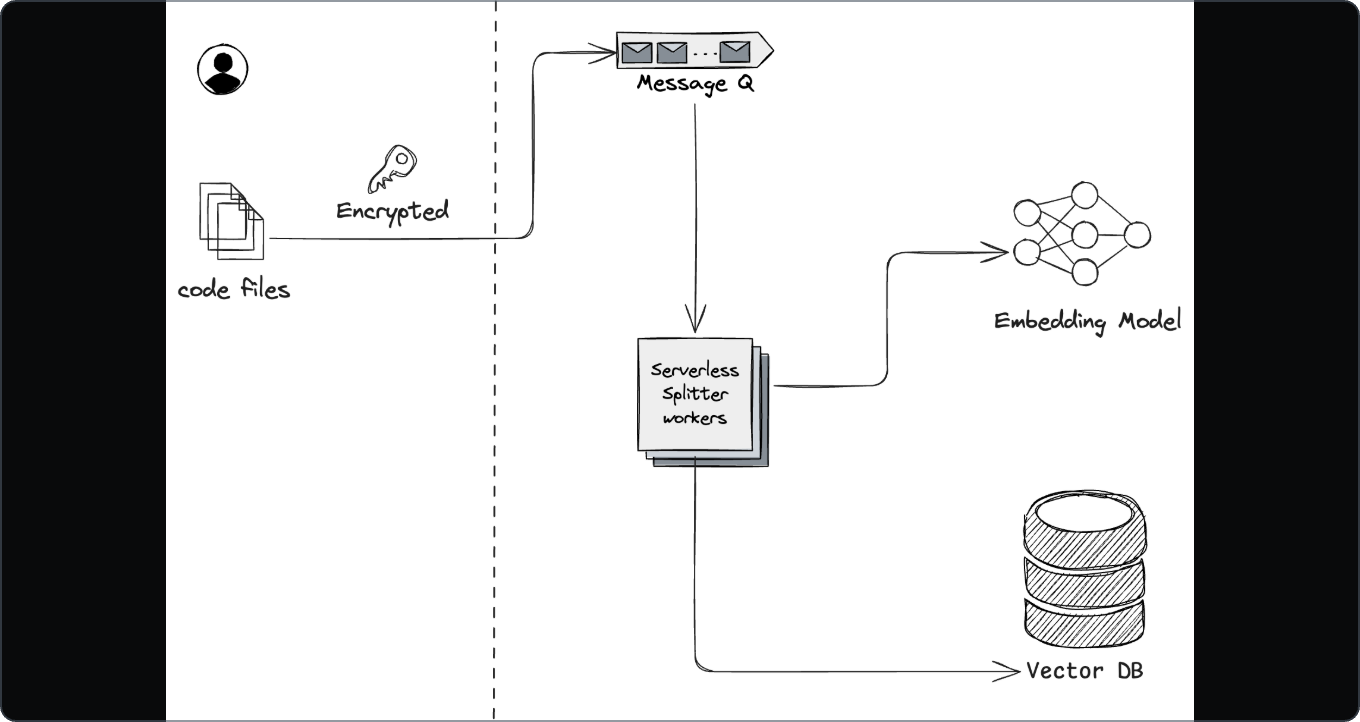
On the client side, we build a code graph representing functions, classes, modules and the relationships between them (e.g., call graphs, inheritance, cross‑language links). We also pre‑index Codebase knowledge such as design documents, architecture diagrams and internal wiki pages. This pre‑index allows us to perform graph traversals and concept‑based lookups with ultra-low latency.
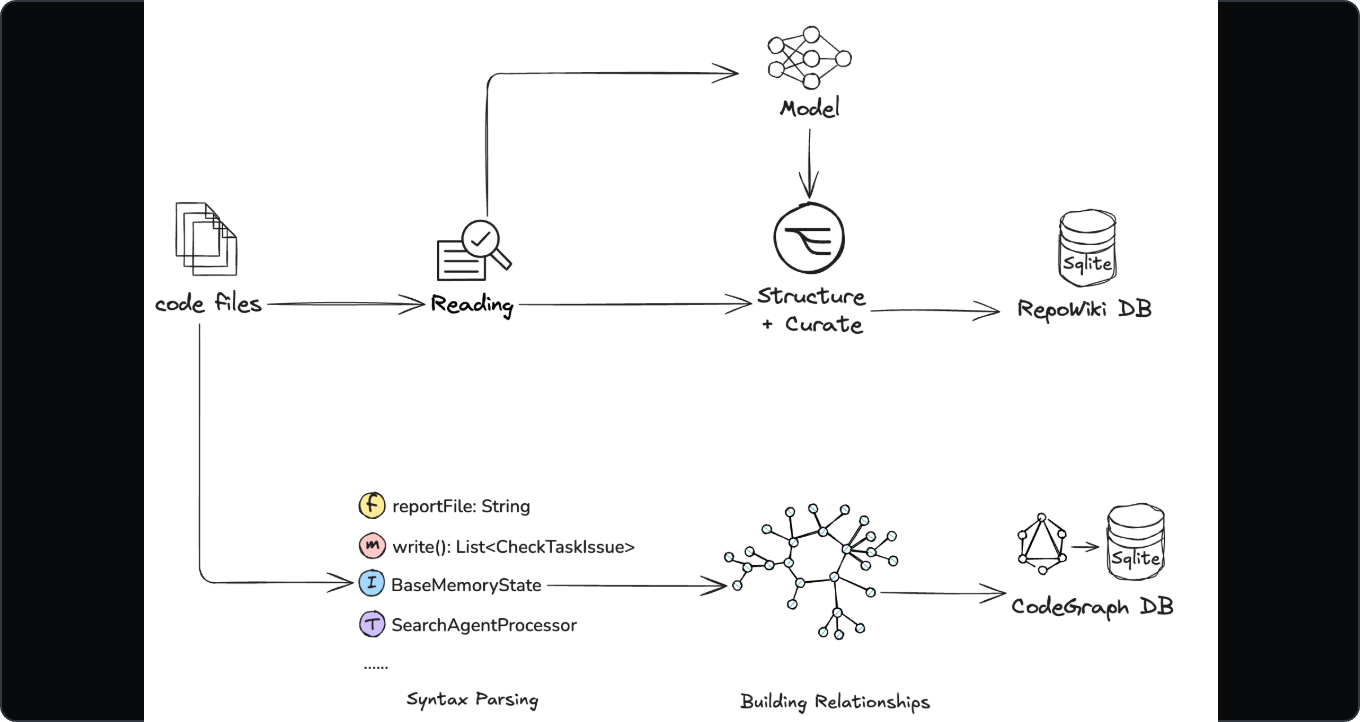
When a user issues a query (via chat, completion or code search), the system:
This hybrid approach ensures that relevant but textually dissimilar code (such as a function definition referenced by a call‑site) is surfaced alongside semantically similar snippets. It also allows the system to align retrieval with the developer’s current branch and local changes.
Every developer has a personal index tied to their current working state. When you switch branches, edit files or perform search‑and‑replace operations, the client notifies the server of the changes, and the server updates the corresponding embeddings within seconds. The graph is updated simultaneously. This real‑time synchronization ensures that suggestions always reflect the latest state of your codebase.
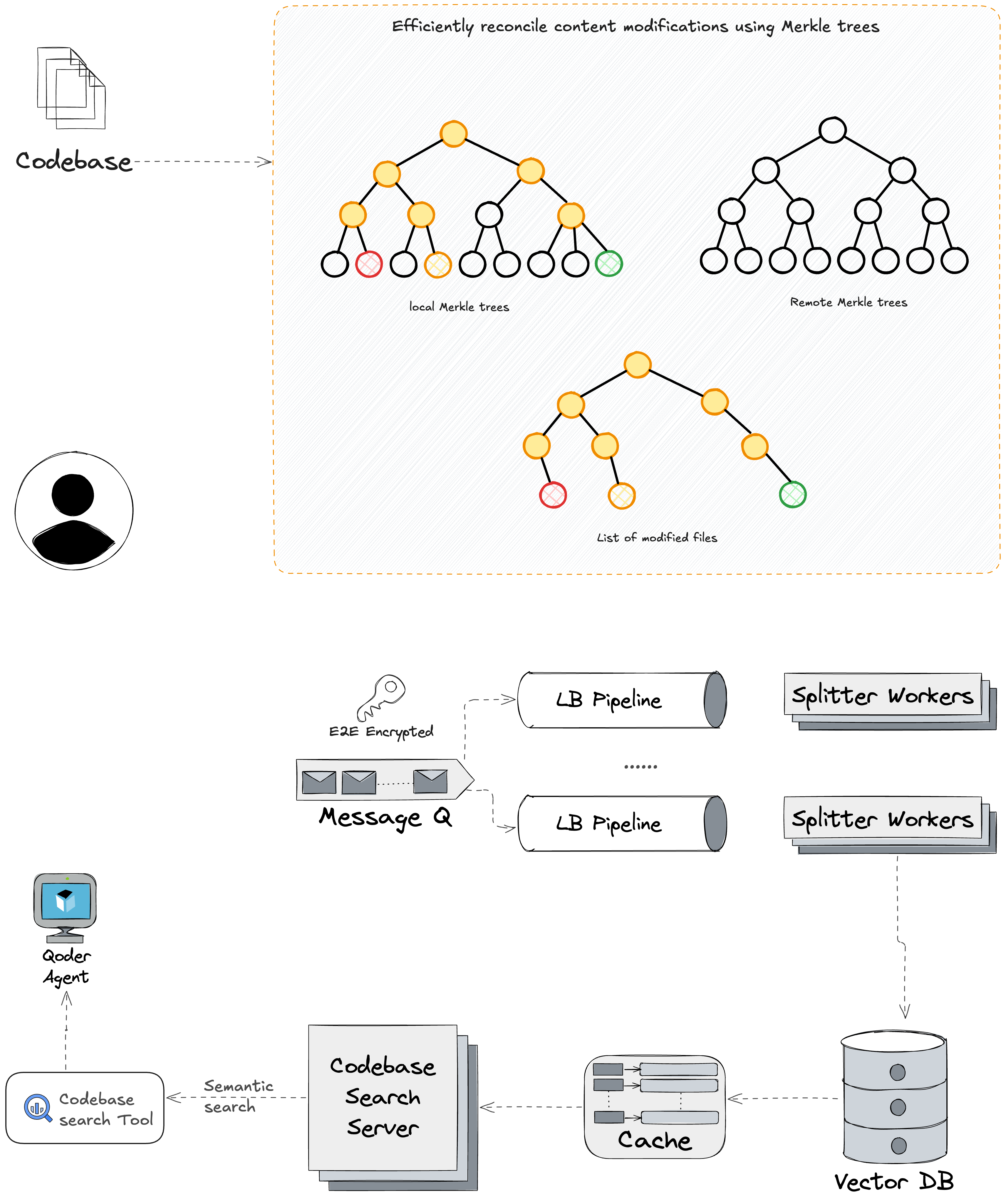
Our backend is built to handle the high throughput of software development. It processes thousands of files per second and scales horizontally to accommodate large repositories. The client caches graphs to avoid redundant computation, and batched updates prevent network congestion.
We never send raw code to third‑party services; all embedding computation and vector search occur within our own infrastructure. Before retrieving any snippet, the client must prove possession of the file’s content by sending a cryptographic hash, ensuring that only authorized users can access code. Embeddings are encrypted in transit and at rest.
When working on a large monorepo, Qoder may need to understand how a service interacts with downstream components. Qoder Agent searches the entire codebase—not only for definitions with similar names, but also for the call chain, configuration files, and design documents related to that function—thanks to graph traversal and knowledge pre-indexing.
During an incident, you need to quickly identify all code paths affected by a failing component. Our hybrid retrieval surfaces related code modules, tests and runbooks, allowing you to triage faster than with generic search.

1,502 posts | 511 followers
FollowAlibaba Cloud Community - August 22, 2025
Alibaba Cloud Community - July 30, 2026
Alibaba Cloud Community - July 17, 2026
Alibaba Cloud Community - July 28, 2026
Alibaba Cloud Big Data and AI - July 6, 2026
ApsaraDB - June 24, 2026
1,502 posts | 511 followers
Follow Token Plan
Build more, spend less. One plan, every modality.
Learn More
Alibaba Cloud Model Studio
A one-stop generative AI platform to build intelligent applications that understand your business, based on Qwen model series such as Qwen-Max and other popular models
Learn More Vector Retrieval Service for Milvus
A cloud-native vector search engine that is 100% compatible with open-source Milvus, extensively optimized in performance, stability, availability, and management capabilities.
Learn More Qwen
Qwen
Full-range, open-source, multimodal, and multi-functional
Learn MoreMore Posts by Alibaba Cloud Community

