As AI coding agents evolve at breakneck speed, a fundamental problem has come into sharp focus: AI can write code, but it struggles to truly understand it. The deeper issue is that even the most capable models cannot reliably complete real-world engineering tasks without structured constraints and rich contextual grounding.
Today's mainstream AI coding agents share a set of well-documented limitations in project-level semantic understanding:
These limitations confine AI agents to point-by-point retrieval, lacking the kind of holistic, three-dimensional perception of a codebase that effective engineering demands. An industry consensus is emerging: making AI agents genuinely useful requires building what the community increasingly calls Harness Engineering — a discipline that encompasses environment design, intent specification, feedback loops, observability tooling, architectural constraints, and context engineering. At the core of this discipline lies an Engineering Knowledge Foundation — the codified norms, architectural guardrails, feedback mechanisms, and knowledge accumulation systems that collectively determine whether an agent can move from "occasionally useful" to "consistently reliable."
To address this challenge, we built the Engineering Knowledge Engine — a multi-dimensional code cognition system that integrates code files, commit history, RepoWiki, memory, and more to give AI agents deep contextual understanding.
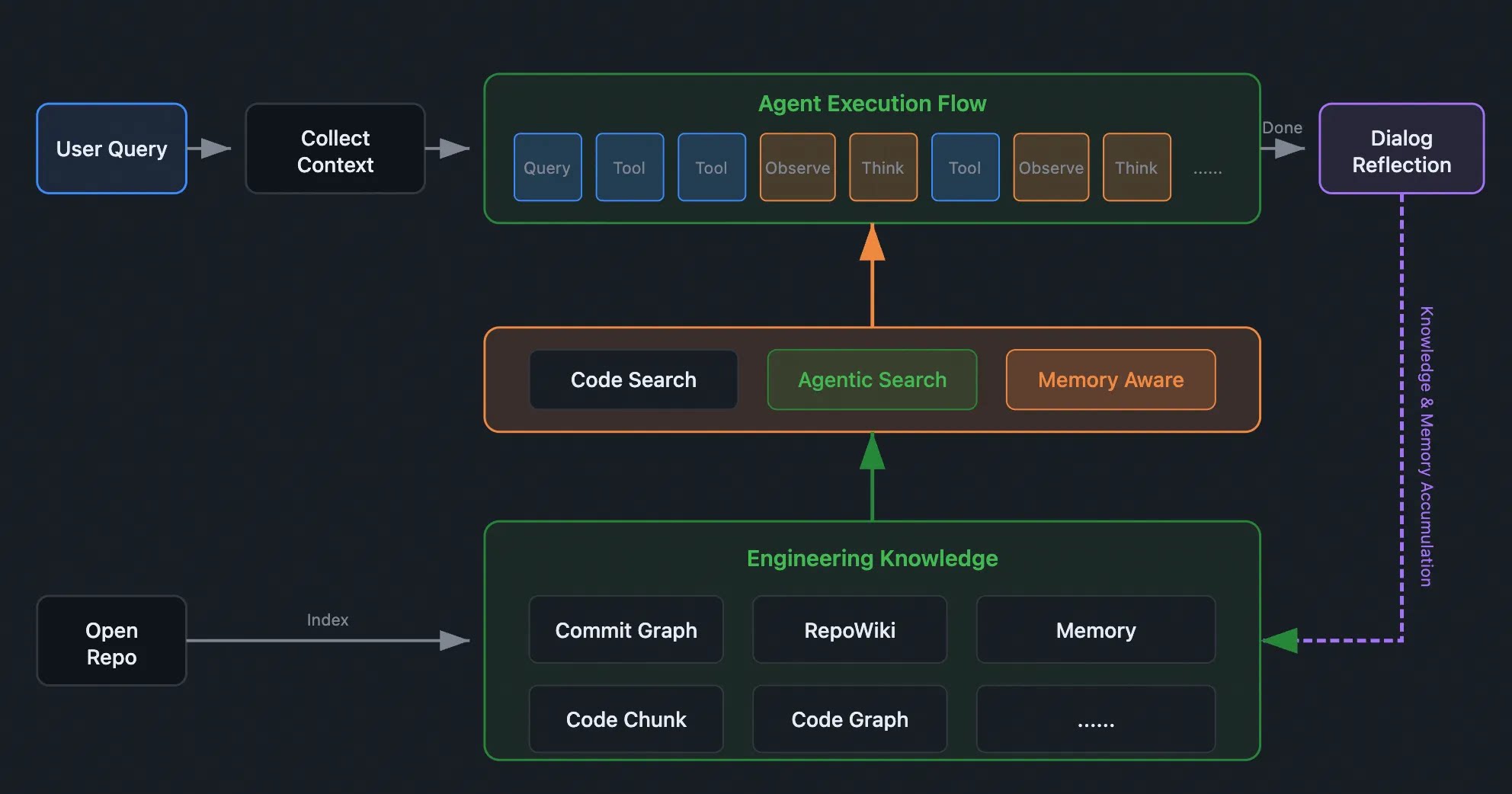
Qoder automatically builds the data layer for the Engineering Knowledge Engine, proactively analyzing and constructing multiple index types — Commit Graph, RepoWiki, Memory, Code Chunk, and Code Graph — that weave previously scattered engineering information into a rich, interconnected knowledge network. Rather than returning isolated code snippets, the agent retrieves contextually grounded information that carries design patterns, dependency relationships, and architectural context.
More importantly, Qoder establishes a self-reinforcing knowledge flywheel. On one side, the engine automatically analyzes and evaluates each completed agent session, distilling valuable engineering insights into persistent memory. On the other, whenever a Git commit lands, Qoder captures the change in real time, semantically analyzes the incremental code and its impact, and synchronizes the new knowledge into RepoWiki — keeping the knowledge base in lockstep with the codebase. This means that the more the agent is used and the more frequently the code evolves, the richer the accumulated knowledge becomes and the stronger the agent's understanding grows. The system transitions from passive retrieval to active learning, achieving continuous self-evolution and compounding value.
This continuously evolving knowledge accumulation mechanism is the core value proposition of the engineering knowledge foundation: every agent misstep becomes a signal to refine knowledge, tighten specifications, and strengthen constraints; every code iteration brings the knowledge base closer to the reality of the living codebase. An agent's capability ceiling is jointly determined by the engineering environment in which it operates.
Vector retrieval forms the base layer of the agent's perception of the code world. It enables natural language queries to map directly to relevant code entities, eliminating the blind guesswork inherent in traditional keyword-matching tools like grep. Through an efficient index scheduling strategy, Qoder reduces indexing time by an average of 5x compared to similar products in the industry. 95% of newly opened repositories are fully indexed in under one minute.
The Code Graph explicitly models semantic relationships between code entities — calls, references, inheritance, implementations, and more — elevating the agent's awareness of symbol-level relationships throughout the codebase. When the agent processes a query like "how is user login authentication implemented?", it doesn't just retrieve directly matching code snippets. Through the graph's relational links, it intelligently surfaces the full context: authentication logic, token services, session management, and related modules.
When agents use retrieval tools to find relevant code, embedding-based vector retrieval creates a "black box" mapping between natural language and code snippets — one that cannot capture higher-level semantic signals. Commit messages, however, are natural carriers of high-level semantic summarization, bridging the gap between what to do and _how it's done_. Qoder uses language models to enhance low-quality commit messages, building a two-stage retrieval pipeline — Query → Commit Message (intent) → Code — that effectively closes the semantic gap between high-level requirements and low-level implementation.
The combination of Code Graph, Commit Graph, and chunk-level vector retrieval creates a connect-the-dots effect, linking local details into broader patterns. But agents that rely solely on local context and generic code patterns miss something critical: the project-specific design language and architectural constraints that make code fit within its system. AI-generated code is often syntactically correct yet stylistically and architecturally out of place.
RepoWiki addresses this by automatically generating and maintaining high-level project knowledge — architectural design documents, module-level documentation, development conventions, and coding standards — forming a living knowledge base that evolves alongside the codebase.
The Memory system gives the AI agent persistent recall across sessions, strengthening the Knowledge Engine's awareness of project configuration, development conventions, historical design decisions, and change patterns. After each conversation, the system analyzes the dialogue to extract valuable insights, abstracting them into memory cards. These memories undergo automatic consolidation, deduplication, and value assessment — enabling the memory layer itself to self-evolve over time.
If the preceding five capabilities are the Knowledge Engine's "senses" and "memory," then Agentic Search is its "cognitive core" — a task-driven retrieval decision framework that dynamically schedules, fuses, and reasons over multi-source, heterogeneous knowledge.
Traditional retrieval tools (such as grep_code or single-modality vector retrieval) return one type of result at a time. The primary agent must iteratively invoke multiple tools across many rounds to gather sufficient information — an approach that, for complex engineering tasks, easily retrieves large volumes of irrelevant context, leading to context pollution.
What makes Agentic Search transformative is that it elevates retrieval itself into a plannable, reflectable, iterable sub-task. Based on the current task objective, confidence levels in the existing context, coverage gaps across knowledge sources, and the semantic granularity of each source, it generates and executes an optimal multi-hop retrieval strategy in real time.
For example, given the request: _"Add idempotency checks to the order service, compatible with the existing Redis distributed lock mechanism, and avoid conflicts with the inventory deduction optimization"_, Agentic Search automatically orchestrates the following reasoning path:
inventory optimization, extracting their change scope and design constraints.RedisDistributedLock class's inheritance chain, callers, and key method signatures — ensuring new logic is compatible with the lock lifecycle.Using the same underlying model, introducing the Engineering Knowledge Engine significantly improved agent efficiency during the retrieval phase. Tool invocation rounds and frequency dropped substantially, directly driving a 21% reduction in overall token consumption. Thanks to the engine's high-precision recall, the system demonstrated strong logical robustness — precisely avoiding unintended modifications to unrelated files (such as cache.py) and effectively eliminating side effects in code generation.
On our proprietary benchmark suite, Qoder Agent Bench, the experimental group with the Engineering Knowledge Engine enabled significantly outperformed the baseline:
These results demonstrate that richer, more accurate multi-source context not only improves correctness but also reduces redundant reasoning and trial-and-error overhead. Agentic Search maintains agent effectiveness while dramatically reducing irrelevant context.
A/B experiments with real users further validated the Engineering Knowledge Engine's practical value. Under the same underlying model, the experimental group (with the engine enabled) versus the control group (using only traditional tools like search_file and grep_code):
Codebase Retrieval (including vector retrieval, Code Graph, Commit Graph, and RepoWiki):
Memory System:
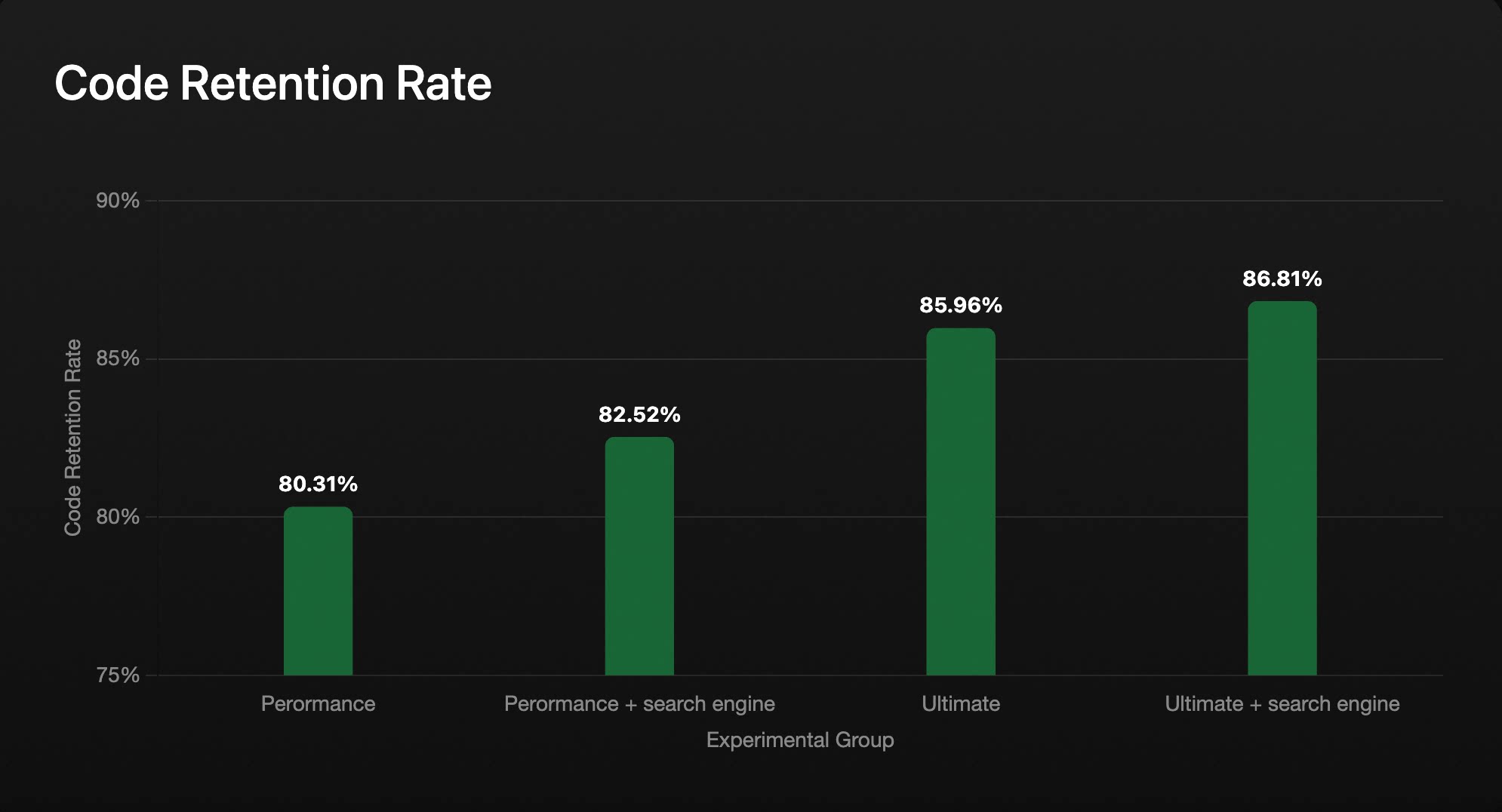
The Knowledge Engine empowers agents to generate code that is more precise, reliable, and aligned with user expectations — significantly boosting code retention rates and meaningfully reducing conversation dissatisfaction.
The Engineering Knowledge Engine marks a pivotal shift in AI-assisted development — from "code generator" to "engineering collaborator." But how far this transformation can go ultimately depends on the quality of the engineering environment we build around the agent.
Practice has shown that an agent's quality ceiling is determined not only by model capability, but more critically by the maturity of its underlying engineering foundation. Whether documentation is accurate, whether architectural constraints are enforceable, whether the knowledge base evolves in sync with the codebase — the quality of this "infrastructure" directly determines whether an agent can complete real engineering tasks consistently, reliably, and predictably.
In such an environment, AI doesn't just see code structure — it understands the intent behind it, the design decisions that shaped it, the technical constraints that bound it, and the evolutionary trajectory that brought it to its current state. Every agent misstep should become an opportunity to strengthen the engineering foundation. Every piece of accumulated knowledge narrows the cognitive gap between human and machine.
This is not merely a technical advance. It is a fundamental re-examination of software engineering itself: make the engineering environment good enough, and the agent will be good enough. This may be the most pragmatic path toward sustained improvement in software development productivity.
AI Coding Enters the "Agent Teamwork" Era: Introducing Qoder Experts Mode

1,495 posts | 509 followers
FollowAlibaba Cloud Native Community - April 16, 2026
Alibaba Cloud Native Community - May 18, 2026
Alibaba Cloud Community - July 3, 2026
Alibaba Cloud Native Community - March 25, 2026
Alibaba Cloud Native Community - June 23, 2026
Alibaba Cloud Native Community - June 8, 2026
1,495 posts | 509 followers
Follow Token Plan
Build more, spend less. One plan, every modality.
Learn More
Alibaba Cloud Model Studio
A one-stop generative AI platform to build intelligent applications that understand your business, based on Qwen model series such as Qwen-Max and other popular models
Learn More Qwen
Qwen
Full-range, open-source, multimodal, and multi-functional
Learn More AI Acceleration Solution
Accelerate AI-driven business and AI model training and inference with Alibaba Cloud GPU technology
Learn MoreMore Posts by Alibaba Cloud Community

