In most AI coding agents today, code retrieval is embedded directly in the main model's reasoning loop: the model generates a search query based on user intent, calls a tool, stuffs the results into context, and keeps reasoning. This "main model as searcher" pattern feels natural—but it breaks down as tasks get harder:
Single Retrieval Method. Each tool call typically uses one retrieval method—a vector search, a grep, or a symbol lookup. But real queries are compound: "Find all middleware implementations in the auth module and trace their call chains." The model has to ping-pong between tools across multiple reasoning turns, burning tokens and time at every hop.
Context Pollution. Every raw search result gets dumped into the main model's context window. Most of it is noise—wrong files, test mocks, deprecated handlers, changelog entries. The model ends up splitting its attention between understanding user intent and _filtering retrieval junk_. It does both poorly.
Compounding Search Cost. Key information is rarely in one place—it's scattered across files, layers, and modules. The model falls into a costly "search → read → realize it's wrong → search again" loop, each cycle eating into the token budget and the user's patience.
Capability Mismatch. The main model is built for reasoning and code generation, not for planning multi-step search strategies. Making a frontier model decide "what to grep first, which directory to explore next, how to combine results from three different tools" is using a sledgehammer to crack a nut.
The core idea is simple: stop making your reasoning model do search. Give it a search agent instead.
The main model describes what it needs—objectives, scope, desired output format—and hands off to an independent Search Agent. The Search Agent plans a strategy, launches parallel searches, iterates until it converges, filters noise, and returns only the relevant, distilled results the main model actually needs. The main model never sees the dead ends.
Why this works:
The main model emits a structured retrieval request: what to find, where to look, and what the output should look like. It does not specify which tools to use or in what order. This keeps the interface clean—the main model expresses goals, not procedures.
The Search Agent translates intent into an executable plan. It selects tool combinations, decides on parallel vs. sequential execution, and plans a coarse-to-fine search trajectory. It also manages iteration budgets and token compression—deciding when to stop searching and when to dig deeper.
The agent runs the plan against the codebase using a diverse tool suite—semantic search, regex matching, graph traversal, file/directory operations, file reading, wiki/doc search—then assembles the output: summaries, file paths, and line ranges.
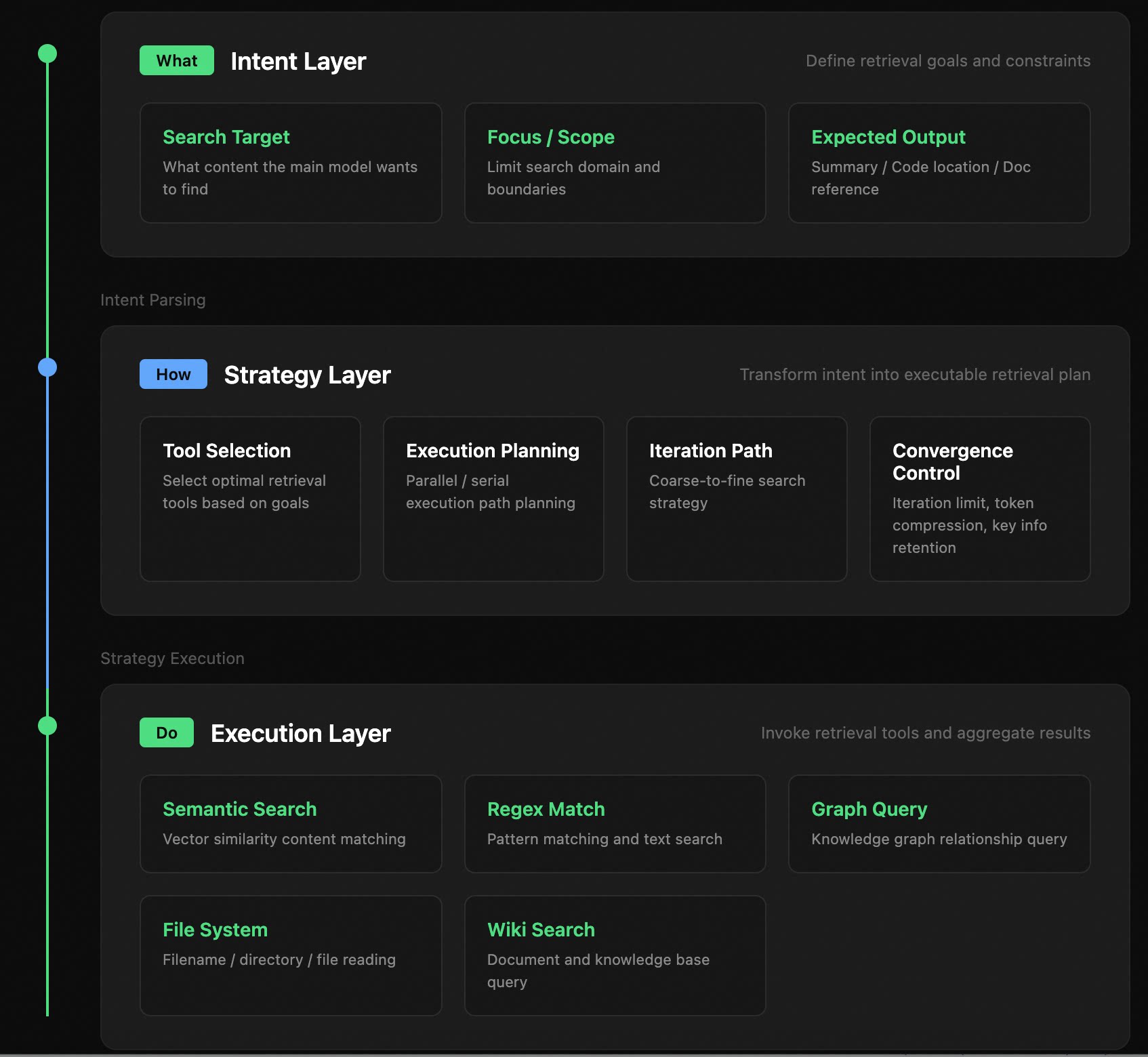
Because the Search Agent's only job is retrieval—no reasoning about user intent, no code generation—its context stays clean and its prompt can be laser-focused. We pack in strong retrieval instructions and high-quality tool-call traces (few-shot examples of good search behavior), making each search step more controllable, reusable, and evaluable.
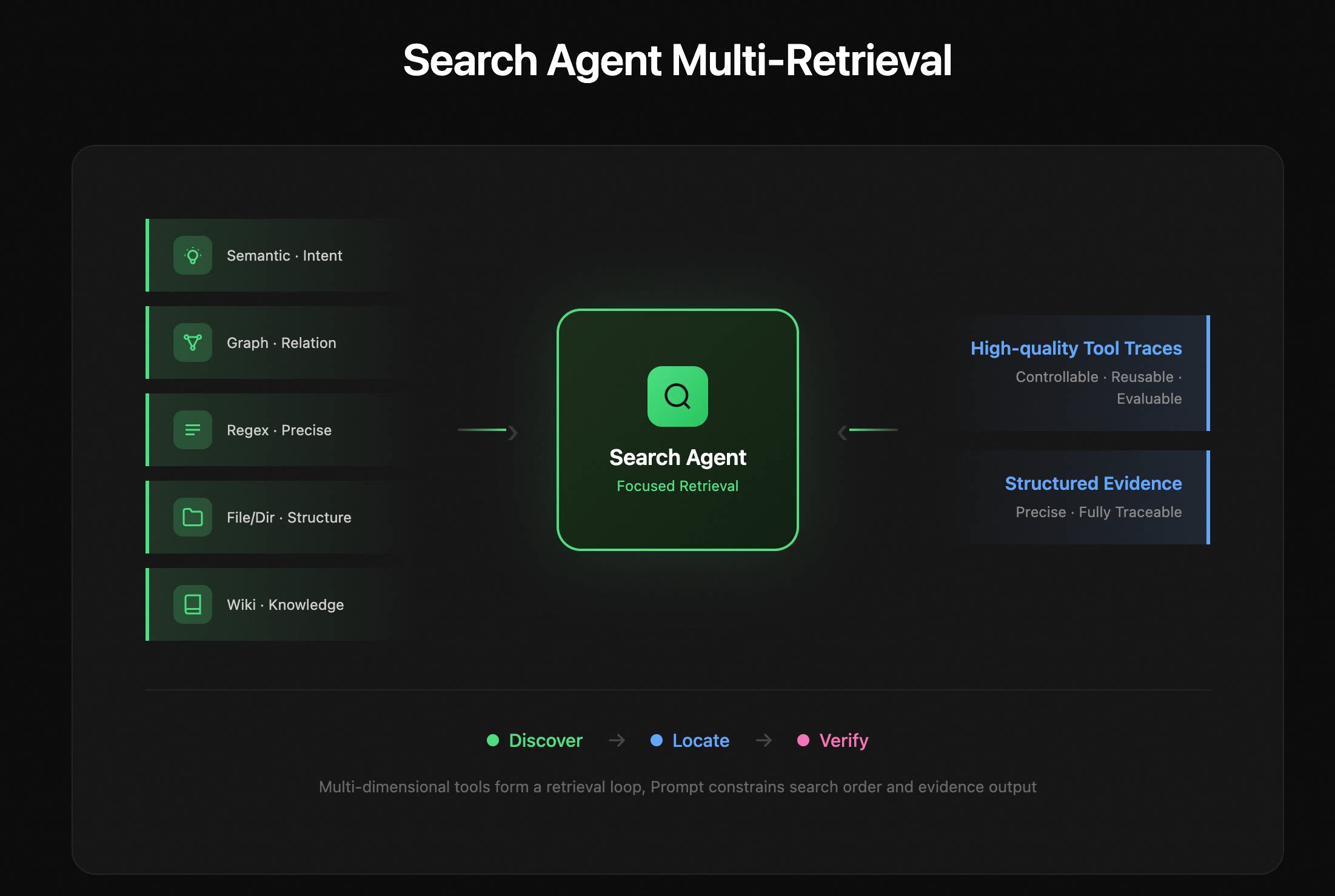
The tool suite covers complementary retrieval approaches:
| Tool | What It Does | When to Use It |
|---|---|---|
| Semantic Search | Embeds queries and matches by conceptual similarity | Initial exploration, fuzzy matching, inconsistent naming |
| Graph Search | Traverses call chains, inheritance trees, import graphs | Tracing function calls, mapping blast radius, understanding dependencies |
| Regex Matching | Exact pattern matching across the entire codebase | Error messages, specific constants, configuration keys |
| File Search | Finds files by name or path pattern | Entry points, config files, module boundaries |
| Directory Exploration | Explores project structure and hierarchy | Understanding project layout, identifying module organization |
| File Reading | Reads specific content of located files | Confirming implementation details, verifying parameters and edge cases |
| Wiki / Docs Search | Searches project documentation and architecture specs | Background knowledge, terminology alignment, understanding conventions |
These tools form a retrieval loop: semantic search captures _semantic relevance_, regex pins down _exact occurrences_, graph search traces _structural relationships_, and file-level tools complete the chain from discovery → location → verification.
The key architectural advantage: since the Search Agent doesn't carry reasoning tasks, its context budget is entirely devoted to search quality. No attention wasted on "how should I implement this feature"—just "where is the code I need."
In the following example, under the same base model, introducing the Search Agent decouples retrieval from reasoning. The main model dispatches search tasks asynchronously and directly consumes refined results for code generation. This reduces reasoning rounds and cuts main model token consumption by 30.2%.
We evaluated on Agent Bench—45 real-world coding tasks across multiple languages:
| Configuration | Score Change | Main Model Input Tokens | Credit Cost |
|---|---|---|---|
| Search Agent + Premium Model | +2.3% | -10.4% | -14.2% |
| Search Agent + Efficient Model | +0.5% | -11.0% | -8.4% |
Using the Efficient Model as the baseline, the relative improvements:
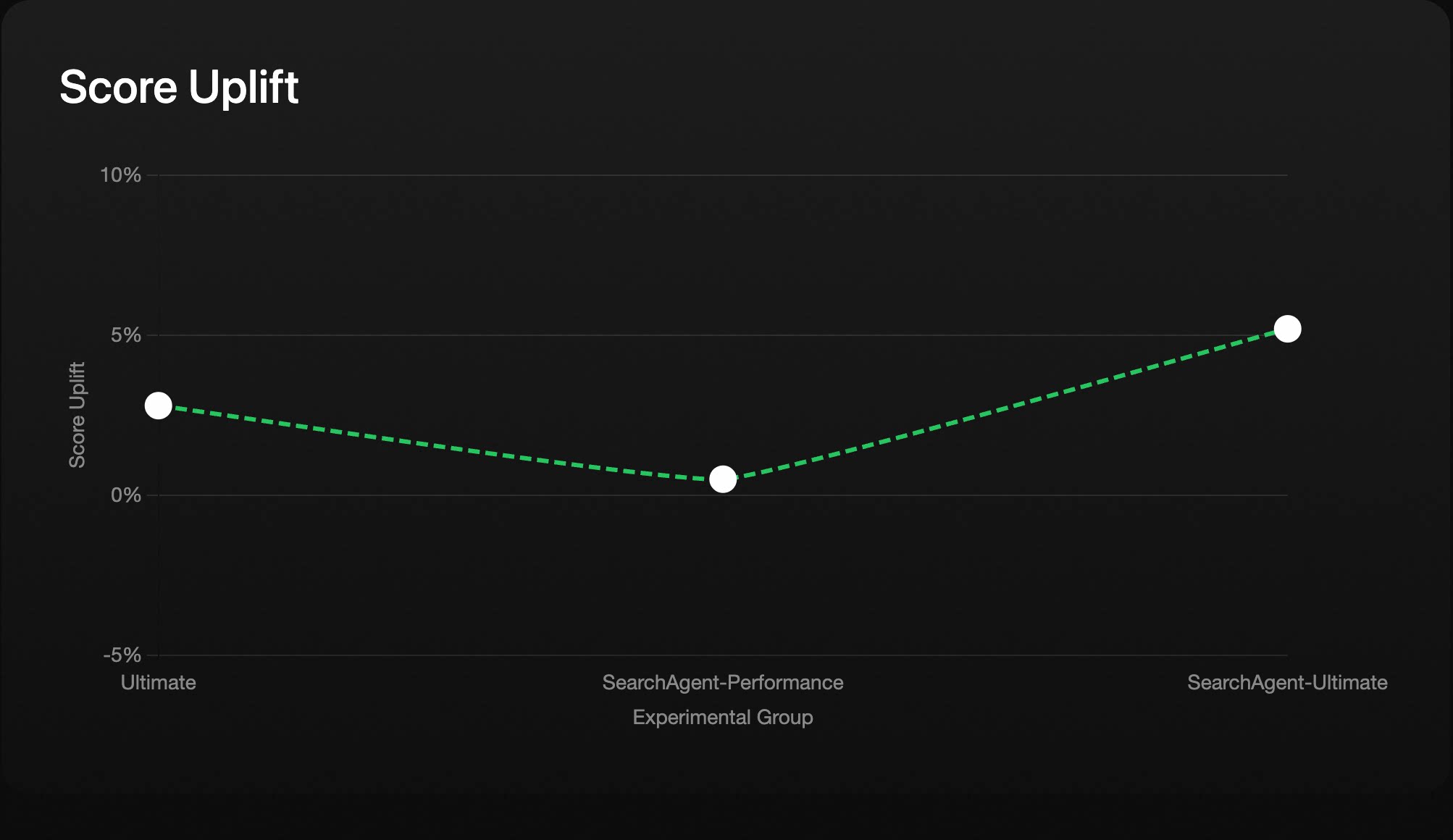
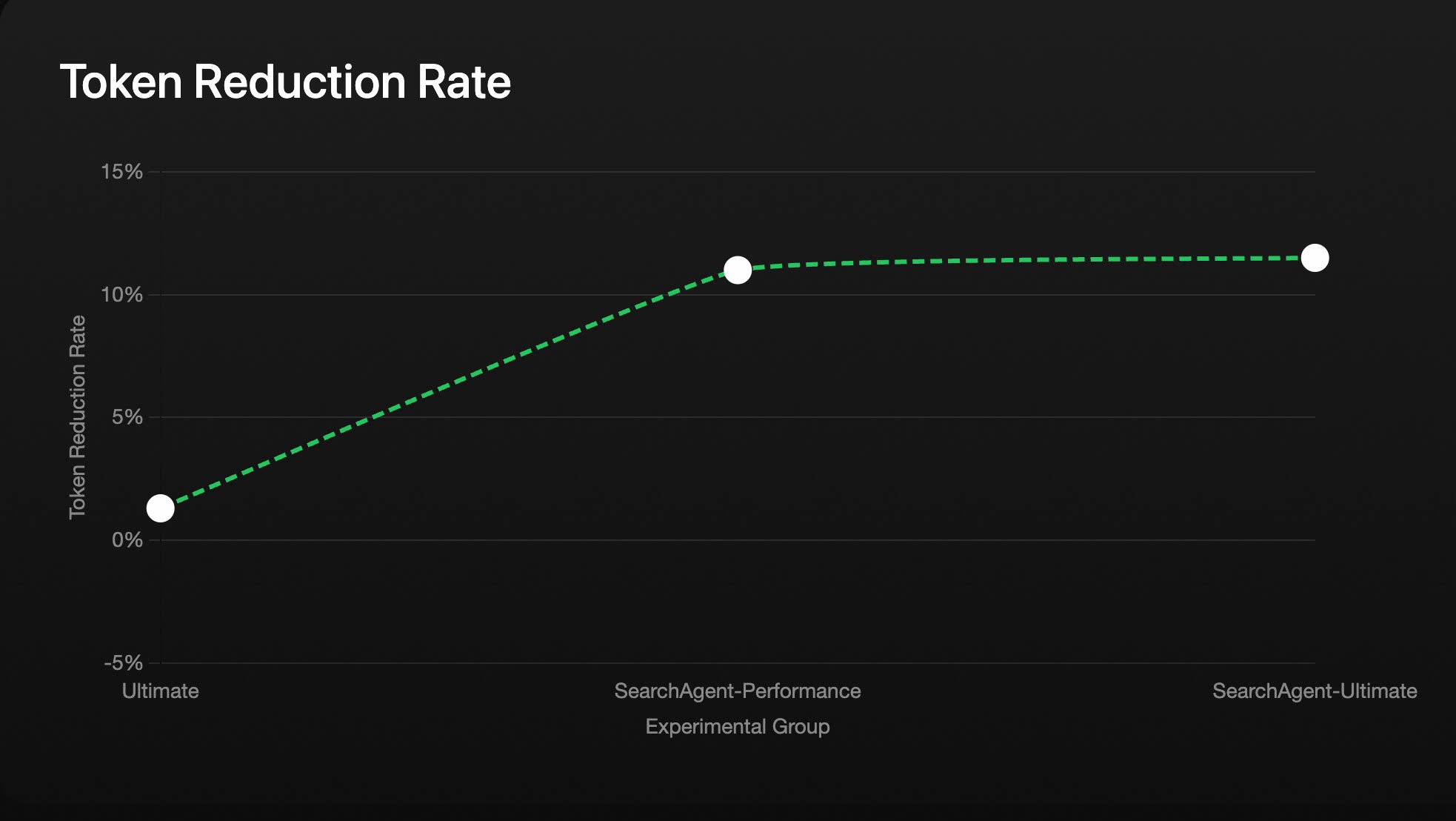
The pattern is consistent: better scores and lower costs. The Search Agent doesn't just save tokens—it improves task completion by giving the main model cleaner, more relevant context.
We deployed the Search Agent in production and ran controlled A/B experiments on complex tasks requiring deep codebase understanding. The headline finding: token savings scale with repository size.
| Repository Size | Token Reduction |
|---|---|
| Small (0–1K files) | -1.61% |
| Medium to Large (1K–100K files) | -12.57% |
| Extra-Large (100K+ files) | -30.46% |
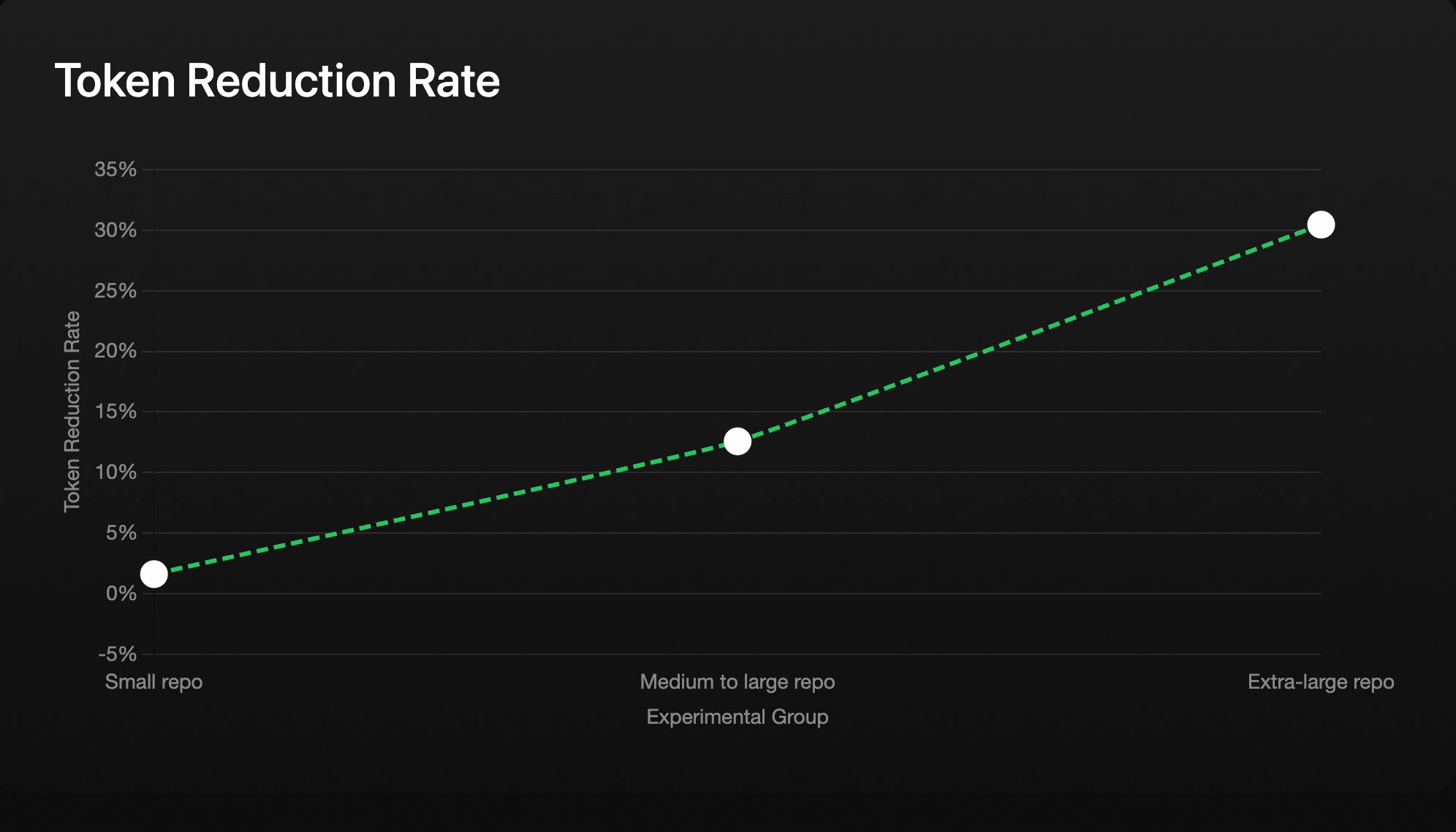
This scaling behavior makes intuitive sense. In small repos, the main model can often find what it needs in a few greps. In massive codebases—where the search space is orders of magnitude larger and relevant code is scattered across hundreds of files—the Search Agent's ability to explore in parallel, iterate, and filter pays off dramatically.
Retrieval quality sets the performance ceiling for AI coding agents. Moving from "main model does its own search" to "dedicated Search Agent" is a leap from passive single-shot retrieval to proactive multi-round exploration—better results at lower cost.
The fundamental insight: retrieval and inference are different tasks, and they deserve different agents.
We're continuing to push on three fronts:
The goal is moving Agentic Search from "works" to "works remarkably well."

1,495 posts | 509 followers
FollowCloudSecurity - April 9, 2026
Alibaba Cloud Community - June 16, 2026
Alibaba Cloud Community - July 28, 2026
Alibaba Cloud Native Community - May 8, 2026
Alibaba Cloud Community - June 9, 2026
Alibaba Cloud Community - May 21, 2026
1,495 posts | 509 followers
Follow Token Plan
Build more, spend less. One plan, every modality.
Learn More
Alibaba Cloud Model Studio
A one-stop generative AI platform to build intelligent applications that understand your business, based on Qwen model series such as Qwen-Max and other popular models
Learn More Qwen
Qwen
Full-range, open-source, multimodal, and multi-functional
Learn More AI Acceleration Solution
Accelerate AI-driven business and AI model training and inference with Alibaba Cloud GPU technology
Learn MoreMore Posts by Alibaba Cloud Community

