In Qoder 1.0, our most important direction is to build a task environment that is better suited for Agents to execute tasks and for developers to manage Agents. Qoder 1.0 is the core capability under this direction: it upgrades Chat into an agentic task runtime, giving every task clear workspace boundaries, execution boundaries, artifact boundaries, delivery boundaries, and persistently effective knowledge boundaries.
In a traditional IDE, a Workspace is basically the directory opened in a window. The file tree, terminal, Git panel, and editor all operate around it. This design assumes that window state, execution state, and delivery state are usually aligned.
But in Qoder 1.0, a task may span multiple workspace states.
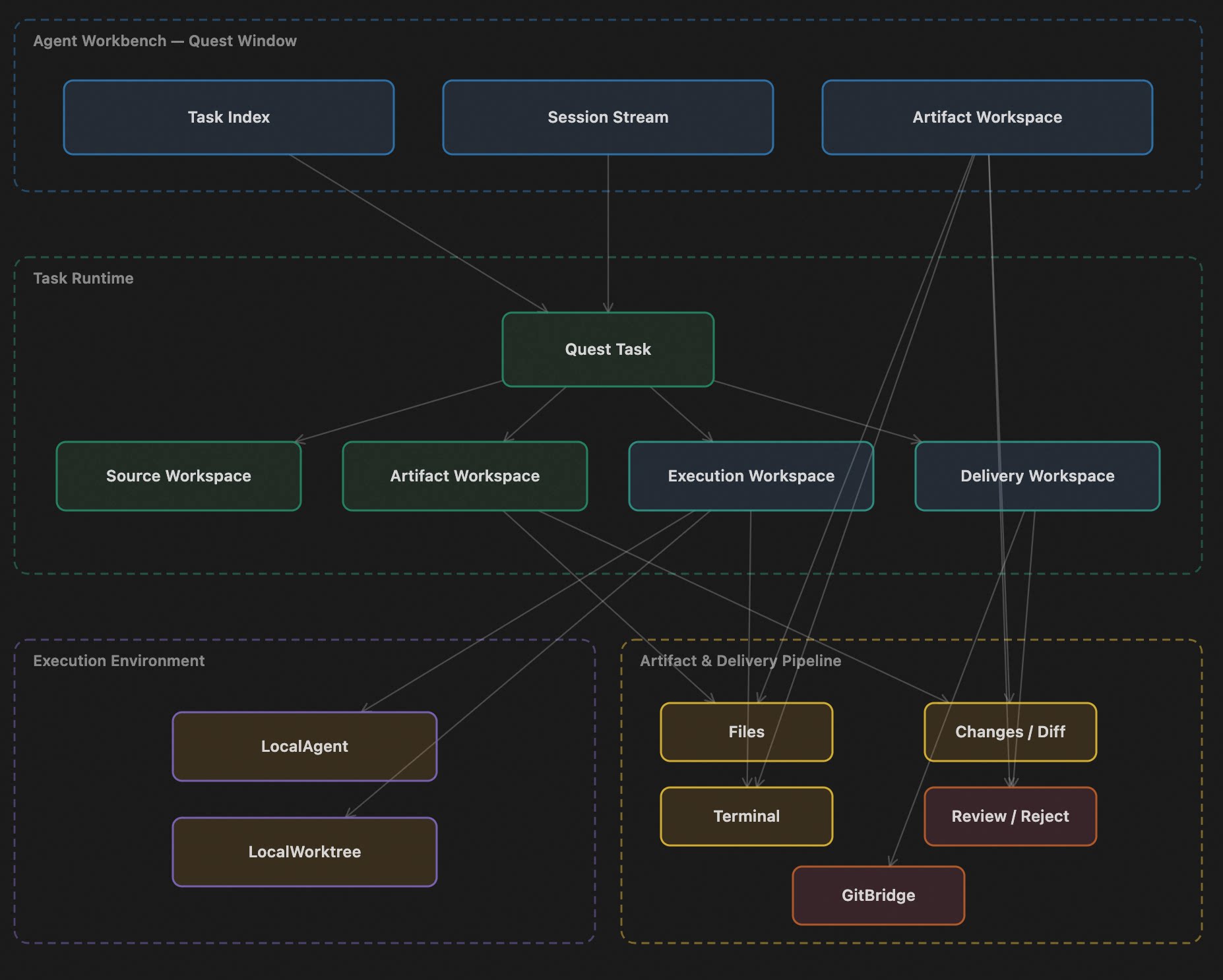
In Agent mode, these layers mostly overlap. The current directory is the execution directory, the execution directory is also the artifact directory, and Review and Commit operate on the same Git root directory.
Once Worktree is introduced, however, these boundaries are separated: the task is created from the source repository, the Agent executes in an isolated worktree, files and Review should follow the worktree, and when the user creates the next Quest, it should return to the source repository.
The value of a local Worktree is that it allows multiple Quests to progress in parallel. The Agent can modify files in an isolated directory, while the user can inspect the changes in the artifact area on the right and then decide whether to Review, Apply, or Commit. This model may look like "creating one more branch directory," but in reality it is more like assigning an independent execution boundary to each task.
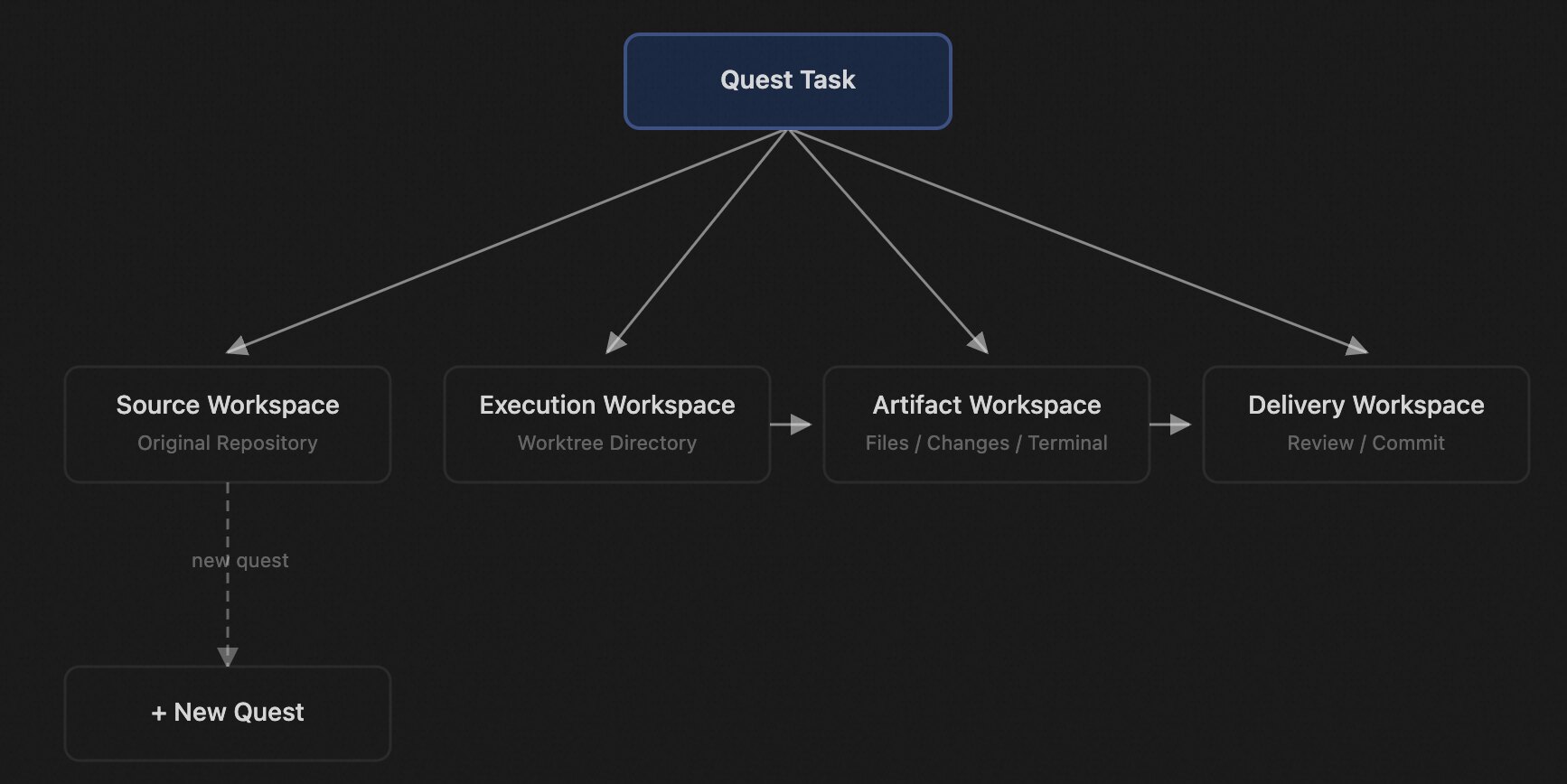
If this boundary is unstable, every subsequent action becomes shaky.
Apply may write to the wrong directory. Reject may roll back the wrong files. Review may compare the wrong diff. Commit may calculate against the wrong Git root directory. Worse still, these errors often do not appear when the Agent is writing code; they only surface when the user is ready to deliver the task.
So what Qoder 1.0 truly needs to stabilize is the complete chain: a task is created from the source project, runs inside its bound execution environment, resolves artifacts from the current task, lets Review consume the current task's diff, and commits to the current task's delivery target.
Only when this chain is stable does multi-task parallelism become more than a pile of directories. It becomes parallel execution of multiple task runtimes.
The three-column Quest mode view answers a more engineering-oriented question: how does an Agent task move from a session into a result that can be viewed, reviewed, and committed?
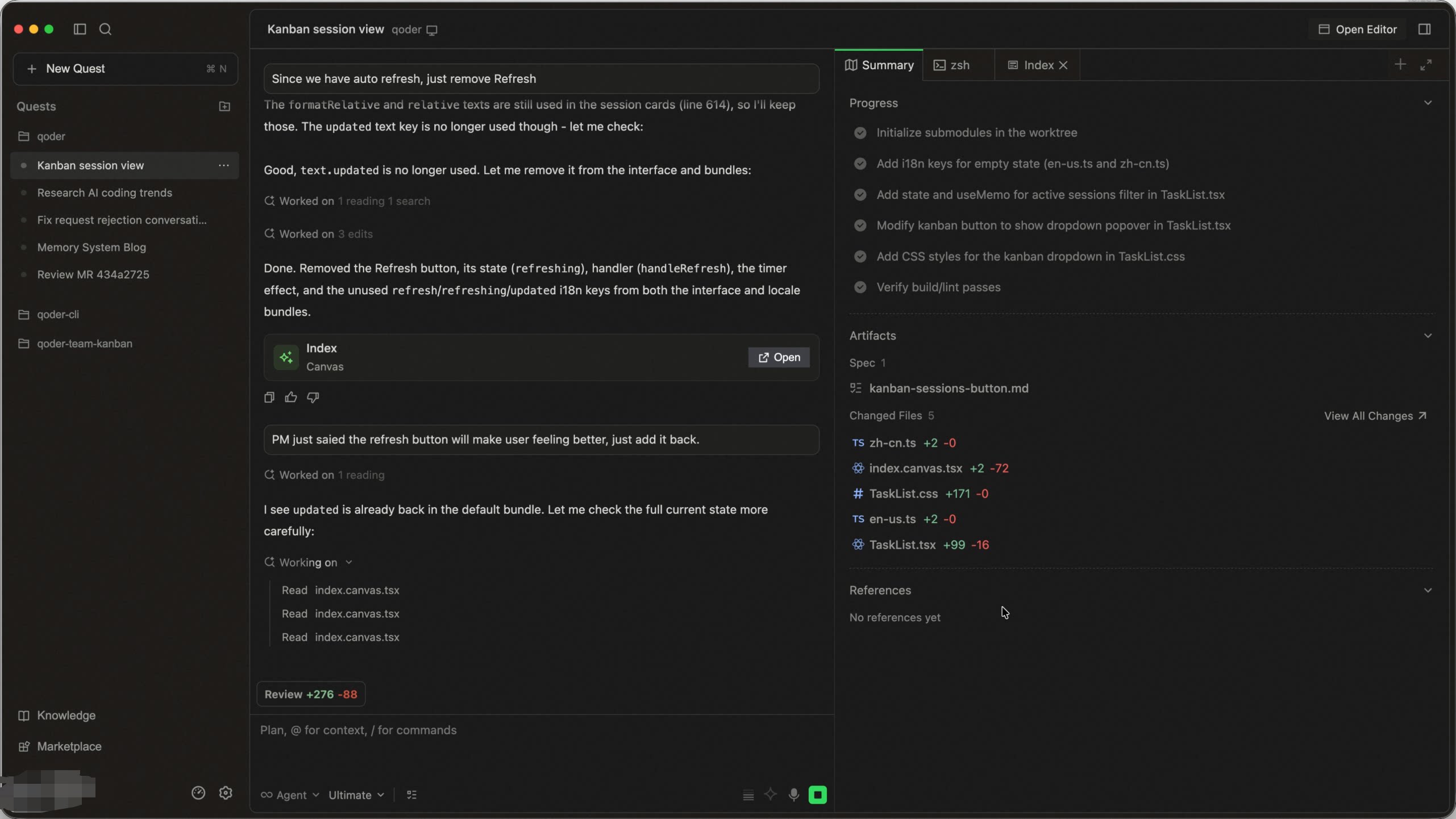
But delivery is not only about looking at the diff. Users also need to know "why this task made these changes." That is what the summary and reference area are responsible for: laying out the context the Agent relied on, so Review is not only about inspecting the code result, but also about examining the reasoning basis behind it.
In the Qoder 1.0 story, memory and project knowledge are not separate, parallel features. They are part of the task execution environment. They determine whether the Agent can understand user intent, project constraints, and team conventions while executing a task. But knowledge cannot simply be injected into the Agent as a global prompt pool.
For a Coding Agent, knowledge must have scope:
Without knowledge scope, a knowledge engine can easily become a source of pollution. Therefore, in Qoder 1.0, knowledge boundaries must be bound to the workspace.
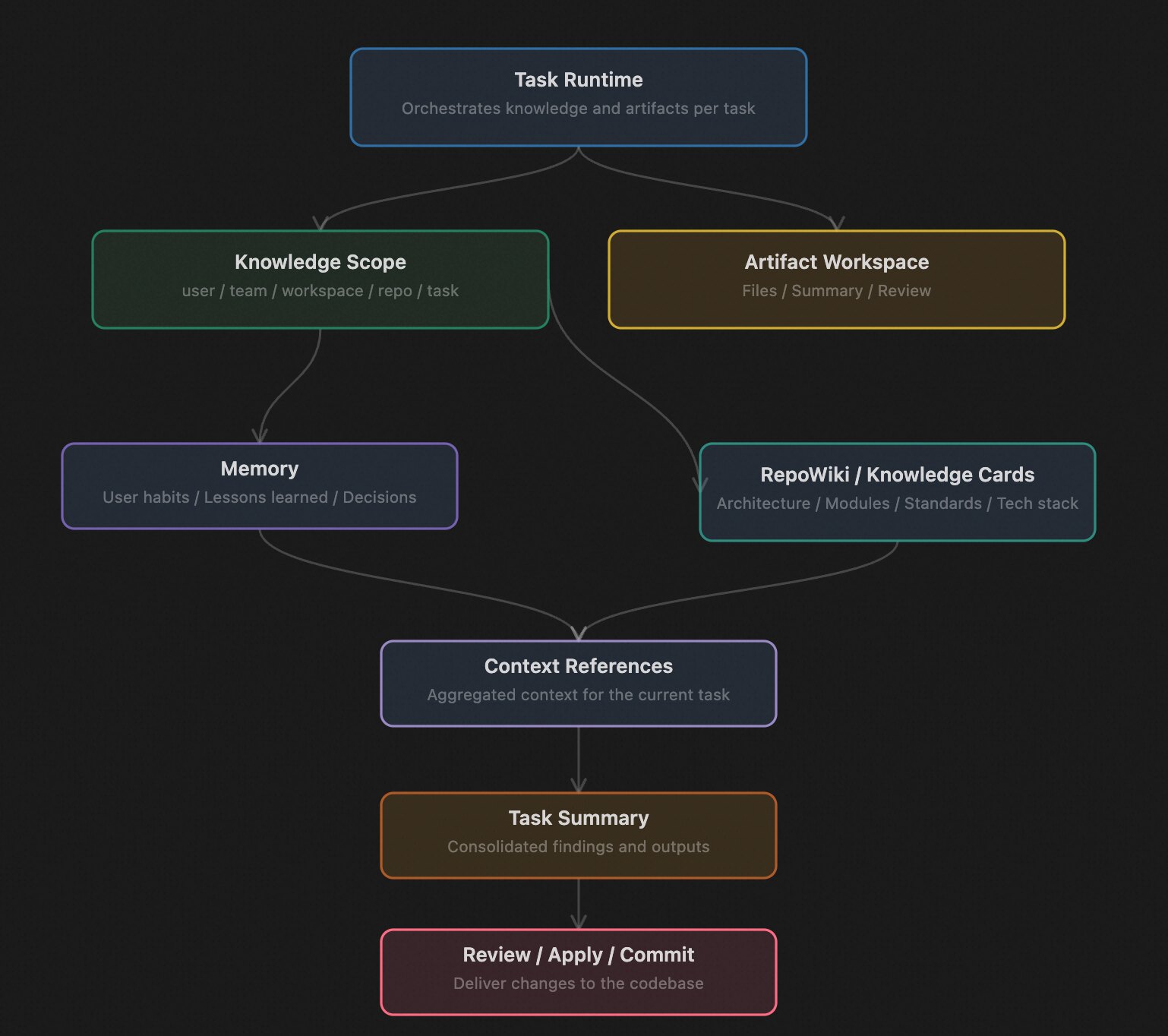
Here, the value of the knowledge engine is not just that the Agent "knows more background." It also enables the Agent to make more accurate judgments while executing a task: what the user truly wants, how the system should be integrated, how the code should be written, and whether the result meets the team's delivery requirements.
To evaluate whether memory and project knowledge are truly effective, we conducted both online business evaluations and offline task evaluations on internal projects.
The online evaluation compared results with "memory enabled" against results with "memory disabled," tracking metrics such as dissatisfaction rate, code retention rate, input tokens, and conversation turns. A three-day online A/B test across the top five categories showed that the memory system reduced dissatisfaction by 22.09%, increased code retention by 11.10%, reduced input tokens by 40.13%, and reduced conversation turns by 32.60%.
The offline evaluation built task sets around architecture understanding, convention compliance, and tech-stack adaptation. The results showed that with architecture knowledge enhancement, task completion scores improved by about 25%, while token consumption dropped by about 30%. With tech-stack knowledge enhancement, end-to-end scores improved by about 25%, while token consumption dropped by about 15%. Coding-standard knowledge also significantly improved the degree to which code conformed to required conventions.
These evaluations show that knowledge enhancement is not a generic prompt strategy, but an engineering capability that can be measured. It directly affects the Agent's key decisions: knowing where to make changes, how to write the code, which conventions to follow, and how to align with the project's real operating environment.
What Qoder 1.0 aims to do is not to make Chat larger, but to upgrade Chat into a task runtime.
Chat is responsible for conversation, but real delivery requires more stable task boundaries: which project the task belongs to, where the Agent executes, where artifacts are displayed, which diff Review should inspect, which Git root directory Commit should target, and which user, team, and repository the knowledge comes from.
Only when these boundaries are stable can Agents truly execute tasks in parallel. Only when the basis for decisions is traceable can Review judge the result. Only when the delivery path is clear can tasks be safely entrusted to the Agent.
An LLM-Driven Self-Iterating Knowledge Engine for Software Engineering

1,495 posts | 509 followers
FollowAlibaba Cloud Community - June 16, 2026
Alibaba Cloud Community - July 23, 2026
Alibaba Cloud Community - July 31, 2026
Alibaba Cloud Community - July 28, 2026
Alibaba Cloud Community - January 20, 2026
Alibaba Cloud Community - June 16, 2026
1,495 posts | 509 followers
Follow Token Plan
Build more, spend less. One plan, every modality.
Learn More
Alibaba Cloud Model Studio
A one-stop generative AI platform to build intelligent applications that understand your business, based on Qwen model series such as Qwen-Max and other popular models
Learn More Qwen
Qwen
Full-range, open-source, multimodal, and multi-functional
Learn More AI Acceleration Solution
Accelerate AI-driven business and AI model training and inference with Alibaba Cloud GPU technology
Learn MoreMore Posts by Alibaba Cloud Community

