Not a general-purpose knowledge management tool retrofitted onto the coding scenario, but something built for software engineering from the very first line of code—and designed to truly take root in the enterprise and integrate with ease.
AI coding assistants have become remarkably capable, yet they don't know your code, and they don't remember your project. No matter how large a general-purpose model is, if it knows nothing about your project, it can never truly serve you.
The individual developer's predicament—collaborating every day, yet starting from zero every day
The bottleneck isn't model capability—it's memory.
The enterprise team's predicament—knowledge exists, but it doesn't accumulate and it doesn't flow
When knowledge doesn't accumulate, every person and every Agent keeps rediscovering the same things.
Andrej Karpathy proposed the idea of an LLM Wiki, and GBrain subsequently turned it into an open-source product. They pointed to a direction worth following.
Karpathy's insight is key: why do humans give up on maintaining a Wiki? It's not that they can't write—it's the "bookkeeping cost" of maintenance. Updating cross-references, keeping summaries current, flagging contradictions—these costs grow faster than the value of the knowledge itself. But an LLM never tires, and its maintenance cost approaches zero.
This gives rise to a new paradigm: compile knowledge once, then continuously reuse and grow it. Rather than improvising a patchwork every time it's used, let knowledge be accumulated and iterated like a codebase. This stands in sharp contrast to traditional RAG—RAG starts from scratch with every question and knowledge never accumulates; the compiled-knowledge paradigm gives knowledge an "accumulation effect"—the more it's used, the richer it gets and the deeper its understanding becomes.
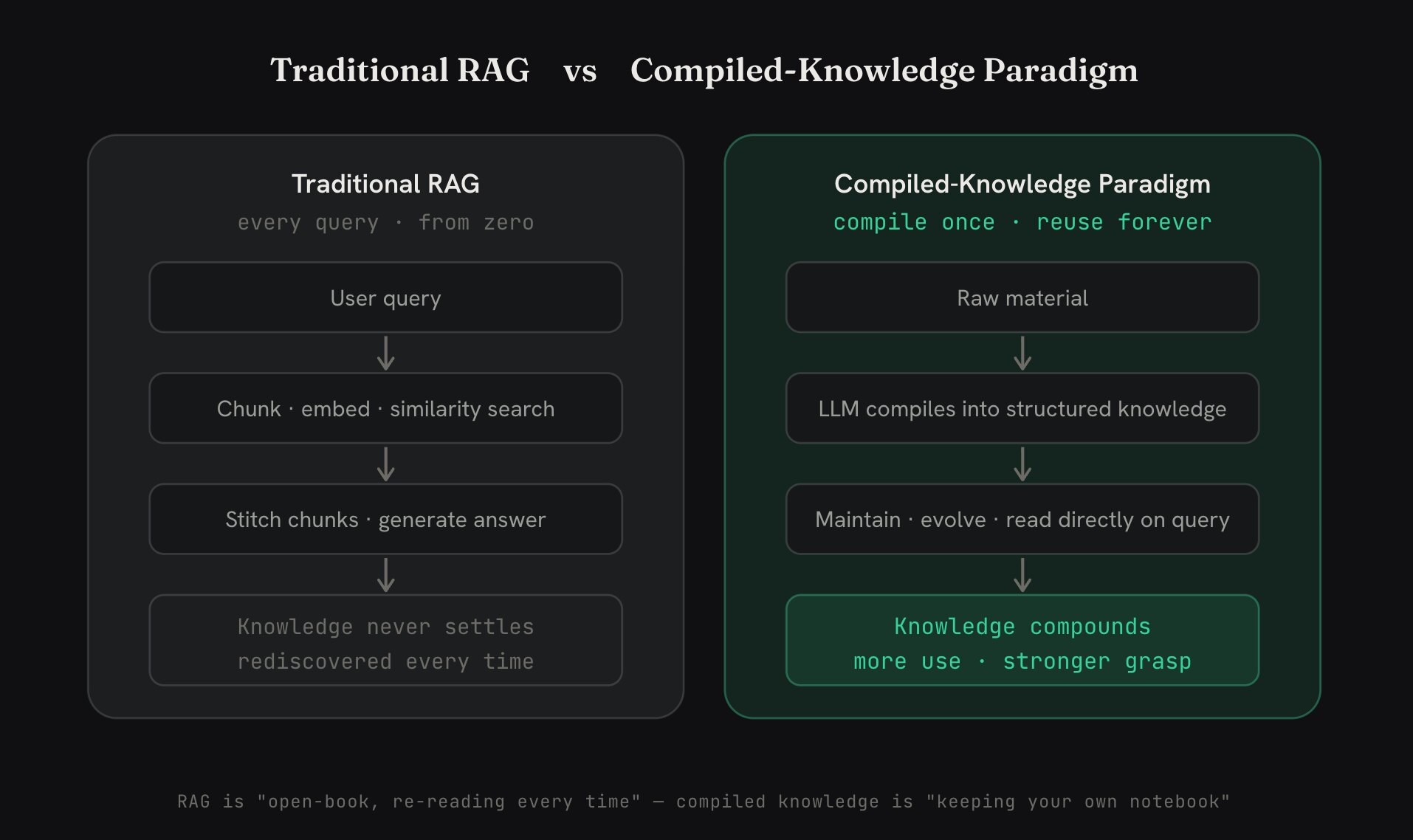
Both LLM Wiki and GBrain are general-purpose knowledge tools. They established a paradigm in the general-knowledge domain, but neither took the software engineering scenario—the most fitting, and also the most difficult—to its full potential. Qoder Knowledge Engine 2.0 has achieved industry-leading results in the software engineering knowledge domain.
Centered on the idea of "compiled knowledge" and grounded in the real scenarios of software engineering, Qoder Knowledge Engine 2.0 offers answers across four dimensions: how to distill knowledge, how to keep knowledge alive, how to architect the capability stack, and how enterprises can genuinely put it to work.
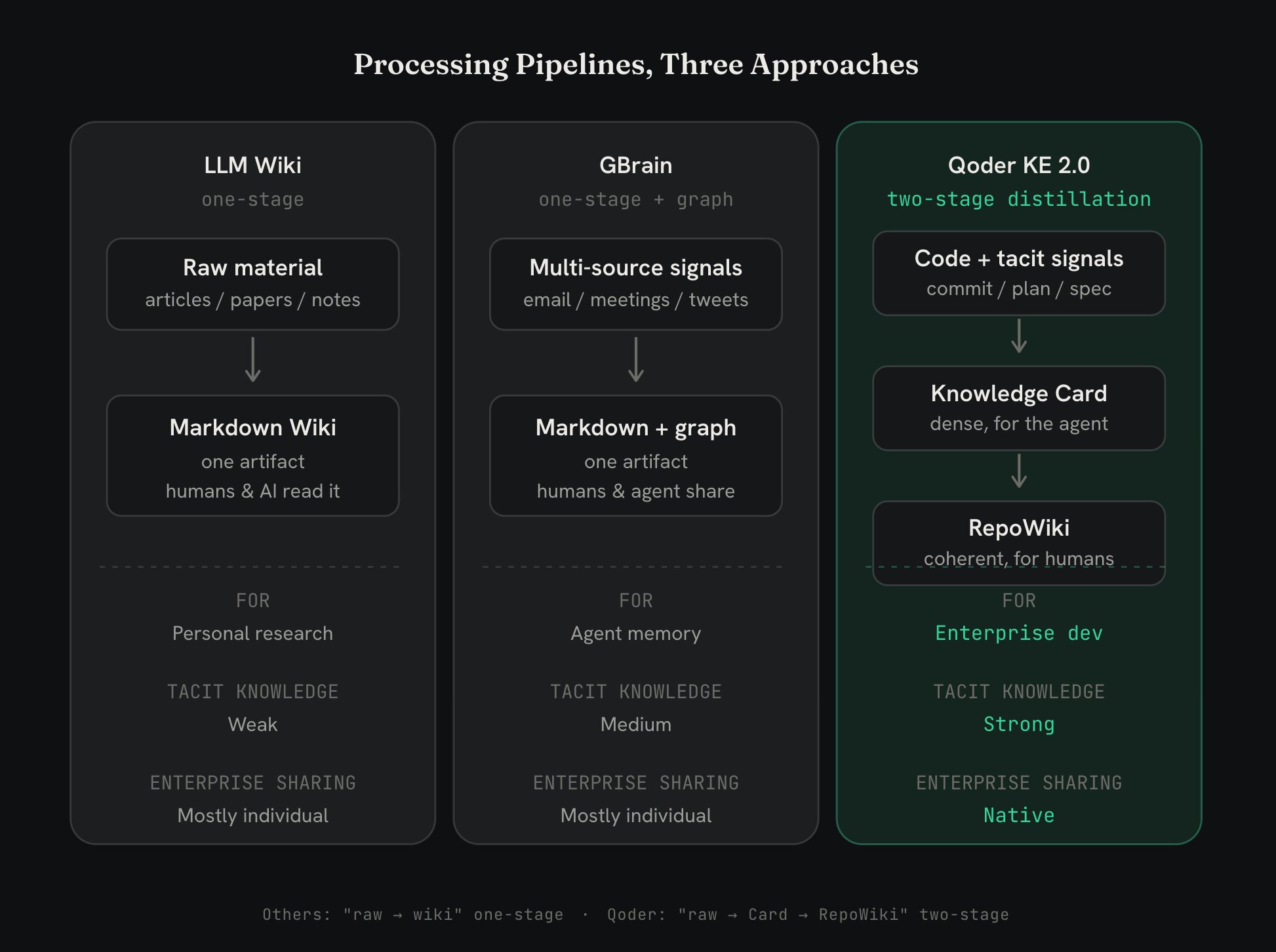
Compiled knowledge has an unavoidable tension: when raw material is compiled directly into a single Wiki, humans and AI read the very same artifact. But an Agent wants high-density, structured signals, while a human wants a coherent, readable narrative—one artifact serving two needs inevitably shortchanges one of them.
Qoder's answer is two-step distillation: raw signals are first compiled into Knowledge Cards (for the Agent), and then RepoWiki (for humans) is distilled from those Knowledge Cards. This is precisely the engineering expression of the Zen notion of the "three stages of seeing a mountain"—seeing the mountain as a mountain, seeing the mountain as not a mountain, and seeing the mountain as a mountain once more.
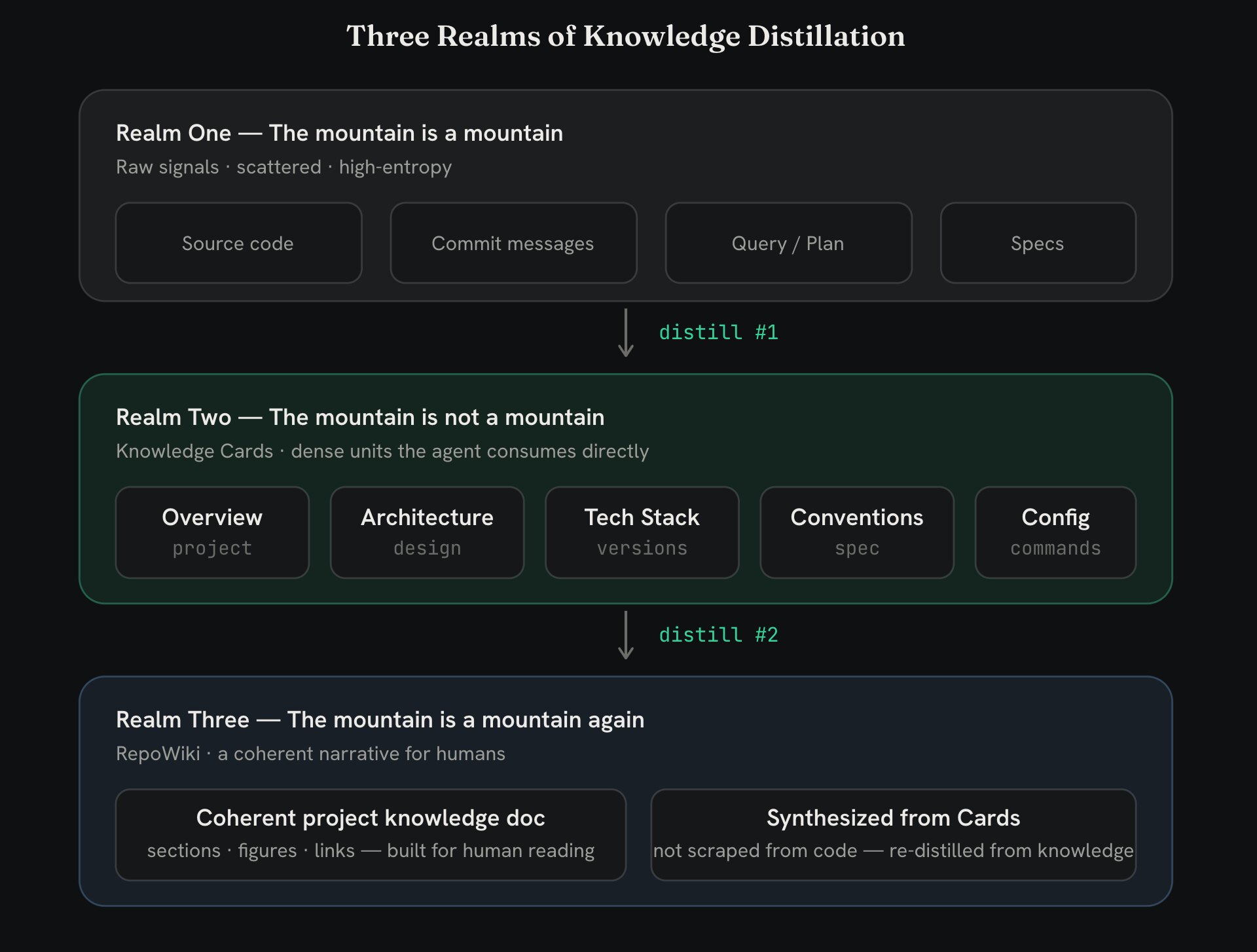
Why does this layering matter so much? The Agent wants density—Knowledge Cards are structured, single-responsibility, and locatable, so retrieval hits the mark in one shot. The human wants coherence—RepoWiki is narrative and threads the whole system together. And tacit knowledge can only come from people—design intent, the history of pitfalls, and specification constraints aren't visible in the code; they can only be extracted from commit messages and the plans/specs within conversations, and Knowledge Cards are precisely their best carrier.
The greatest enemy of a knowledge base is going stale. Qoder uses two flywheels—mutually independent yet mutually feeding—to let the knowledge base grow in real time alongside development activity—with no one needing to maintain it specifically.
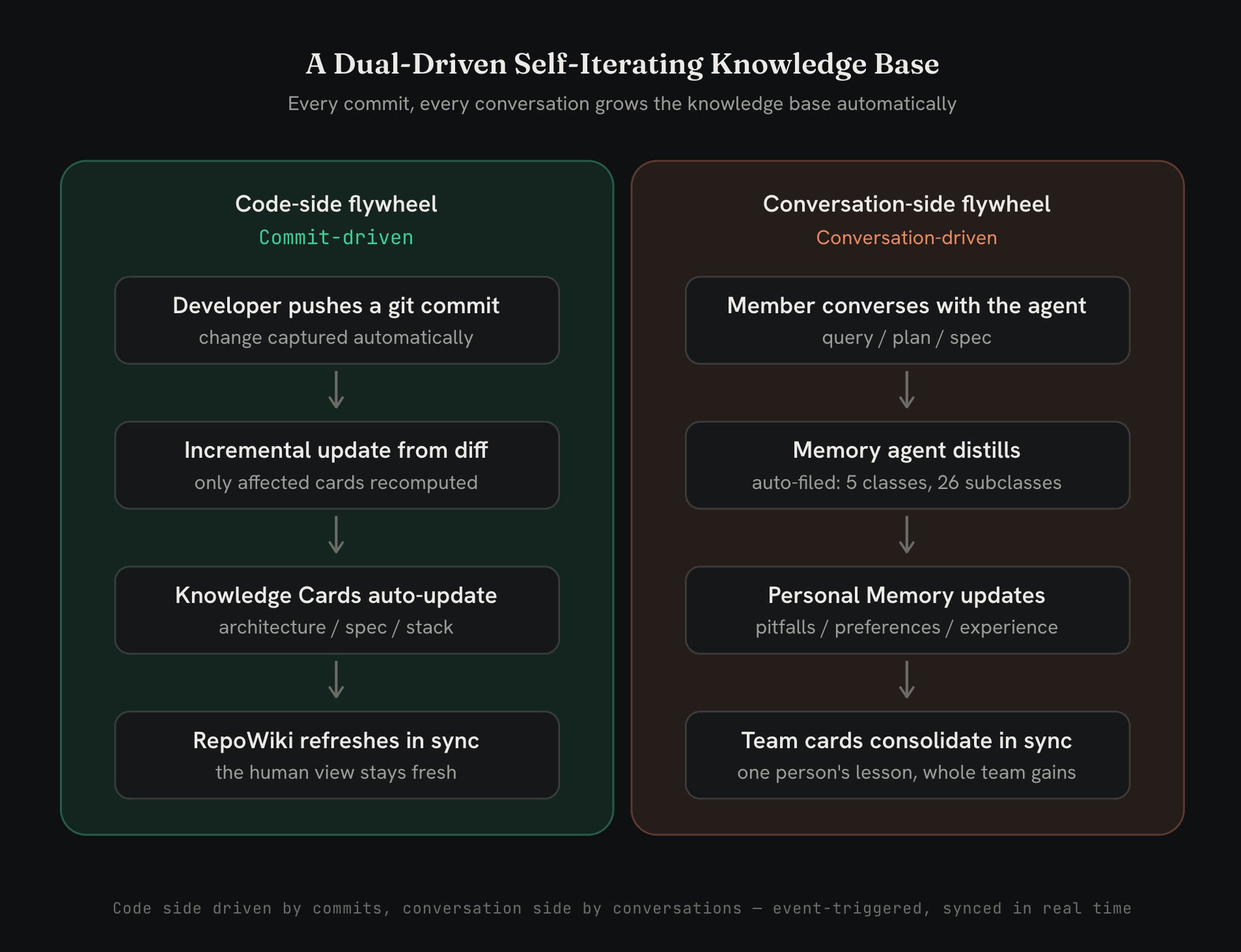
Each flywheel governs one side:
Putting the methods above into a system yields a six-layer capability stack—from low-level vector retrieval up to the top-level Agentic Search cognitive hub, with each layer doing its own job.
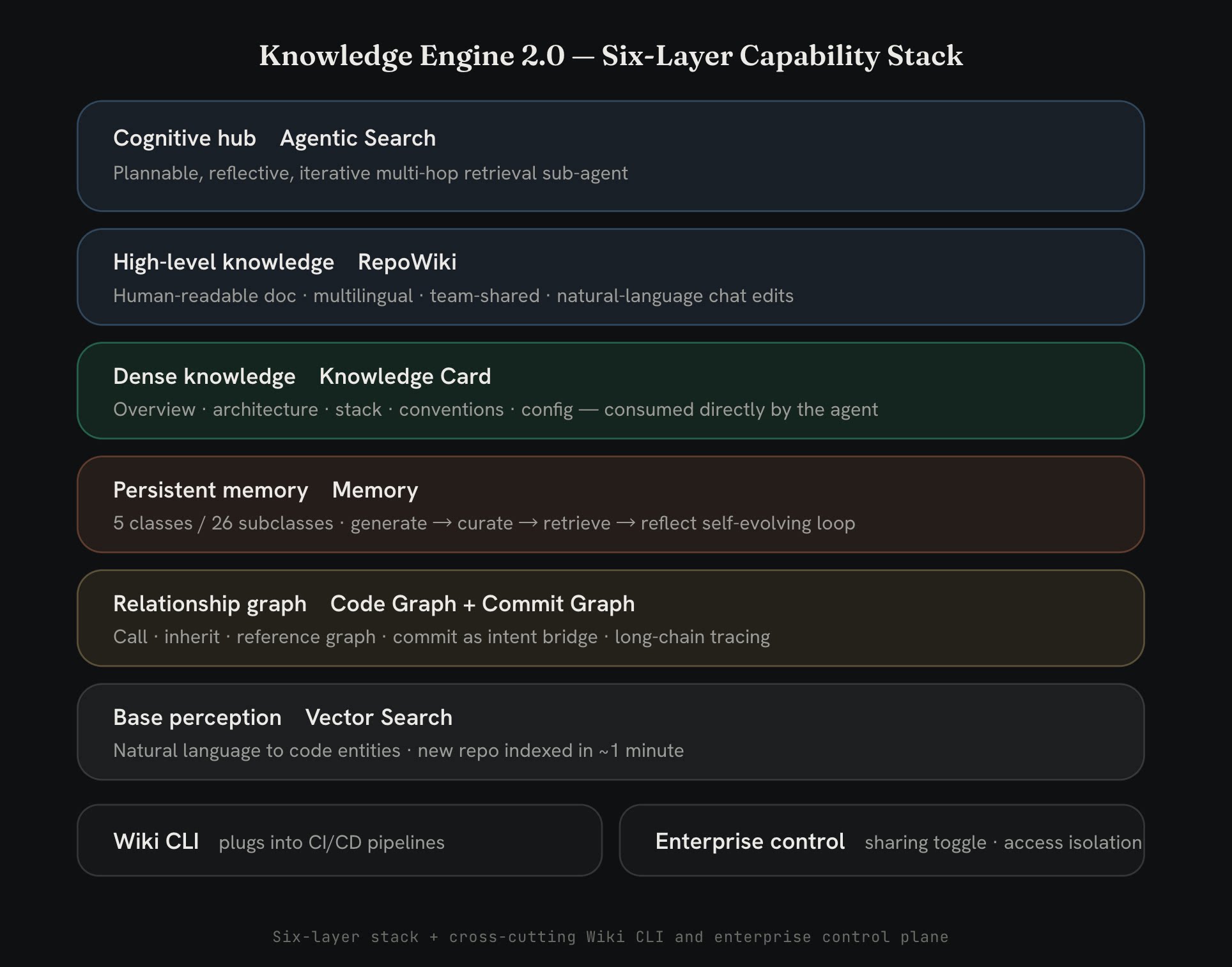
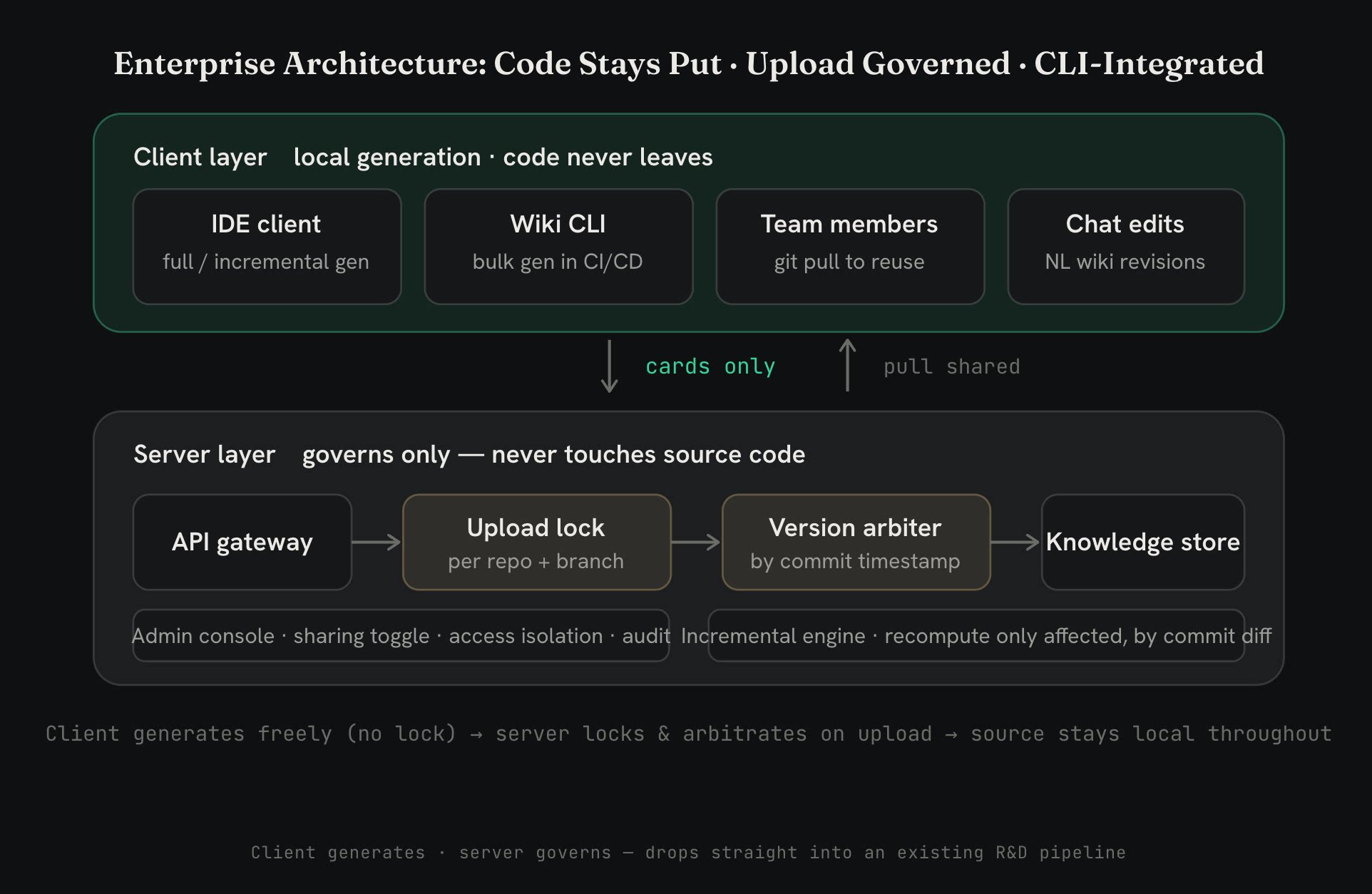
Enterprises face three real-world thresholds when using a knowledge engine: code security must not leave the perimeter, multi-person collaboration must not conflict, and the process must fit into the pipeline. Qoder Knowledge Engine 2.0 has an answer for each.
Code stays within the perimeter—client-side generation
Knowledge is generated locally on the client; the server can never access source code and only receives structured Knowledge Cards. Zero risk of leaking enterprise code assets.
Collaboration without conflict—version-lock arbitration
The server applies an upload lock at the repo + branch granularity, then uses commit-version arbitration so an older version never overwrites a newer one.
A process that integrates—Wiki CLI + sharing
The Wiki CLI batch-generates without an IDE and plugs into CI/CD; teams share via the .qoder/repowiki directory through git; administrators manage it centrally.
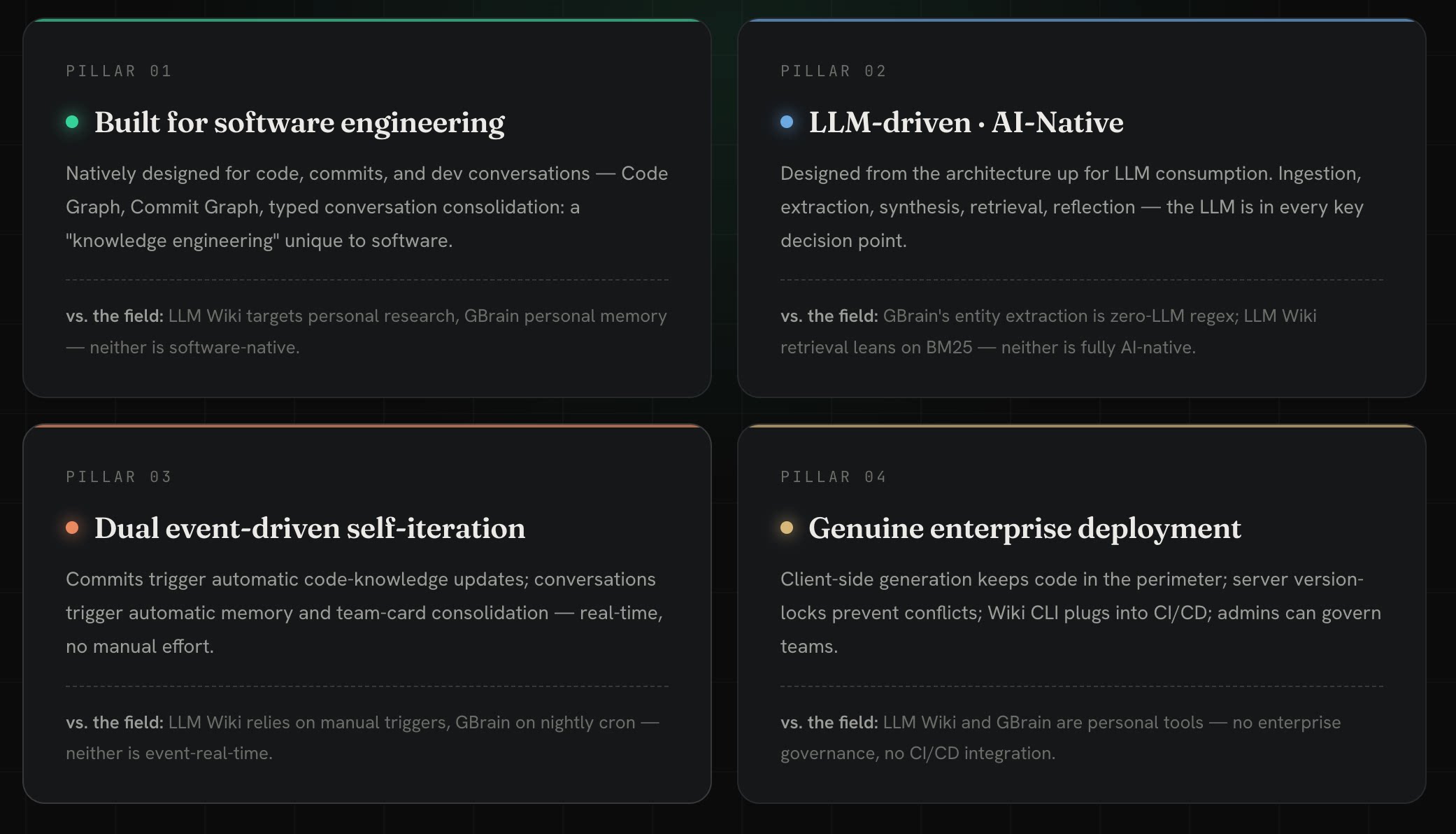
The industry's mainstream LLM Wiki and GBrain are both excellent general-purpose knowledge management tools. But Qoder Knowledge Engine 2.0 has achieved industry-leading results in the software engineering domain across four dimensions.
The most intuitive difference is the level of knowledge processing. Both LLM Wiki and GBrain use "one-step processing"—raw material becomes a Wiki directly; Qoder uses "two-step distillation"—raw signals first become Knowledge Cards, then RepoWiki.
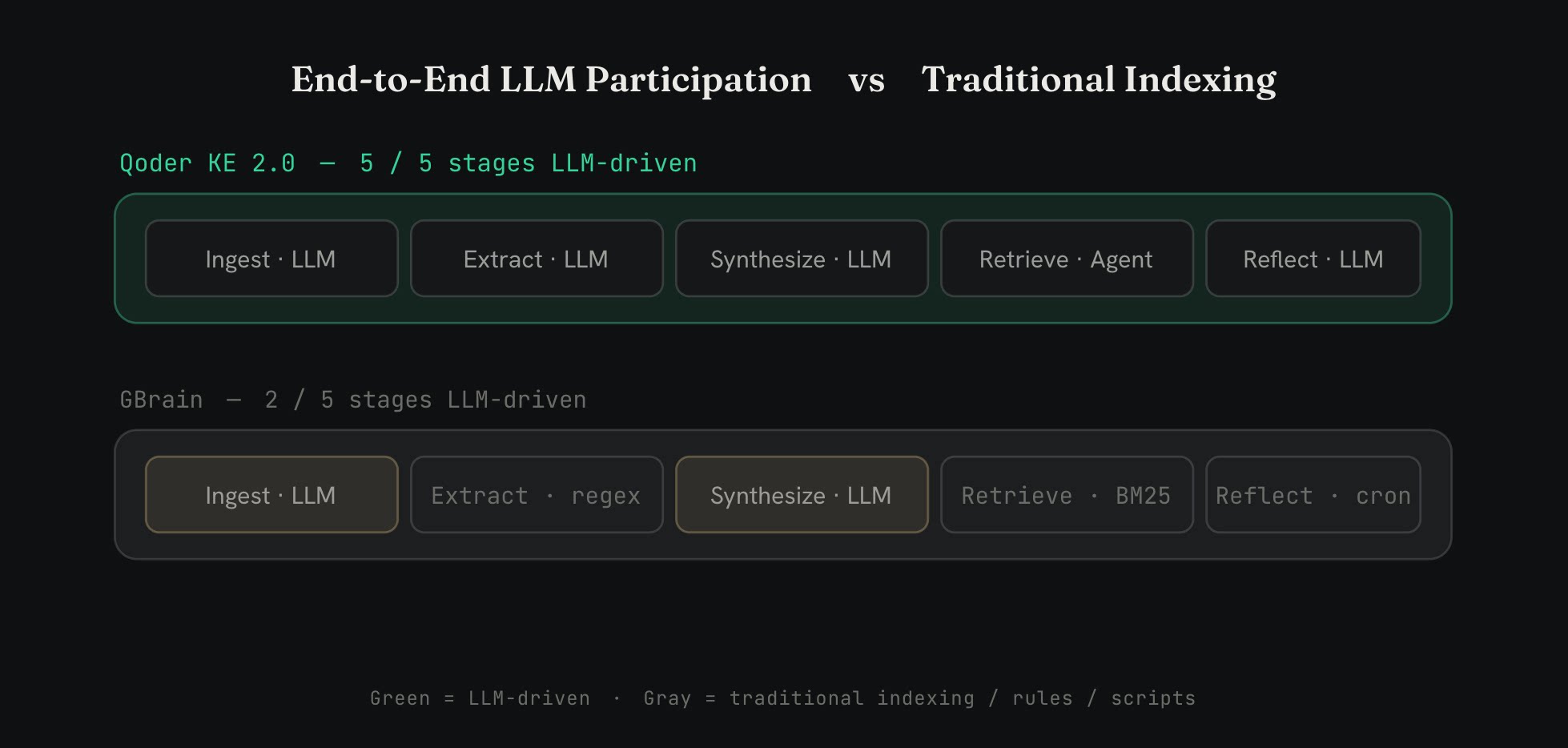
Among these, the AI-Native dimension is the easiest to underestimate. One of GBrain's publicly promoted core selling points is "zero-LLM-call entity extraction"—using regex to infer relationships, which is cheap and fast but lossy and can only recognize 5 preset relationship types; LLM Wiki's retrieval layer relies mainly on traditional indexes such as BM25. Qoder Knowledge Engine 2.0, by contrast, involves the LLM across the entire pipeline.
One self-assessment and one cross-comparison—two sets of data jointly verify that the Qoder Knowledge Engine isn't merely "a knowledge system that was built," but something that genuinely improves the Agent's task effectiveness and execution efficiency.
Centered on the real-world effectiveness of the Coding Agent, the Knowledge Engine accumulates three core kinds of knowledge—architecture, coding standards, and tech stack—providing support respectively across three layers: "system understanding," "code mergeability," and "runtime environment compatibility." End-to-end performance in typical software engineering scenarios is as follows.
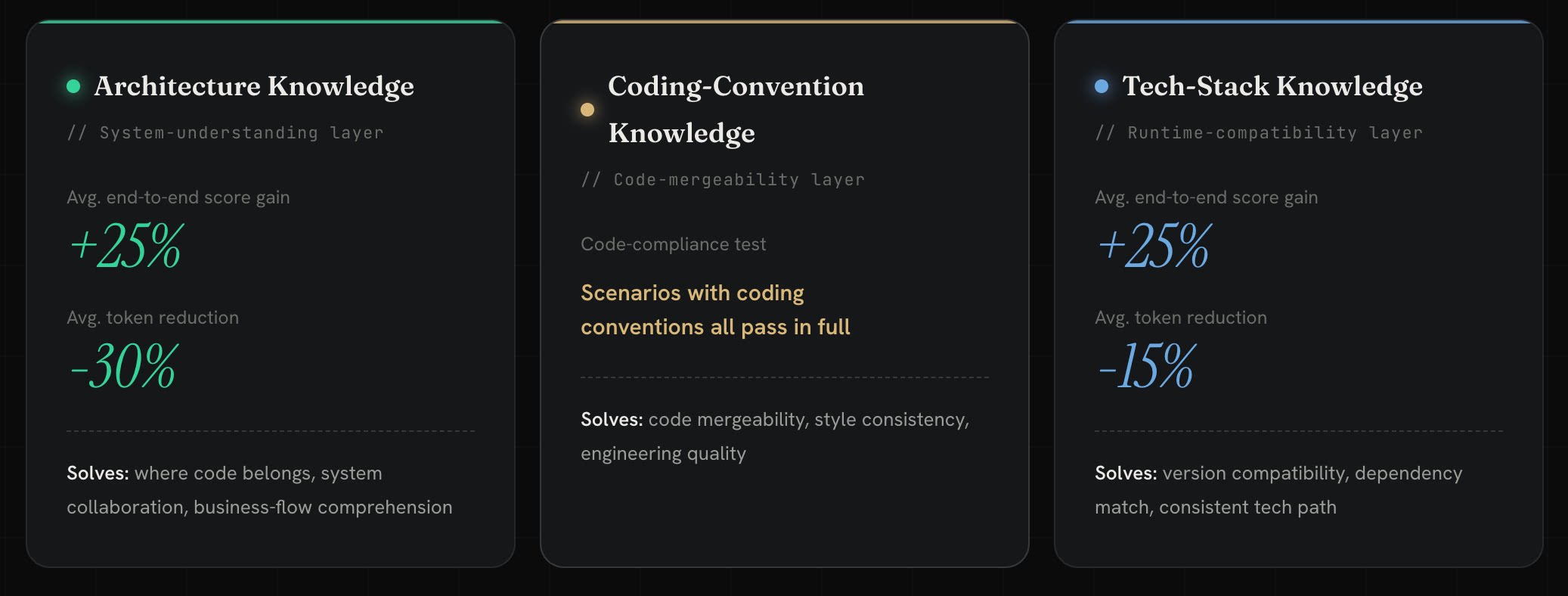
Additional note: after connecting the Knowledge Engine, all typical software engineering scenarios improved their end-to-end scores from different starting points to near a perfect 1.0—the lowest-starting scenario going from 0.28 straight to 1.0, demonstrating the quality of the knowledge.
Across multiple real code repositories, the Qoder Knowledge Center was compared side by side with comparable knowledge management tools, Graphify and GBrain. The results on three core metrics are as follows.
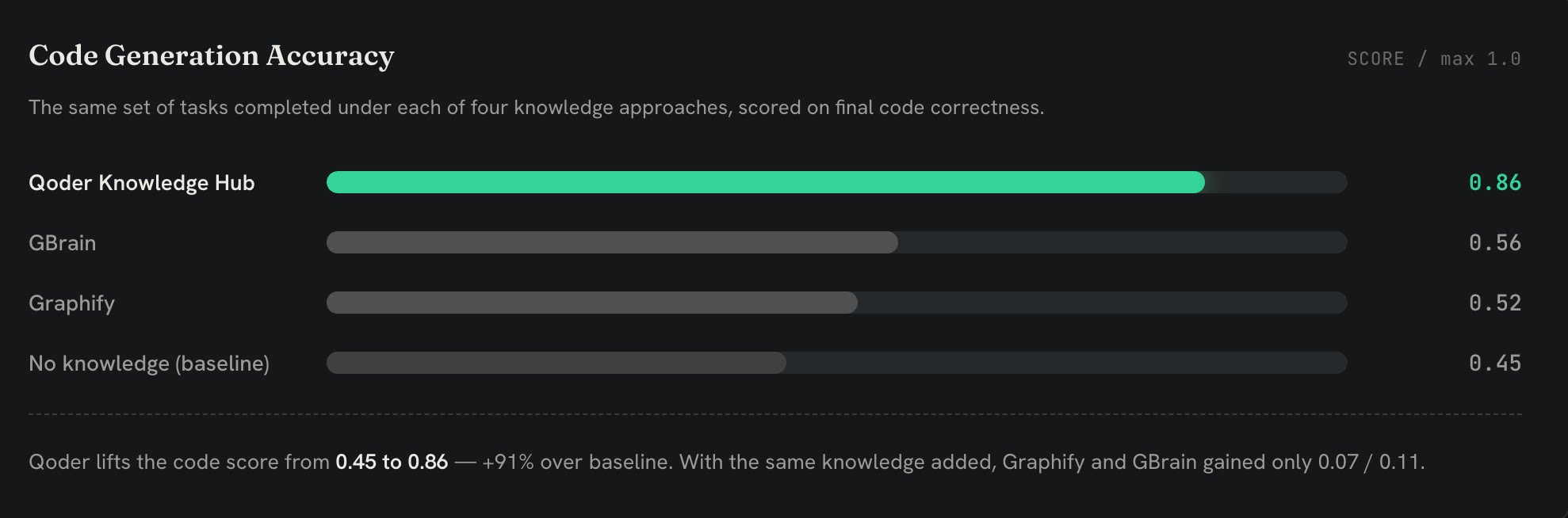
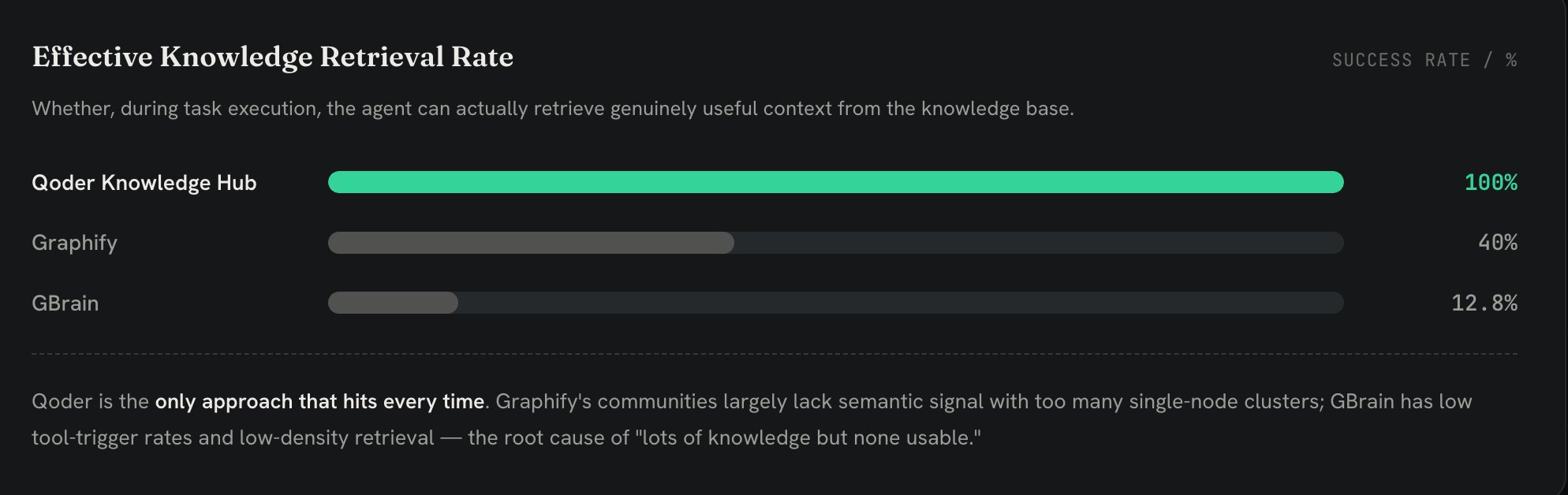
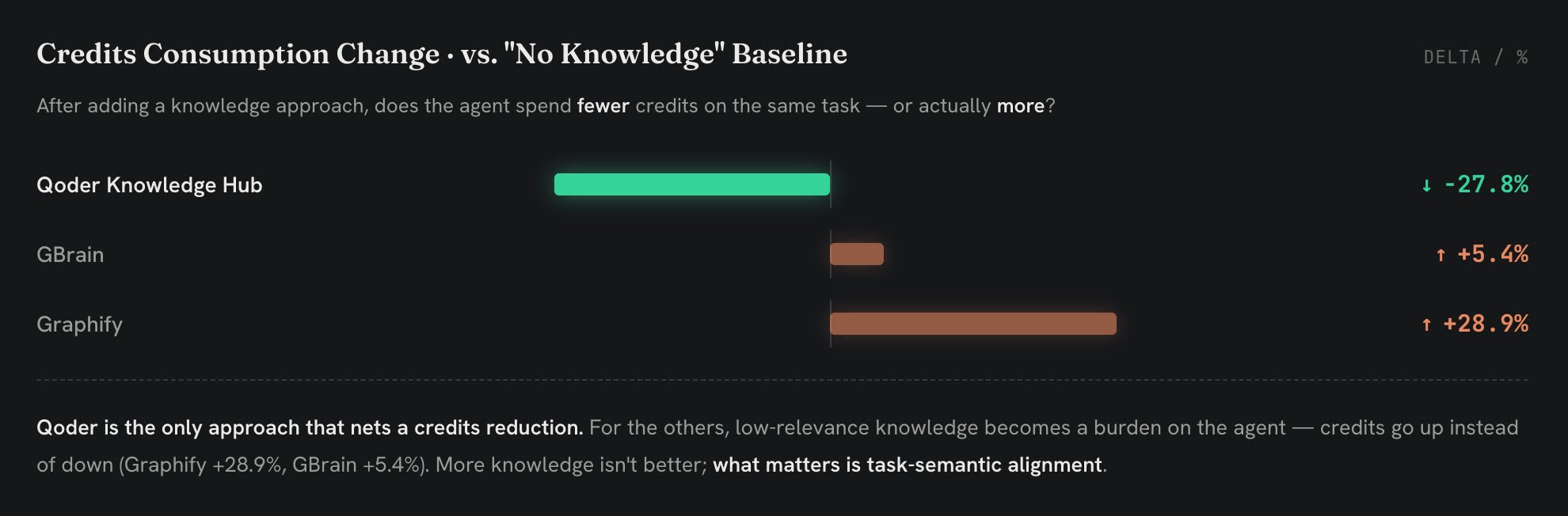
By structurally organizing software engineering knowledge that is aligned with task semantics, the Knowledge Center lets the Agent obtain highly relevant, low-noise contextual information during the retrieval stage—and this is exactly the fundamental difference that sets the Qoder Knowledge Engine apart from general-purpose knowledge management tools.
An AI-Native, self-iterating knowledge engine built for software engineering—it feeds the Agent structured Knowledge Cards while accumulating coherent RepoWiki for people; it updates automatically with every commit and learns automatically from every conversation; one person contributes and the whole team benefits—and it genuinely takes root in the enterprise, integration-ready out of the box.


1,495 posts | 509 followers
FollowAlibaba Container Service - February 25, 2026
Alibaba Cloud Data Intelligence - January 6, 2025
Alibaba Cloud Community - July 28, 2026
Alibaba Cloud Native Community - March 25, 2026
Alibaba Cloud Community - June 16, 2026
Alibaba F(x) Team - September 1, 2021
1,495 posts | 509 followers
Follow Token Plan
Build more, spend less. One plan, every modality.
Learn More
Alibaba Cloud Model Studio
A one-stop generative AI platform to build intelligent applications that understand your business, based on Qwen model series such as Qwen-Max and other popular models
Learn More YiDA Low-code Development Platform
A low-code development platform to make work easier
Learn More Qwen
Qwen
Full-range, open-source, multimodal, and multi-functional
Learn MoreMore Posts by Alibaba Cloud Community

