The AI paradigm shift has driven the rapid growth of AI-Native enterprises. These enterprises include AI startups, one-person companies, and innovation teams within traditional enterprises. They share the following characteristics and demands: First, they use AI Agents as a core capability to build new product moats. As Large Language Models (LLMs) become ubiquitous, AI context (including memory, knowledge, Agent Skills, etc.) becomes a valuable asset. Therefore, building an AI context foundation compatible with both Single-Agent and Multi-Agent architectures is critical. Second, they leverage AI to boost efficiency so humans can focus on business while AI achieves unmanned O&M. This requires the data foundation to Support context fencing for Agent sub-Job streams, automatic start and stop, and fallback guarantees when AI makes faults.
As Agent systems grow increasingly complex, the patch-based evolution of traditional data products has become inadequate. AgenticDB is a data foundation built on Alibaba Cloud AnalyticDB for PostgreSQL as its core, integrating AI application backend services and context Management. It helps enterprises quickly launch AI products to explore the marketplace, accumulate AI context to strengthen User stickiness and product competitiveness, accompany AI-Native enterprises through rapid growth, and ultimately stride into a new Future in the AI era.
For AI-Native enterprises at different stages of development, AgenticDB leverages its High-Performance retrieval-augmented generation DPI engine and global data lake warehouse to build an enterprise context hub. On top of a unified underlying technology stack, it provides different Version Features, ensuring AI-Native enterprises can launch quickly while also providing migration Solutions for advanced stages.
Launch (Edition):
Advanced version:
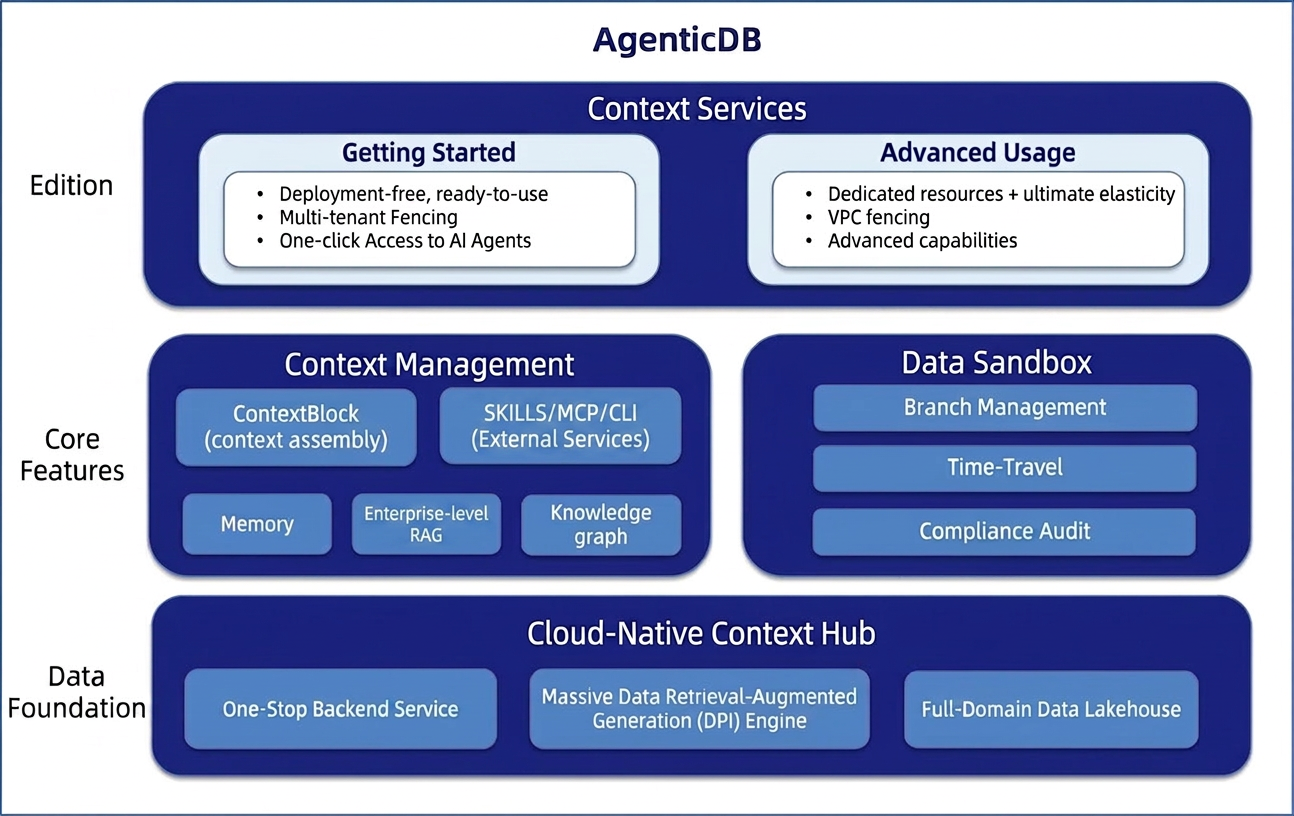
🔗 Data sandbox:https://www.alibabacloud.com/help/en/analyticdb/analyticdb-for-postgresql/data-sandbox-management
🔗 Context service: https://www.alibabacloud.com/help/en/analyticdb/analyticdb-for-postgresql/context-service
Scenario description: Focus on vertical scenarios to achieve efficient intelligent interaction with low resource consumption through flexible deployment and cost control for AI scenario exploration.
Core challenges: Fast iteration requires rapid deployment and publishing. Unpredictable traffic peaks are encountered, while operational costs are extremely sensitive, demanding the best cost-effectiveness.
AgenticDB Solutions:
Application Setup:
Context Service:
Scenario: An enterprise agent platform is typically a complex system composed of multi-agents.
Core JavaScript Challenge: In large-scale multi-agent systems, complex sub-job streams cause intertwined contexts, requiring both Strict fencing mechanisms and Shared Feature capabilities.
AgenticDB Solutions:
Context Management
Data Sandbox:
Scenario description:
Core JavaScript Challenge: Each Vibe Coding application requires an independent fencing environment base, causing Cost to surge dramatically. Traditional databases lack version management capabilities comparable to Code.
AgenticDB Solution:
Branch Management:
One-Stop Backend Service:
Launch phase:
Advanced lossless migration: As your business scales and requires high concurrency, strict fencing, and advanced customization, you can seamlessly migrate from the managed service pattern to dedicated resources. The same underlying architecture ensures consistency of data formats and interface protocols. The migration procedure requires zero code changes and zero data loss, achieving a smooth transition from getting started to advanced at the lowest cost.
Supports memory data classification
Enterprise knowledge base
Update frequency:
Context assembly: Assembles contexts through ContextBlock to implement class file system management, with modular encapsulation of retrieval-augmented generation, memory, and skills. This enables contexts to be managed, retrieved, and shared like files, improving the modularity, collaboration, and security of agents.
Agent bootstrapping: Agent skills in procedural memory undergo iterative optimization, such as removing redundant steps and fixing fault logic.
High-speed branch Management: Creates branches within milliseconds for the same copy of data based on Copy on Write technology. Supports multilayer sub-branch creation. Each branch has an independent environment and fencing Status, ensuring parallel jobs do not interfere with each other. Supports deriving new branches from the main branch (MAIN) at any specified point in time, perfectly adapting to parallel exploration and hypothesis authentication scenarios for agents.
Agile Reset and recover: Provides fine-granularity Fault Tolerance mechanisms. When branch data is contaminated or logic errors occur, you can one-click Reset the Status from the parent branch, or directly discard the current branch and recreate it. This greatly reduces agent trial-and-error Cost and ensures business continuity.
Time-Travel: Supports point-in-time "data travel" queries. Multi-Agent systems can obtain data snapshots and Status context at any historical moment to implement cross-time Status comparison, review, and decision optimization.
Full-link compliance Audit: Built-in multi-Version data retention mechanism that completely records data change history. Supports full data backtracking and operation log audit to meet enterprise-level Security compliance requirements and ensure that every agent decision is documented.
Supports Serverless one-stop backend service. AI agents can directly invoke resources such as databases, Auth, Storage, and Edge Functions without manual configuration or debugging. Fully managed and O&M-free.
Supports hybrid indexes combining graph and partition indexes (NOVA Disk), with built-in quantization compression algorithms such as PCA, PQ, and RaBitQ, and asynchronous write + merge query read/write pattern. Outperforms mainstream open source competitors across multiple dimensions including query retrieval, index build, real-time write/update/delete performance, storage cost, and efficiency.
As the AI Agent era arrives, the AI-Native agile enterprise development pattern is becoming an industry trend. Traditional data infrastructure constrains AI-Native enterprises from realizing their potential, rapidly expanding into the marketplace, and building secure, isolated, traffic-aware AI context infrastructure after reaching maturity. AgenticDB focuses on context storage, security, management, and application to provide full-lifecycle product capabilities for AI-Native enterprises at different development stages, helping them build a product moat in the AI era. AgenticDB is now officially open for invitational preview. We sincerely invite AI-Native enterprises and organizations to use it and build the new data infrastructure for the AI era. We believe that more highly secure, user-aware super AI applications will emerge in the future, reaching every corner of society and industry.
PolarDB-X Optimizer Tips | Incremental Prediction of Time Columns in Statistics
Fully-managed PolarDB-X Mem0 Service: Enabling Infinite AI Memory Extension and Dual-Use Integration
ApsaraDB - October 24, 2025
ApsaraDB - March 29, 2026
ApsaraDB - February 7, 2025
Alibaba Cloud Community - May 28, 2026
ApsaraDB - February 20, 2021
Alibaba Cloud New Products - August 10, 2020
 AnalyticDB for PostgreSQL
An online MPP warehousing service based on the Greenplum Database open source program
Learn More AnalyticDB for MySQL
AnalyticDB for MySQL is a real-time data warehousing service that can process petabytes of data with high concurrency and low latency.
Learn More Vector Retrieval Service for Milvus
A cloud-native vector search engine that is 100% compatible with open-source Milvus, extensively optimized in performance, stability, availability, and management capabilities.
Learn More PolarDB for PostgreSQL
Alibaba Cloud PolarDB for PostgreSQL is an in-house relational database service 100% compatible with PostgreSQL and highly compatible with the Oracle syntax.
Learn MoreMore Posts by ApsaraDB


