Cloud Backup provides three backup methods for Elastic Compute Service (ECS) instances: ECS File Backup Essential Edition, ECS Backup Essential Edition, and standard backup features. You can switch from ECS File Backup Essential Edition or ECS Backup Essential Edition to the standard backup features as needed.
For more information, see Feature comparison of Different ECS backup editions.
Switching scenarios
You can switch from ECS File Backup Essential Edition or ECS Backup Essential Edition to the standard backup features as needed.
If you use ECS Backup Essential Edition and the amount of protected source data on your ECS instance approaches 500 GB, you can switch from ECS Backup Essential Edition to the standard backup features.
Each subscription ECS Backup Essential Edition instance can protect up to 500 GB of data on an ECS instance. This limit applies only to the total size of source files for File Backup and source databases for Database Backup. This limit does not include the size of ECS instance backups. If you exceed this limit, your backup jobs will fail.
If you use ECS File Backup Essential Edition and require more flexible file backup policies, such as changing the backup frequency or retention period, or need enterprise-level features such as virus detection for backup points or cross-region backup, you can switch from ECS File Backup Essential Edition to the standard backup features.
ECS File Backup Essential Edition provides only basic file backup and recovery features.
Switch from ECS Backup Essential Edition to standard backup features
If the amount of protected source data on your ECS instance approaches 500 GB, you can switch from ECS Backup Essential Edition to the standard backup features. The standard backup features allow you to create separate backup jobs for ECS files, ECS-hosted databases, and ECS instances. Alternatively, you can reduce the number of files and databases in your backup plan.
If you do not want to switch to the standard backup features to create independent backup jobs for ECS files, ECS-hosted databases, and ECS instances, you can reduce the number of files and databases that you back up. For more information, see Back up and restore data.
Switching Instructions
Each subscription ECS Backup Essential Edition instance can protect up to 500 GB of data on an ECS instance. This limit applies only to the total size of source files for File Backup and source databases for Database Backup. This limit does not include the size of ECS instance backups. If you exceed this limit, your backup jobs will fail.

You have the following options:
Reduce the number of files and databases to be backed up.
Switch to the standard backup features to back up ECS files, ECS-hosted databases, and ECS instances independently. After you switch, new billable items are generated. This switch introduces new pay-as-you-go billable items. The snapshot size fee for ECS instance backup is still charged by ECS and remains unchanged. For more information, see Billing methods and billable items of Cloud Backup.
ECS File Backup: Includes a software usage fee for one file backup client and a fee for backup storage usage.
Database Backup: Includes a rental fee for one data backup repository and a fee for database backup storage usage.
ECS instance backup: Includes a software usage fee charged by Cloud Backup and a snapshot size fee charged by ECS.
You can purchase a resource plan to receive discounts and reduce costs.
Step 1: Unbind the subscription ECS Backup Essential Edition instance
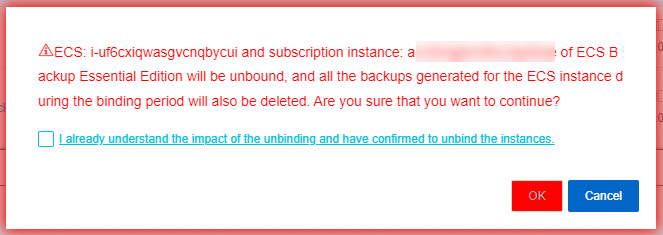
When you unbind a subscription ECS Backup Essential Edition instance from an ECS instance, all backups created for the ECS instance during the binding period are deleted.
Log on to the Cloud Backup console.
In the navigation pane on the left, choose .
In the upper-left corner of the top menu bar, select a region.
On the ECS Backup Essential Edition page, find the target ECS instance, and in the Actions column, choose .
Read the notes in the dialog box, select I already understand the impact of the unbinding and have confirmed to unbind the instances., and click OK.
After the instance is unbound, it is no longer displayed on the ECS Backup Essential Edition page. After you unbind the subscription ECS Backup Essential Edition instance from the ECS instance, all backup data that was previously generated for the ECS instance is deleted.
(Optional) Step 2: Unsubscribe from the subscription ECS Backup Essential Edition instance
You can use the unbound subscription ECS Backup Essential Edition instance to back up other ECS instances. If you no longer need the subscription instance, you can unsubscribe from it.
Alibaba Cloud charges you for the actual duration of use and refunds the fees for the unused subscription period.
Log on to the Cloud Backup console.
In the navigation pane on the left, choose .
In the upper-left corner of the top menu bar, select a region.
On the ECS Backup Essential Edition page, click View Subscription Instances.
In the View Subscription Instances panel, find the subscription instance that you want to unsubscribe from, and in the Actions column, click Unsubscribe.
On the Unsubscribe page that opens, follow the on-screen instructions to unsubscribe from the resource.
Step 3: Start using the standard backup features
You can start backing up ECS files, ECS-hosted databases, and ECS instances independently.
Back up ECS files (New) independently.
Back up ECS-hosted databases independently.
Back up ECS instances independently.
Switch from ECS File Backup Essential Edition to standard backup features
If you require more flexible file backup policies, such as changing the backup frequency or retention period, or need enterprise-level features such as virus detection for backup points or cross-region backup, you can switch from ECS File Backup Essential Edition to the standard ECS File Backup (New) feature.
Step 1: Pause backups for ECS File Backup Essential Edition
After you pause backups, Cloud Backup will not execute subsequent backup jobs. Existing backup versions and backup points are not affected. They automatically expire after the 30-day retention period. If you enabled the feature that retains at least one backup version, the last backup version is not affected by the 30-day retention period.
If backup versions still exist for the ECS instance after you pause backups, you will continue to be charged for the instance.
Log on to the Cloud Backup console.
In the navigation pane on the left, choose .
At the top of the ECS File Backup Essential Edition page, select the region where the target ECS instance is located.
In the Actions column of the instance, click Pause Backup.
In the dialog box that appears, click OK to pause periodic backups.
Step 2: Start using ECS File Backup
Use the ECS File Backup (New) feature to independently back up your files, and complete at least one backup job to generate a usable backup version.
Step 3: Cancel backups for ECS File Backup Essential Edition
When you cancel backups for an ECS instance, Cloud Backup deletes all backup points for the instance, stops billing, and removes the ECS instance from the backup list.
Canceling backups deletes all existing backup points. Before you cancel backups in ECS File Backup Essential Edition, make sure that you have generated a usable backup version as described in Step 2: Start using ECS File Backup. This ensures that you have backup data available for recovery. If you cancel backups before you create a new one, you cannot restore data in the event of data loss.
This operation permanently deletes all backup points, and they cannot be recovered. Before you proceed, confirm that the new backup plan is running as expected and you no longer need the old backup data.
At the top of the ECS File Backup Essential Edition page, select the region where the target ECS instance is located.
In the Actions column of the instance, click Cancel Backup. Alternatively, click View Details and then click Cancel Backup to the right of Backup Running Status.
In the dialog box that appears, click OK to cancel backups for the instance.