You can perform a hot migration to migrate an ACK basic cluster to an ACK Pro cluster without interrupting services or affecting the normal operation of the cluster. After the migration is complete, it cannot be rolled back.
Why migrate to ACK Pro
ACK Pro clusters are built on ACK basic clusters and designed for large-scale production environments. They provide enhanced security and reliability and are covered by service level agreements (SLAs) that include compensation clauses.
ACK basic clusters have the following limitations:
-
A maximum of 2 clusters per account.
-
A maximum of 10 nodes per cluster.
-
No guaranteed availability for the control plane.
These clusters are intended primarily for personal learning and testing. To increase your cluster size and ensure high availability of the control plane, we recommend that you migrate to an ACK Pro cluster. For more information about the differences, see Cluster types.
Usage notes
|
Item |
Description |
|
Billing |
After you migrate an ACK basic cluster to an ACK Pro cluster, you are charged cluster management fees. The billing of other cloud resources remains unchanged. |
|
Kubernetes version |
Only clusters that run Kubernetes 1.18 or later are supported. After the migration, the Kubernetes version of the cluster remains unchanged. For more information, see Support for Kubernetes versions. |
|
Rollback |
Cluster migration does not support rollback. You cannot migrate an ACK Pro cluster back to an ACK basic cluster. If the migration fails, the system automatically rolls back the cluster. |
If you want to both migrate and upgrade, migrate the cluster first and then upgrade the Kubernetes version separately.
Procedure
The migration process consists of two phases: a precheck and the cluster migration. An ACK basic cluster must pass the migration precheck before it can be migrated to an ACK Pro cluster.
If the cluster fails to pass the precheck, follow the on-screen instructions to go to the details page and view further information about the failure.
-
Log on to the Container Service Management Console . In the navigation pane on the left, click Clusters.
-
On the Clusters page, find the ACK basic cluster that you want to migrate and choose in the Actions column.
-
In the dialog box that appears, read the notes and click precheck.
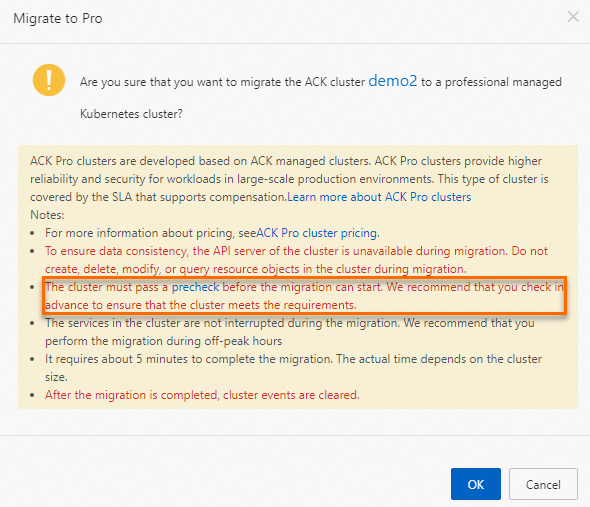
After you click precheck, you are redirected to the Container Intelligent Service (CIS) console. Click Start and follow the instructions to run a precheck on the cluster. If the cluster fails to pass the precheck, follow the instructions on the Migration Check page to view further information about the failure.
-
After the cluster passes the precheck, read the notes in the dialog box and click OK.
After the migration is complete, the Cluster Specification column for the cluster on the Clusters page changes from Basic to Professional.
FAQ
Are the services in the ACK basic cluster affected during the migration?
During the migration, the control plane components of the ACK basic cluster enter a dormant state. Running services are not affected.
How long does the migration take?
The migration includes three stages: the control plane enters a dormant state, etcd data is backed up, and the control plane components are started. The overall process takes approximately 10 to 15 minutes. During this time, the cluster is expected to be unavailable for 5 to 10 minutes.
Does the cluster access endpoint change after the migration?
After the migration, the IP address of the SLB instance associated with the Kubernetes API server does not change. When you use the kubeconfig file to access the cluster, the IP address remains the same.
What to do next
-
Upgrade the Kubernetes version of your migrated cluster.
-
Manually limit the permissions of the worker RAM role assumed by nodes in the cluster to enhance node security.