Create cloud-based IDE instances for AI development with JupyterLab or VS Code, configure resources, storage, and networking options.
Quick start
-
Log on to the PAI console, select a Region, click Workspaces in the left navigation pane, and select your workspace.
-
Click Interactive Modeling (DSW) > Create Instance. Configure these parameters (leave others at defaults, see Console parameters for all parameters):
Parameter
Description
Instance Name
Example:
dsw_test.Resource Type
Select Public Resources (pay-as-you-go billing).
Instance Type
Example:
ecs.gn7i-c8g1.2xlarge(1 × A10 GPU, 8 vCPUs, 30 GiB memory).If out of stock, select another instance type.
Image config
Select Alibaba Cloud Image, then search for and select
modelscope:1.31.0-pytorch2.8.0-gpu-py311-cu124-ubuntu22.04(Python 3.11, CUDA 12.4).ModelScope images offer broad compatibility and comprehensive third-party libraries.
Click OK. When the status changes to Running, the instance is ready.
If the instance fails to start, see Instance start failures.
-
Find the instance on the list page and click Open in the Actions column to open the IDE.
For more instance operations, see Access and manage DSW instances in the console.
-
DSW instances with public resources start incurring runtime charges as soon as they enter the running state, even if you don't open WebIDE or run code. Stop or delete the instance when not in use to avoid charges.
-
The system disk for this instance is a free cloud disk. If the instance remains stopped for more than 15 consecutive days, data on the cloud disk is permanently deleted and cannot be recovered. Back up important data or mount cloud storage to transfer data.
Common configuration scenarios
A basic instance might not meet all AI development needs. Configure additional features for specific use cases:
|
Use case |
Need |
Configuration |
Documentation |
|
Persistently store code and data |
System disks provide temporary storage only. Data is deleted when instances are deleted or remain stopped for extended periods. Save important files for long-term use or share data between instances. |
Mount cloud storage via Dataset Mounting or Mount storage (OSS, NAS, or CPFS) to a folder on the instance. |
Mount a dataset, OSS bucket, NAS file system, or CPFS file system |
|
Increase public network download speed |
DSW instances use a shared gateway by default. Bandwidth limitations might cause slow downloads for large files. |
Configure a VPC and use a Private Gateway. Requires a NAT Gateway and EIP for the VPC. |
Use a dedicated gateway to increase the public network access speed |
|
Develop remotely using SSH |
Develop with local tools like VSCode or PyCharm instead of web-based IDE. |
Select Enable SSH, enter your SSH Public Key, and select Access over Internet. Associate an existing NAT Gateway and EIP. |
|
|
Access web services within the instance |
Publish a web application running inside the instance to the public internet. |
Add a Custom Services, configure the service port, and enable public network access. Add an inbound rule to the security group for that port. |
Console parameters
Basic information
|
Parameter |
Description |
|
Instance Name |
Enter a unique descriptive name for the instance. |
|
Tag |
Add tags based on business needs for search, location, batch operations, and billing. |
Resource information
|
Parameter |
Description |
|
Resource Type |
|
Environment information
|
Parameter |
Description |
|
Image Configuration |
Supported image types:
|
|
System Disk |
Stores files during development. When Resource Type is Public Resources, or when Resource Quota uses subscription general computing resources (CPU cores ≥ 2 and memory ≥ 4 GB, or with GPU), each instance gets a free 100 GiB disk. Disk can be expanded at console-listed prices. Warning
For permanent storage, configure Dataset Mounting or Mount storage. |
|
Dataset Mounting |
Stores datasets for reading or persists files created during development. The following two dataset types are supported:
Mount Path: The path where the dataset is mounted in the DSW instance, for example, Note
For more information about mounting, see Mount a dataset, OSS bucket, NAS file system, or CPFS file system. |
|
Mount storage |
Use storage mounting to access datasets or persist files.
For more information about mounting, see Mount a dataset, OSS bucket, NAS file system, or CPFS file system. |
|
Working Directory |
The startup directory for JupyterLab and the Web IDE. The default is |
Network information
|
Parameter |
Description |
|
VPC Settings |
This parameter is available only when Resource Type is set to Public Resources. To use a DSW instance within a Virtual Private Cloud (VPC), create a VPC in the same region as the DSW instance and configure this parameter. You also need to configure a vSwitch and a Security Group. For details on configuration policies for different scenarios, see Network configuration. |
|
vSwitch |
This parameter can be configured when a VPC is configured. A vSwitch is a subnet within a VPC. Your DSW instance and other cloud resources connect to the vSwitch. |
|
Security Group |
This parameter is required when a VPC is configured. A security group is a virtual firewall for a DSW instance. It controls all inbound and outbound network traffic. |
|
Internet Access Gateway |
The following configuration methods are supported:
The following parameters are available only when a CPFS dataset is mounted:
Note
If a CPFS dataset is mounted, you must configure a VPC, and the selected VPC must be the same as the one used by CPFS. |
|
Extended CIDR Block |
This parameter can be configured after you configure a vSwitch. If the number of available IP addresses in the VPC is insufficient for your growing business, or if the initial network planning resulted in an address shortage, you can use an extended CIDR block to expand the VPC address space. For more information, see Use a secondary CIDR block. |
Access configuration
|
Parameter |
Description |
|
Enable SSH |
For remote connection to the instance. This option is available only after you select a VPC. When enabled, a Custom Services named SSH appears. If you use a custom image, ensure that |
|
SSH Public Key |
You can configure this parameter after turning on the SSH Configuration switch. Note
To support both VPC and public network login, add public keys from multiple clients. Add each public key on a new line. You can add up to 10 public keys. |
|
Custom Services |
Used to configure SSH remote access or access services in an instance over the Internet.
|
|
Create Private Zone in VPC |
Creates an internal authoritative domain (PrivateZone). Use this domain within the VPC to access the instance's SSH service or other custom services, which avoids the inconvenience of a changing instance IP address. Creating a PrivateZone domain incurs charges. For more information, see Alibaba Cloud DNS Product Billing. |
|
NAT Gateway |
When accessing a service in the instance from the public network, this gateway maps public requests ( |
|
EIP |
Provides a public IP address for accessing services in the instance from the public network. |
Roles and permissions
|
Parameter |
Description |
|
Visibility |
Choose Visible to the Instance Owner or Visible to Current Workspace. |
|
Instance Owner |
Only the workspace administrator can change the instance owner. |
Troubleshooting
Instance start failures
Q: How can I diagnose and fix DSW instance startup failures?
First, check the Events tab on the instance details page for specific error messages. Common errors and their solutions are listed below.

The following are common errors and their solutions:
-
-
-
-
-
-
-
Cause: This error indicates your system disk is full. You can check disk usage in the DSW terminal:
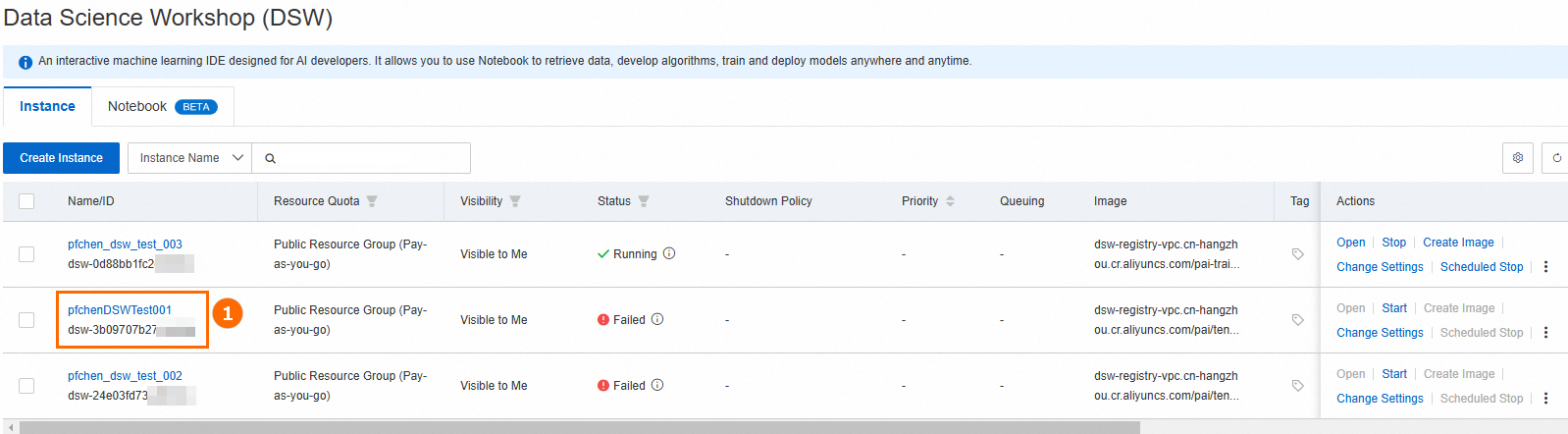
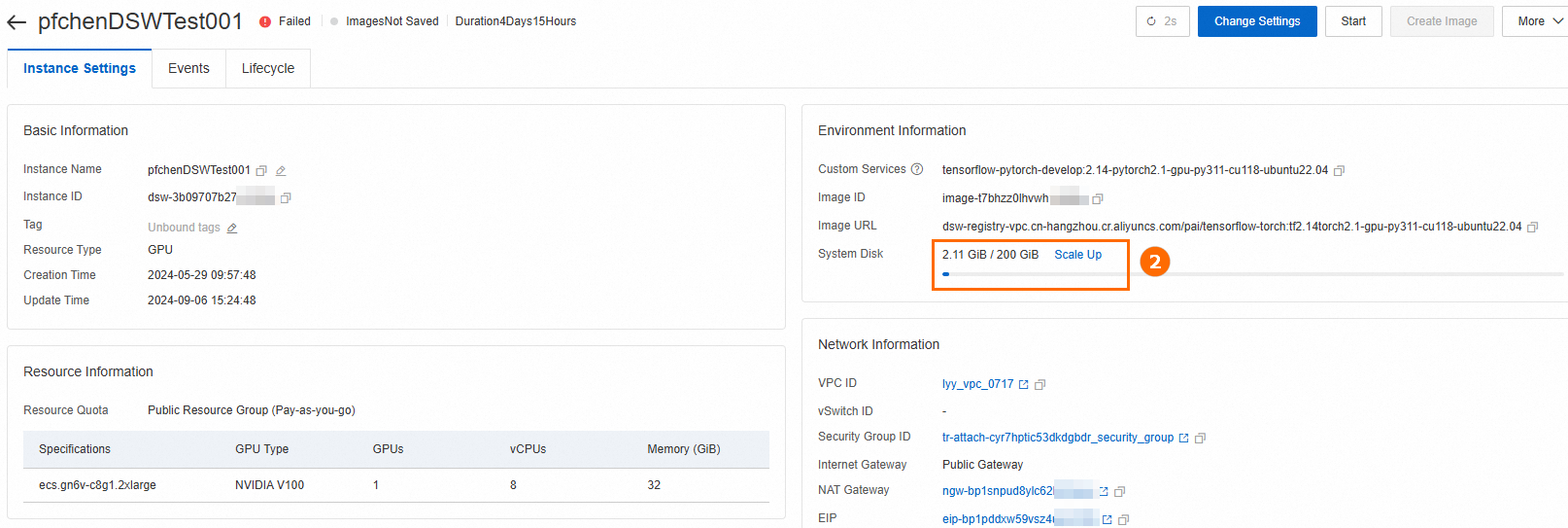
-
Solution: Expand the system disk. Go to the instance details page and use the Change Configuration feature.
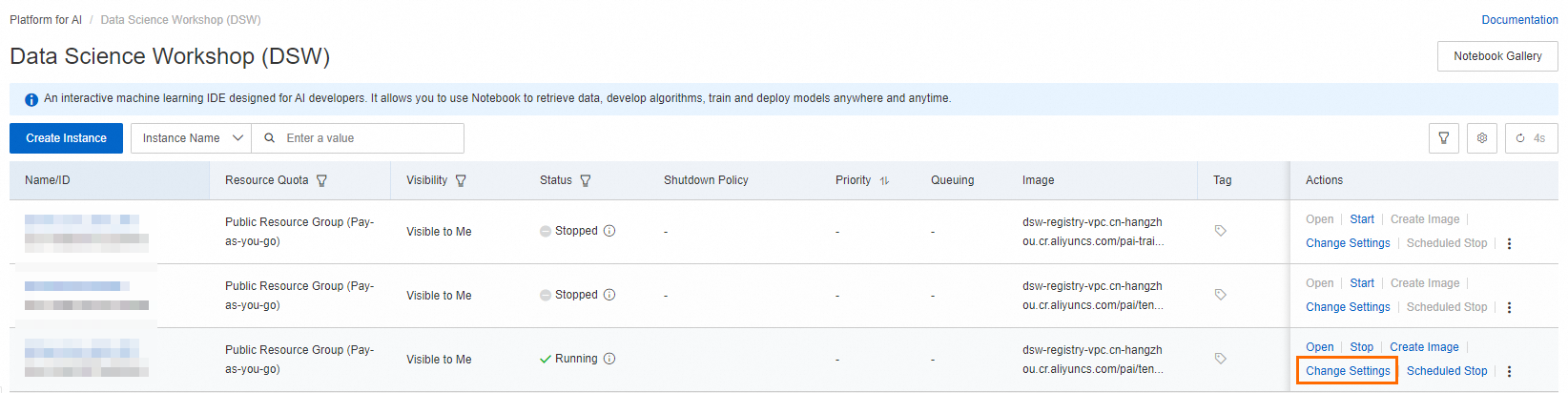 Important
An expanded system disk incurs continuous billing even when the instance is stopped. To stop all billing, delete the instance. Back up all necessary data before deletion.
-
-
-
-
-
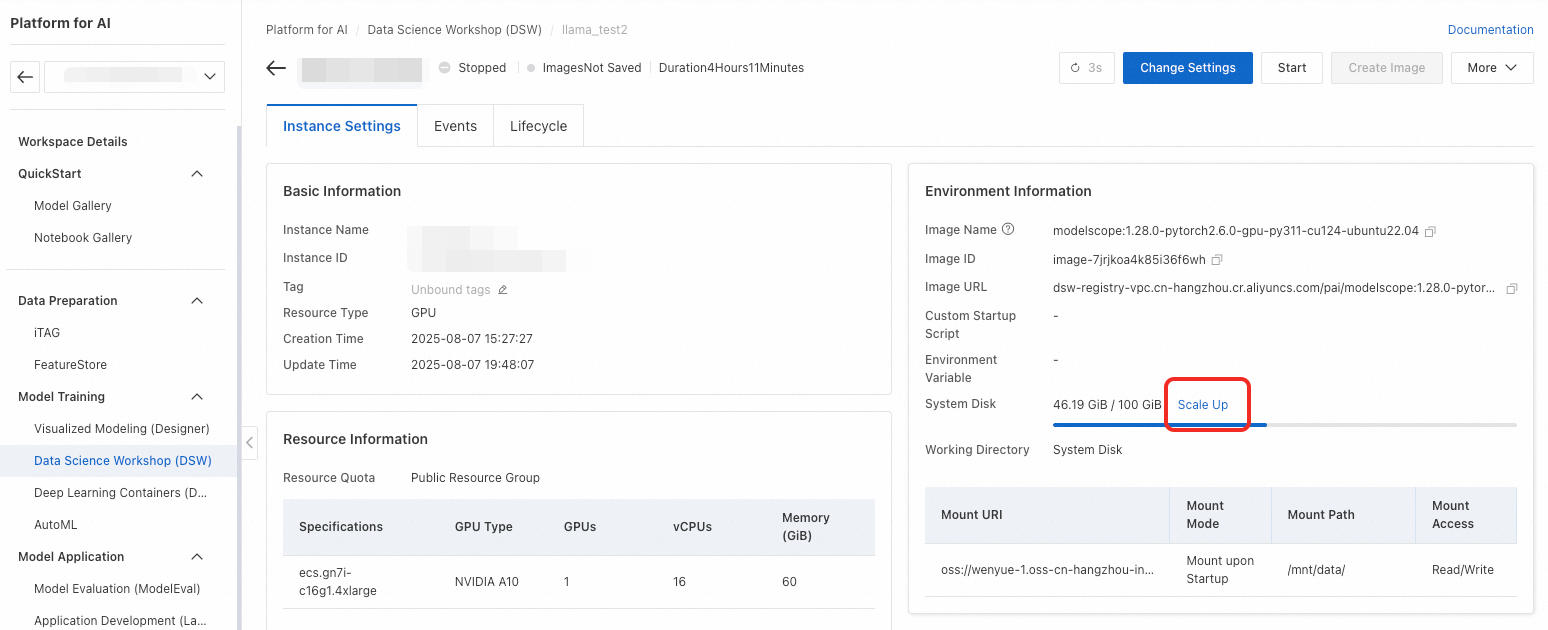
Cause: The image used for the instance is too large for the current system disk size.
-
Solution: Expand the system disk using the Change Settings feature on the instance details page. This incurs additional storage charges.
-
-
Q: What should I do when resources are out of stock or quotas are insufficient?
Common errors:
-
"Your requested resource type [ecs.******] is currently unavailable" (Out of stock).
-
"Your resource usage has exceeded the default limitation" (The two-GPU limit per region has been exceeded).
-
"The cluster resources are fully utilized" (All available computing resources are in use).
Causes:
-
Insufficient public resource inventory
-
Public resources are shared among multiple users. The inventory may be low during peak hours.
-
Specific GPU types, such as high-end GPUs, are more likely to be out of stock.
-
Each account is limited to two GPUs per region.
-
-
Insufficient dedicated resource quota
-
The purchased dedicated resource quota is exhausted.
-
Ineffective quota allocation results in an insufficient quota for a workspace.
-
Solutions:
-
Change specification: If the selected GPU type is out of stock, select a different one.
-
Switch region: In the upper-left corner of the PAI console, switch to another region and create an instance there.
-
Increase GPU quota: To use more than two GPUs from public resources, submit a ticket.
-
Purchase dedicated resources: To guarantee resource availability, purchase a dedicated resource quota. For more information, see Create a resource group and purchase resources and Manage resource quotas.
Q: Can I run a Python file when a DSW instance starts?
Use the Custom Startup Script option. Set this when creating a new instance or by modifying an existing one via the Change Settings panel.

The script runs after the instance's underlying resources are ready but before development tools like JupyterLab or WebIDE are started. This is useful for environment customization or initialization tasks.
-
3-Minute Timeout: The script has a 3-minute timeout. Avoid long-running tasks like downloading large files.
-
Log location: After startup, find the script's execution logs in the
/var/log/user-command/directory inside the instance.
Q: How do I find my DSW instance if it's not visible in the console?
Your instance may be in a different region or workspace. Use the dropdown menus on the PAI-DSW console page to switch between available regions and workspaces.

Q: Why is my DSW page blank or the Notebook/Terminal unresponsive?
These issues are typically caused by your local browser or network environment. Try the following steps in order:
-
Clear your browser's cache and cookies, then reload the page.
-
Open the DSW page in your browser's incognito or private mode.
-
Switch your network. For example, if you are on a corporate network, try a mobile hotspot to rule out firewall issues.
-
Try a different browser, such as Chrome or Firefox.
Q: What happens to my data on a DSW instance's Cloud Disk when I stop, restart, or modify the instance?
Data persistence depends on the action taken and whether the instance uses a Cloud Disk or Temporary Storage for its system disk. This answer applies to instances with a Cloud Disk system disk.
-
Stopping the instance: Data may be lost.
-
If the Cloud Disk was expanded or the instance is stopped for fewer than 15 days, data is preserved.
-
If the Cloud Disk was not expanded and the instance remains stopped for more than 15 days, the system permanently erases all data.
-
-
Restarting the instance: Data is retained. All files and installed packages on the system disk are preserved.
-
Changing instance specification (CPU/GPU/memory): Data is retained.
-
Changing instance image: Data on the system disk may be lost. The system may reset disk contents. Data on mounted storage (OSS or NAS) is unaffected. Always back up system disk data before changing the image.
For instances using Temporary Storage, all data on the system disk is permanently deleted upon stopping, restarting, or any configuration change.
Q: Can I recover a DSW instance from a public resource group that was auto-released after 15 days?
No. Instances created from public resources with an un-expanded Cloud Disk are automatically and permanently deleted if they remain stopped for more than 15 consecutive days. Data cannot be recovered.
Instance stop and release issues
Q: What is the correct way to release a DSW instance and its resources?
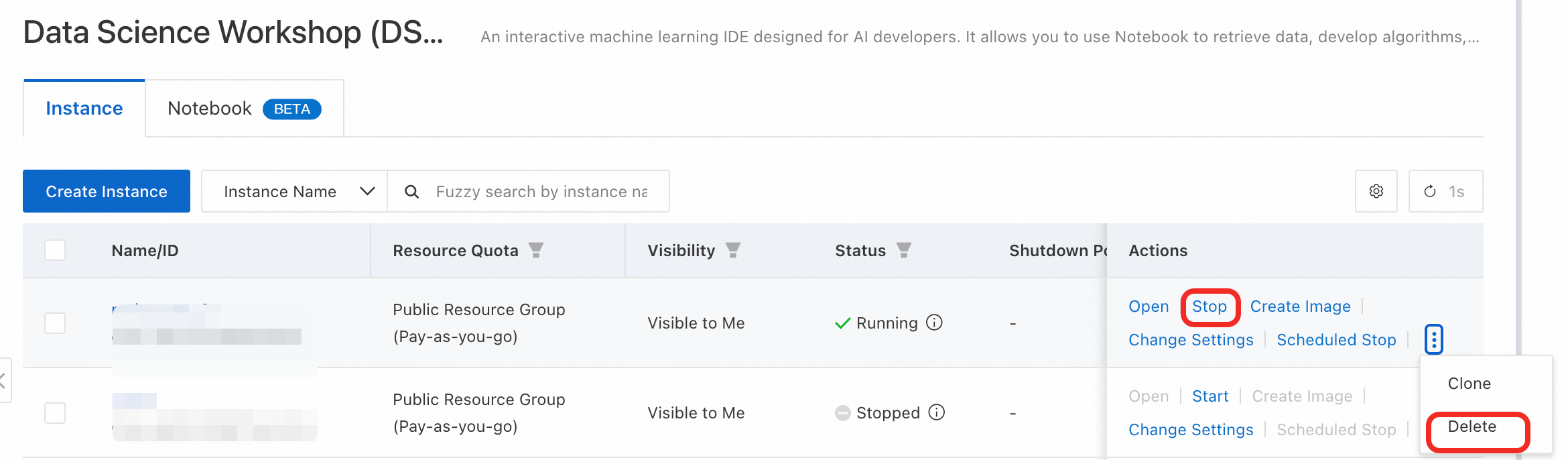
On the DSW console, either Stop or Delete an instance.
-
Stop: Halts compute billing but preserves the instance for later use.
-
Delete: Permanently removes the instance and all its resources, stopping all billing.
Important: If the system disk was expanded, it continues to incur storage charges even when the instance is stopped. To stop all charges, delete the instance.
Q: How do I find my DSW instance if it's not visible in the console?
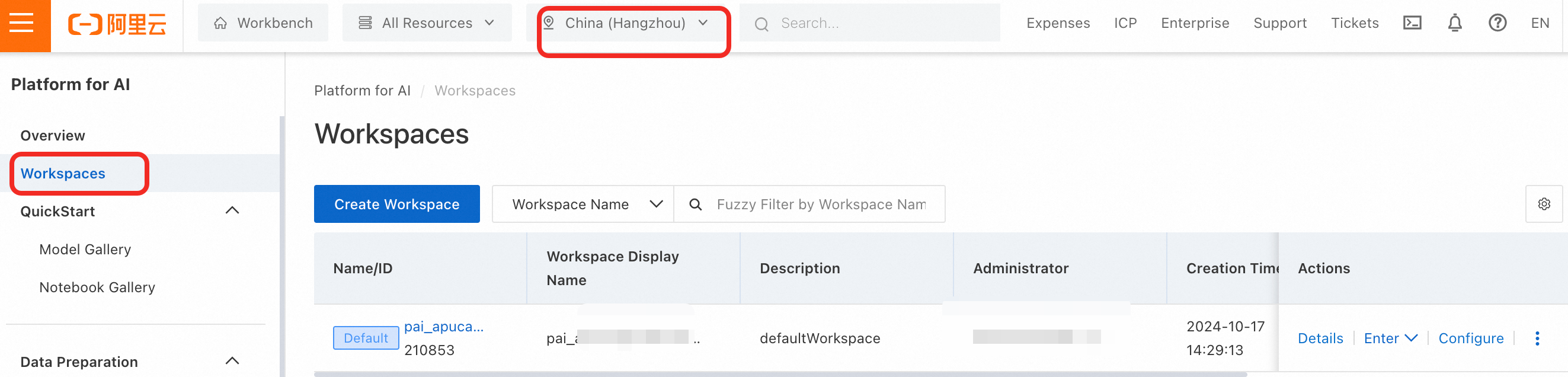
Your instance may be in a different region or workspace. Use the dropdown menus on the PAI-DSW console page to switch between available regions and workspaces.
Q: Do I need to manually release a free trial resource package?
No. Free trial resource packages expire automatically and do not need to be manually stopped or released.
Q: What is the difference between stopping and deleting a DSW instance, and how do I stop all billing?
To completely stop all billing for a DSW instance, delete it.
-
Stop: Releases compute resources (CPU/GPU) and pauses billing for them. However, if the system disk was expanded, storage charges continue.
-
Delete: Permanently removes the instance and all resources, including the system disk. All billing stops completely.
How to choose:
-
Use Stop to preserve the instance environment and data for later use.
-
Use Delete to avoid all future charges. Always back up data before deleting.
Q: What should I do if my DSW instance is stuck in the 'Stopping' or 'Deleting' state?
This can happen if processes inside the instance are not terminating correctly or if high memory usage prevents the instance from responding.
Solution: Wait a few minutes and refresh the page. The system is designed to eventually terminate the instance safely. The status should update to "Stopped" or the instance will be removed from the list if deleted.
Q: Is my data preserved when I stop or delete a DSW instance?
It depends on the action and the type of system disk your instance uses.
-
Stopping an instance:
-
Cloud Disk system disk: Data is preserved if the disk was expanded or if the instance is stopped for less than 15 days. If the disk was not expanded and the instance remains stopped for more than 15 days, all data is permanently erased.
-
Temporary Storage system disk: All data is permanently erased upon stopping.
-
-
Deleting an instance:
Regardless of the disk type, all data on the system disk is permanently erased and cannot be recovered.
Recommendation: To ensure data persistence, save important files to mounted storage (OSS or NAS). Always back up data before deleting an instance.
Q: Why did my DSW instance shut down automatically while it was running?
The instance was likely stopped by the Idle Auto-shutdown policy. This feature automatically stops an instance if CPU and GPU utilization remains below a set threshold for a specified period (e.g., 3 hours). It is enabled by default on free trial instances to conserve resources.
How to disable or modify the policy:
-
Manual stop: Manually stop the instance when not in use to ensure resource savings. The auto-shutdown policy is not guaranteed to trigger every time.
-
Modify policy: To run long-term tasks, modify or disable this policy:
-
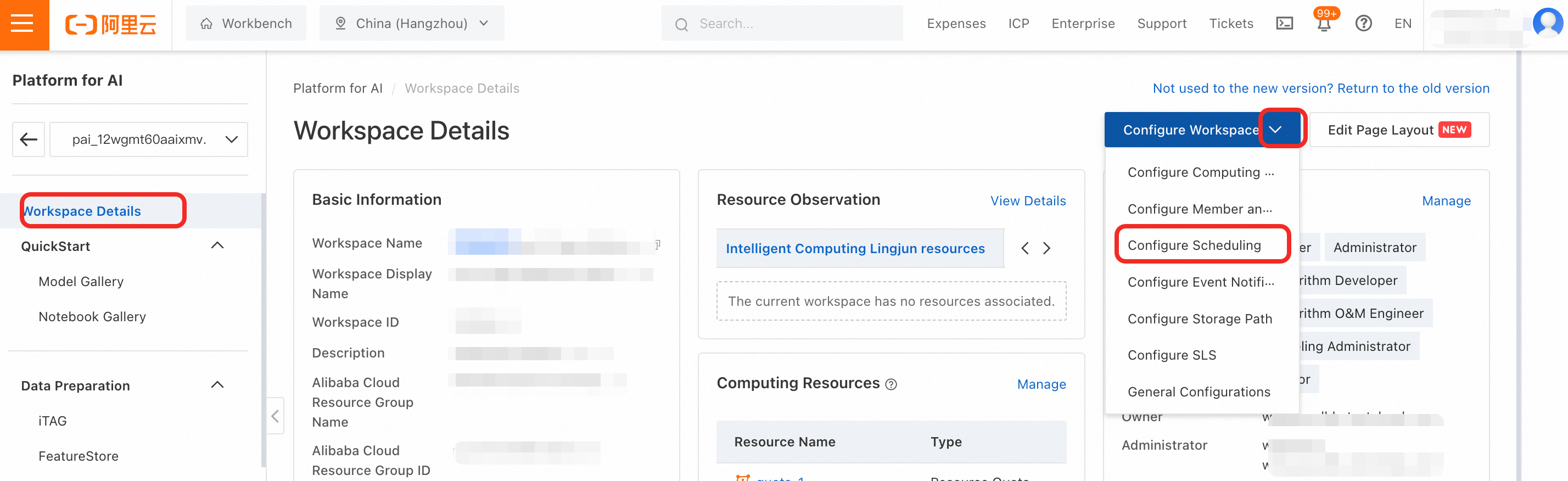
Navigate to your workspace details page and go to Configure Workspace > Auto-stop Settings.
-
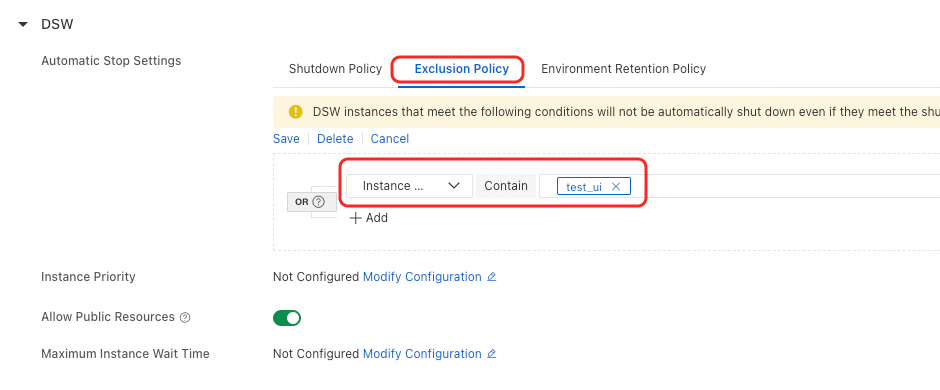
In the DSW configuration section, modify the shutdown policy or add your instance's name to the exclusion list to prevent automatic stopping.
-
Q: Why am I still being billed or seeing a 'Running' status after stopping/deleting all my DSW instances?
This usually happens for one of three reasons:
-
"Running" status refers to a resource package: The "Running" status you see on a billing or free trial page may refer to an active resource package (e.g., "250 compute hours/month"), not an actual DSW instance. The package remains active until it expires.
-
Expanded system disk charges: Stopping an instance only pauses compute charges. If the system disk was expanded, storage charges continue. To stop these charges, delete the instance.
-
Billing data delay: Charges shown may be for usage before stopping or deleting the instance due to billing system delays.