TL;DR: The AI Gateway has introduced a Credits metering dimension, expanding consumer quotas from "Token only" to "Credits-based". It also adds two new resource types: model metadata and providers. The former carries the Credits unit price and specifications for each model, while the latter carries the provider ownership of the service. Whenever a call occurs, the gateway calculates the Credits consumption based on the model's unit price at that moment and charges it to the respective consumer's quota usage.
If traditional API gateways manage the "traffic traffic lights," then the AI gateway has an extra responsibility — attaching a measurable scale to every invocation.
The biggest difference between LLMs and ordinary APIs is that the resources consumed by each invocation are different: a single Q&A can easily consume thousands or tens of thousands of Tokens, and the consumption among input, output, and cache varies significantly. There is also a lack of a unified baseline for comparison among different models. After running for a while, the three most common questions asked by business teams are:
Tokens are the smallest measurable unit, but exposing them directly to business teams is not user-friendly. The weights of Tokens for different models and levels are completely different; you cannot see the difference in resource occupancy just by looking at the number of Tokens. The Credits metering capability of the AI Gateway is designed to solve this by introducing a unified measurement scale that allows cross-model and cross-provider horizontal comparison — Credits, and completes the two tasks of "attribution" and "constraint" around it.
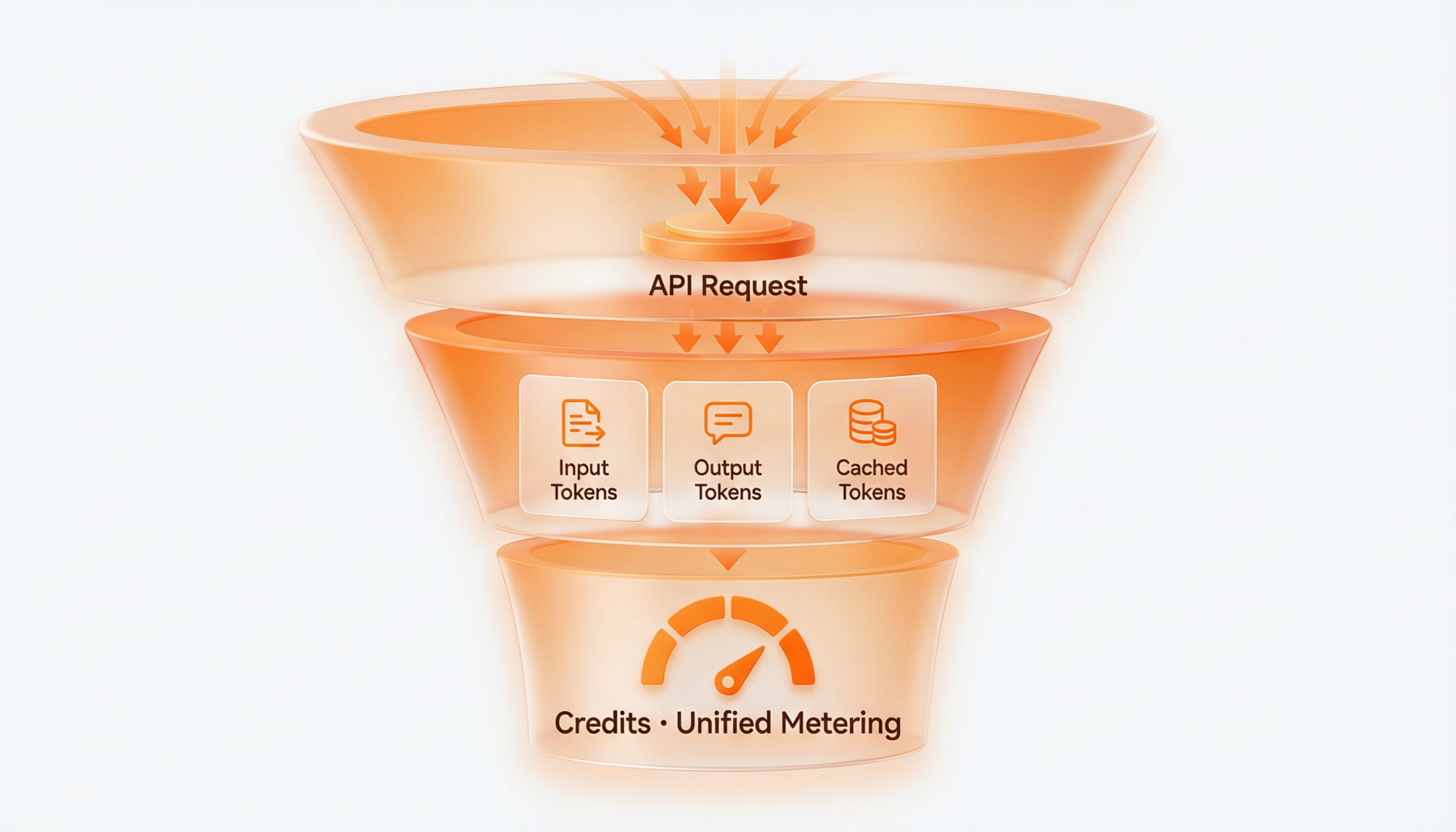
| Capability | What Problem It Solves |
|---|---|
| Model Metadata Management | Maintains the model list within the instance along with their Credits unit price, capabilities, Token limits, and other specification details. This allows for quick model selection in Model APIs and routing, and tracks Credits consumption by model. |
| Provider Management | Allows each service and model to be clearly assigned under a provider name, managing and viewing resources from the provider dimension. |
| Credits Dimension Quota | Evolves quota rules from the "Token" dimension to the "Credits" dimension. |
Let's break them down one by one.
Before this, a model was just a string (such as qwen-max, gpt-4o) to the AI gateway. When performing Credits metering, the gateway had no idea what the corresponding input, output, and cache unit prices were for this string.
AI Gateway has added a new class of resource — Model Metadata. Simply put, it creates a "specification file" for each model.
A file contains:
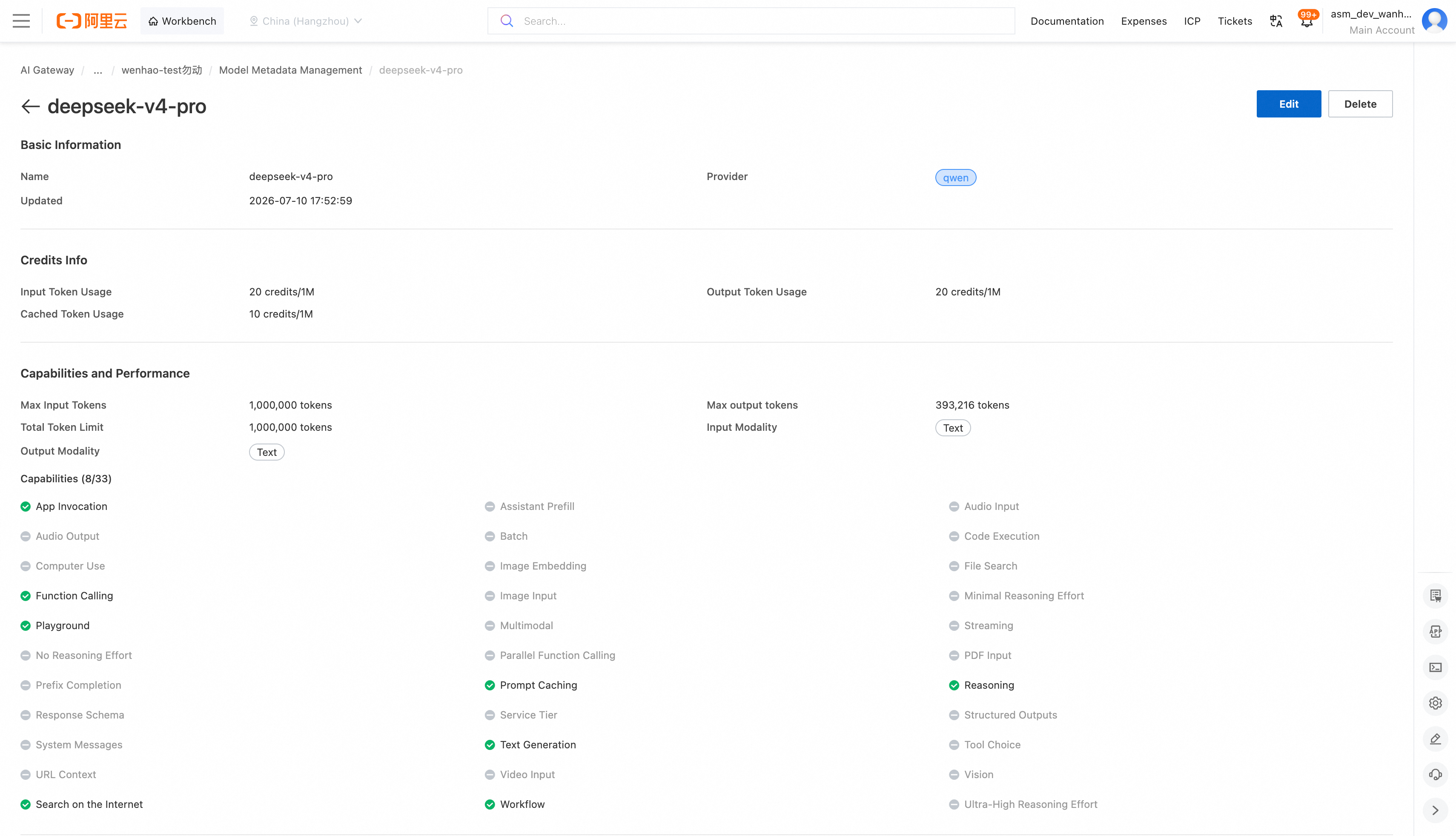
Suppose you maintain a model metadata entry in the gateway:
Name: qwen-max
Provider: Alibaba Cloud Bailian
Input Token Consumption: 8   Credits / 1M tokens
Output Token Consumption: 24  Credits / 1M tokens
Cache Token Consumption: 2   Credits / 1M tokens
Now there is an invocation that uses 1 million input Tokens, 200,000 output Tokens, and 50,000 cache Tokens. The gateway will calculate like this at the very moment the request occurs:
Input Credits = 1 million / 1 million × 8  = 8    credits
Output Credits = 200,000 / 1 million × 24 = 4.8  credits
Cache Credits = 50,000 / 1 million × 2  = 0.1  credits
────────────────────────────────
Total Consumption for this call ≈ 12.9 creditsIn previous versions of the AI Gateway, there was a "LLM Provider" field in the advanced settings of the service, which was essentially a protocol template (openai compatible / anthropic compatible) — it only told the gateway "what protocol to use to interface", but did not mean "which provider the usage of this call should be attributed to."
For example: you could have two "OpenAI-compatible" services, one actually routing to OpenAI and the other to DeepSeek. Their protocols are the same, but they belong to two different providers. The old field could not differentiate them.
Now, the AI Gateway has isolated "Provider" as an independent resource object within the instance, and renamed the original field to avoid confusion:
| Concept | New Name | Purpose |
|---|---|---|
| Original "LLM Provider" field | Renamed to Provider Configuration Template | Only describes the integration protocol |
| Newly added resource | Provider | Carries the dimension of usage attribution |
The two concepts are completely decoupled, with no mutual filtering or inheritance. This way:
This is the most core capability upgrade.
Old Rule__: Set "10 million Tokens per day" for Consumer A — but is A using a lightweight model or a large model? The difference in consumption intensity is unclear.
New Rule__: Set "500 credits per day" for Consumer A — this directly limits the unified measurement scale. Lightweight models can run more times, while large models will naturally run fewer times.
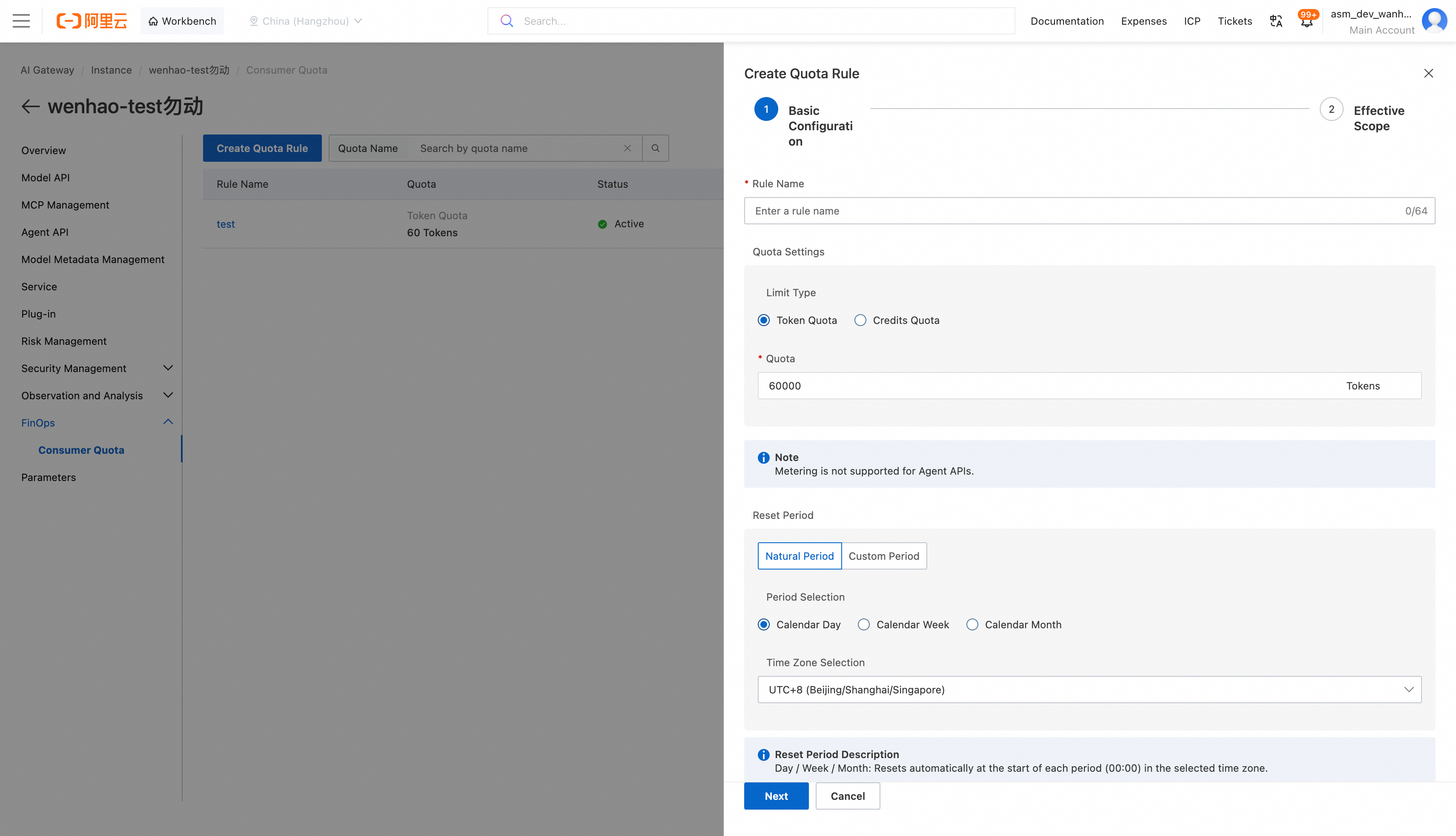
Based on the original creation flow, a "Limit Unit" selection has been added to support configuring quotas in the Credits dimension:
| Field | Type | Description |
|---|---|---|
| Rule Name | Text | Inherited |
| Limit Unit | Radio: token / credits, default token | New |
| Limit Value | Numeric, the suffix displays Tokens / Credits dynamically based on the unit | Inherited |
| Cycle Type | Radio + parameters (calendar day/week/month or custom 1~60 days) | Inherited |
| Time Zone | Dropdown, default UTC+8 | Inherited |
Let's walk through the closed loop with a specific scenario:
Background__: Consumer 'Internal Inference Platform' Monthly Quota = 10000 credits (calendar month + credits)
The following have been configured in the Gateway:
Step 1 · Request Arrival The consumer calls with an API Key. The gateway recognizes him as "Internal Inference Platform" with 9987 credits already consumed this month.
Step 2 · Pre-check This request has not been executed yet. The remaining quota is 13 credits, is it enough? Let it pass first.
Step 3 · Upstream Response Calling qwen-max consumed 50,000 input, 100,000 output, and 20,000 cache Tokens.
Step 4 · Conversion at Request Time
input  =  50,000 / 1 million × 8  = 0.4  credits
output = 100,000 / 1 million × 24 = 2.4  credits
cache  =  20,000 / 1 million × 2  = 0.04 credits
────────────────────────
Total approx. 2.84 credits
Step 5 · Quota Deduction The monthly cumulative consumption for the consumer "Internal Inference Platform" is updated to 9989.84 credits, with 10.16 credits remaining.
Step 6 · Next Request Another call with an estimated 20 credits arrives — the remaining 10.16 is not enough, and the gateway limits the request.
| Focus Areas | The Solution Provided by AI Gateway |
|---|---|
| How many Credits does an invocation consume? | Real-time conversion at the request moment according to the Credits unit price in the model metadata |
| Which provider does the service belong to? | A clear binding relationship is established between services and providers, and a provider can be associated with multiple services. |
| How is consumer usage constrained? | Quota rules support both Token and Credits units, allowing administrators to choose flexibly. |
The Credits metering and quota capabilities are now live. We welcome you to try them out and leave your usage governance needs and feedback in the comments section.
Why Is Your AI Agent Slow? Node.js Agent Connects Models, Tools, and Service Traces in One Go
Owned Channel - Bring Ops Capabilities into Qoder Pinpoint Root Causes in One Sentence

756 posts | 60 followers
FollowAlibaba Cloud Native Community - June 22, 2026
Alibaba Cloud Native Community - February 18, 2025
CloudNative - May 10, 2022
Amuthan Nallathambi - October 12, 2023
Alibaba Cloud Native Community - February 13, 2025
Alibaba Cloud MaxCompute - March 7, 2024
756 posts | 60 followers
Follow Token Plan
Build more, spend less. One plan, every modality.
Learn More
Alibaba Cloud Model Studio
A one-stop generative AI platform to build intelligent applications that understand your business, based on Qwen model series such as Qwen-Max and other popular models
Learn More API Gateway
API Gateway provides you with high-performance and high-availability API hosting services to deploy and release your APIs on Alibaba Cloud products.
Learn More AgentBay
Multimodal cloud-based operating environment and expert agent platform, supporting automation and remote control across browsers, desktops, mobile devices, and code.
Learn MoreMore Posts by Alibaba Cloud Native Community

