Before you use DLC for the first time, you must grant the DLC service-linked role access to your cloud resources. If you use OSS as a storage system, you must also grant the DLC service-linked role permissions to access OSS. This topic describes the permissions required to use DLC.
Background information
Before you use DLC, you must grant the account that you use to perform operations the required permissions for DLC features and OSS. PAI also lets you use workspaces to implement fine-grained access control over DLC training tasks for Resource Access Management (RAM) users. When you use DLC, PAI performs storage operations on dependent products, such as OSS and NAS, in the background. Therefore, you must grant PAI access to OSS and NAS. For more information about the authorization operations, see the following sections.
-
Operating account authorization
Outlines the products that DLC depends on and the required permissions.
-
PAI service account authorization
Grant the Alibaba Cloud account general operation permissions for DLC and access permissions for OSS or NAS.
Operating account authorization
DLC provides a platform for creating and submitting model training jobs. You may need to activate and authorize the following cloud services when you use DLC to create and submit training jobs.
PAI module: DLC
Operation account
Service
Reference
Alibaba Cloud account
You can use an Alibaba Cloud account to perform operations on DLC. No additional authorization is required.
N/A
RAM user
(Recommended)
PAI provides different member roles. You can assume different member roles to the RAM users for convenient permission management. For more information about the permissions of each role, see Roles and permissions.
-
Other dependent cloud products: NAS
NAS is used for data storage. You must activate NAS and grant the required permissions.
Scenario
Description
Reference
Activate NAS
We recommend that you use an Alibaba Cloud account to activate NAS. No additional authorization is required. If you want to activate NAS by using a RAM user, you must grant the
AliyunNASFullAccesspermissions to the RAM user.Authorization: Perform access control based on RAM policies
Common operations: Create a file system
Use NAS
Use NAS after activation:
Authorization: NAS provides detailed RAM control policies. You can grant permissions to RAM users as needed.
Common operations: You need to create a NAS file system and mount it to an instance of PAI.
Dependent cloud service: OSS
You need to activate and authorize OSS for data storage.
Scenario
Description
Reference
Activate OSS
We recommend that you use an Alibaba Cloud account to activate Container Registry. No additional authorization is required. If you want to use a RAM user to activate OSS, you need to grant the
AliyunOSSFullAccesspermissions to the RAM user.Activation: Activate OSS
Authorization: Overview of RAM policy
Common operations: Create buckets
Use OSS
Use OSS after activation:
Authorization: OSS provides detailed RAM control policies. You can grant permissions to RAM users based on your business requirements.
Common operations: You need to create a bucket to upload objects to OSS.
PAI service account authorization
Grant general DLC permissions to an Alibaba Cloud account (root account)
To ensure that DLC functions as expected, make sure that your Alibaba Cloud account has general permissions for DLC. These permissions are typically granted when you activate PAI and create a default workspace. You can follow the instructions in Check whether the AliyunPAIDLCDefaultRole role is attached to the account to verify whether your account has the required permissions. If not, follow the steps in this section to grant the permissions.
-
Log on to the PAI console. In the top navigation bar, select the destination region. On the right side of the page, select the target workspace, and then click Enter DLC.
-
Grant the
AliyunPAIDLCDefaultRolerole.-
Click Go to Authorization.

-
On the Cloud Resource Access Authorization page, click Agree to Authorization. Wait for a message indicating that the authorization is successful.
-
-
Add the AliyunOSSFullAccess permission to the AliyunPAIDLCDefaultRole role.
After you complete the authorization, the account that you use to perform operations has the default role permissions for DLC. You must also add operational permissions for OSS to ensure that DLC features function as expected. The procedure is as follows.
-
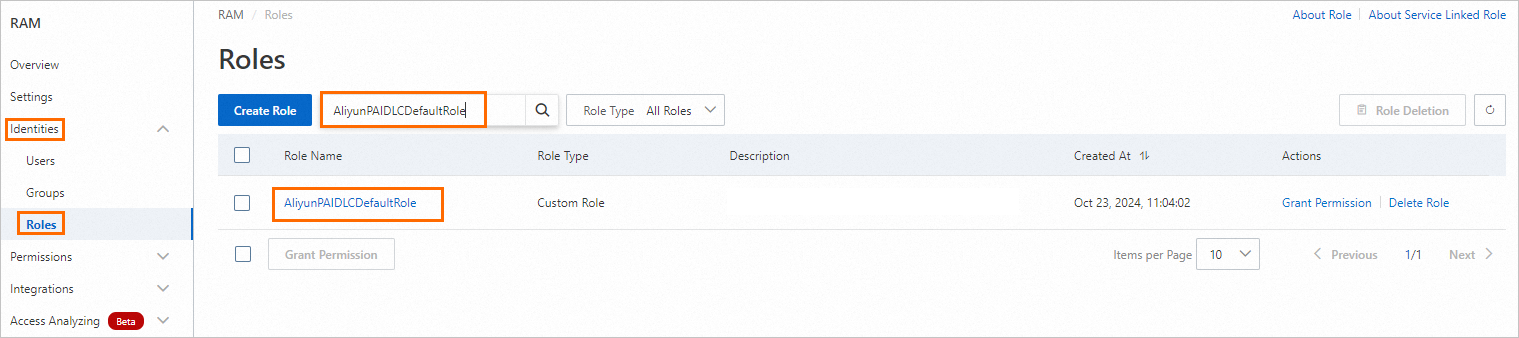
In the RAM console, navigate to the page and find the AliyunPAIDLCDefaultRole role.
-
In the Actions column for the AliyunPAIDLCDefaultRole role, click Add Permissions.
-
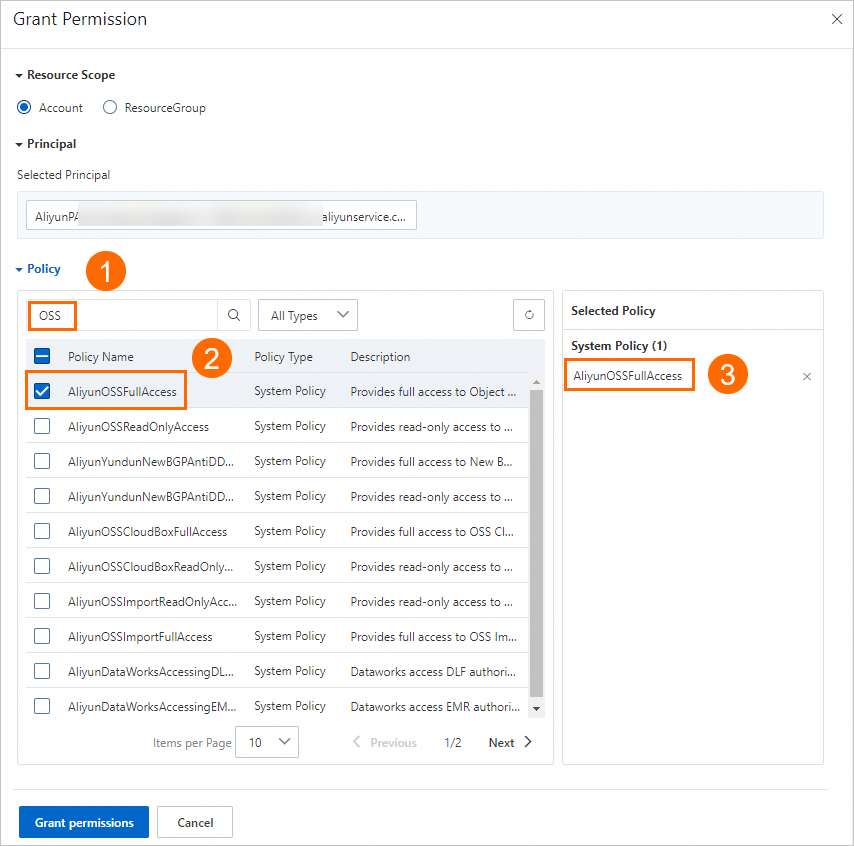
In the Add Permissions panel, configure the parameters.
Parameter
Description
Resource Scope
Select Account Level. The system supports two authorization scopes:
-
Account Level: The permissions take effect within the current Alibaba Cloud account.
-
Resource Group Level: The permissions take effect within the specified resource group.
Principal
The RAM role to which you want to grant permissions. The system automatically specifies the current RAM role. You do not need to change it.
Access Policy
In the text box, enter OSS to search for policies. In the search results, select the required policy. The selected policy appears in the Selected list on the right.
 Note
NoteThe example in the preceding figure uses AliyunOSSFullAccess. However, you should follow the principle of least privilege when you select a policy.
-
-
Click Confirm New Authorization.
-
-
Add the PaiDlcOAuthPolicy permission to the
AliyunPAIDLCDefaultRolerole to ensure that DLC features function as expected. The procedure is as follows.-
In the RAM console, navigate to the page. Click Create Policy to create the custom policy PaiDlcOAuthPolicy. The key parameters are described in the following table. For more information, see Create a custom policy on the Script tab.
Parameter
Description
Script Editor
On the Script Editor tab, enter the following policy document.
{
  "Version": "1",
  "Statement": [
    {
      "Action": [
        "ram:GetDefaultDomain",
        "ram:ListApplications",
        "ram:CreateApplication",
        "ram:ListAppSecretIds",
        "ram:GetAppSecret",
        "ram:CreateAppSecret",
        "ram:DeleteApplication",
        "ram:DeleteAppSecret"
      ],
      "Resource": [
        "*"
      ],
      "Effect": "Allow"
    }
  ]
}
Name
Set this parameter to PaiDlcOAuthPolicy.
-
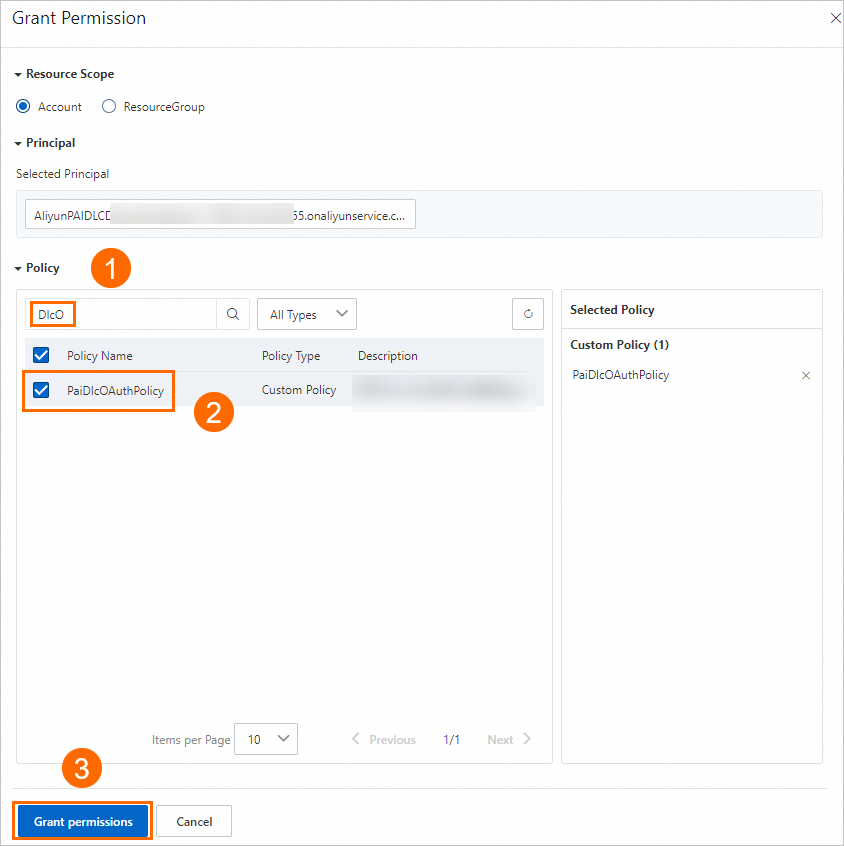
On the page, click Add Permissions in the Actions column for the AliyunPAIDLCDefaultRole role.
-
In the Add Permissions panel, follow the instructions in the following figure to add the PaiDlcOAuthPolicy policy.
-
-
Check the authorization result.
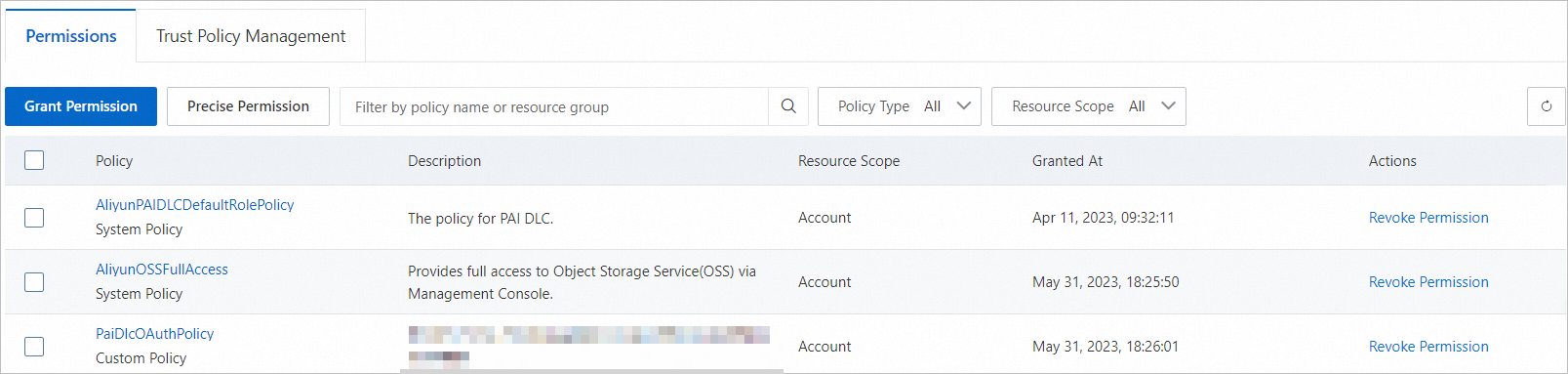
After you complete the preceding steps, click AliyunPAIDLCDefaultRole to verify that the policies are correctly attached to the role.
Grant PAI access to cloud products: OSS and NAS
PAI provides a one-click authorization method to grant PAI access to cloud products such as OSS and NAS. The procedure is as follows:
-
Log on to the PAI console.
-
In the navigation pane on the left, choose . In the DLC section, find OSS and NAS.
-
In the Actions column, check the authorization status of OSS.
-
If the service is not authorized, click One-click Authorization in the Actions column and follow the on-screen instructions to complete the authorization.
-
If the service is already authorized, you can click View Authorization Information in the Actions column to view the details.
-
Reference: Check whether the AliyunPAIDLCDefaultRole role is attached to the account
To ensure that DLC functions as expected, make sure that your Alibaba Cloud account has the AliyunPAIDLCDefaultRole service-linked role. The procedure is as follows.
Only a root account can grant permissions. RAM users cannot grant permissions.
-
Log on to the RAM console.
-
In the left navigation pane, click Identity Management > Role.
-
On the Roles page, enter AliyunPAIDLCDefaultRole in the search box and search for the role.
-
If the role is found, the DLC service role has been granted.
-
If the role is not found, you must grant the permissions. For more information, see Grant general DLC permissions to an Alibaba Cloud account (root account).
-
References
After you grant the required permissions, you can create a DLC job for model training. For more information, see Create a training task.