The features available in Cloud Assistant depend on the agent version. If your current version lacks a feature you need, you can upgrade the Cloud Assistant Agent. This topic describes how to upgrade the Cloud Assistant Agent and how to disable its automatic upgrades.
Limits
The ECS instance on which you want to upgrade the Cloud Assistant Agent must be in the Running state.
Make sure that the Cloud Assistant Agent is installed. For more information, see Install the Cloud Assistant Agent.
Automatic upgrades
In the Mexico and China (Zhongwei) regions, automatic upgrades are not supported if the Cloud Assistant Agent version on an instance is earlier than the versions listed below. You must call the InstallCloudAssistant API operation or manually install the Cloud Assistant Agent to use newer features.
Linux: 2.2.3.515
Windows: 2.1.3.515
By default, the Cloud Assistant Agent runs the aliyun_assist_update upgrade program every 30 minutes. The program is located in one of the following paths:
Windows instances: C:\ProgramData\aliyun\assist\{VERSION}\aliyun_assist_update.exe
Linux instances:
/usr/local/share/aliyun-assist/{VERSION}/aliyun_assist_update
{VERSION} is the version number of the Cloud Assistant Agent. For information about how to view the version number, see Install the Cloud Assistant Agent.
You can configure an automatic upgrade policy for the Cloud Assistant Agent to specify the time windows for upgrades. This helps prevent service disruptions during peak business hours.
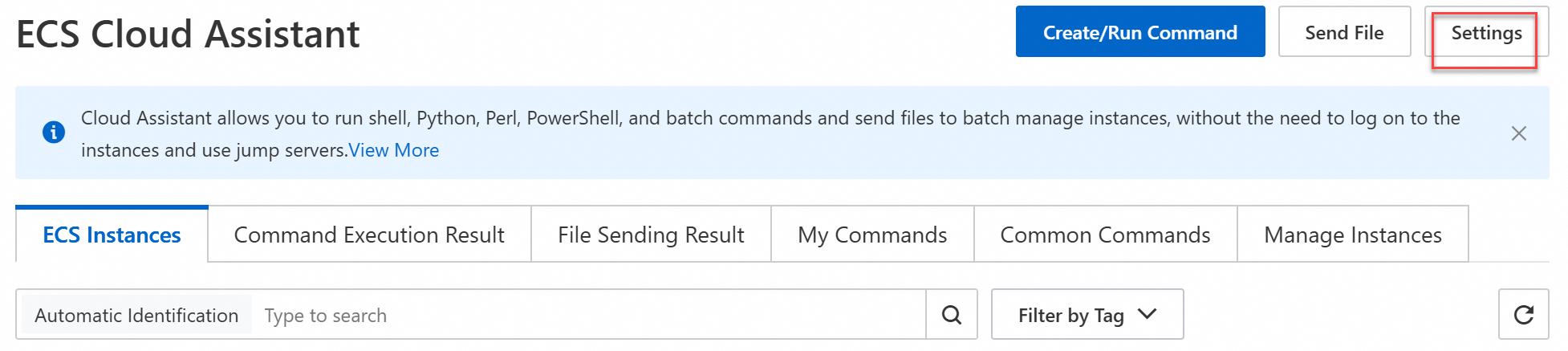
In the upper-right corner of the Cloud Assistant page, click Settings.
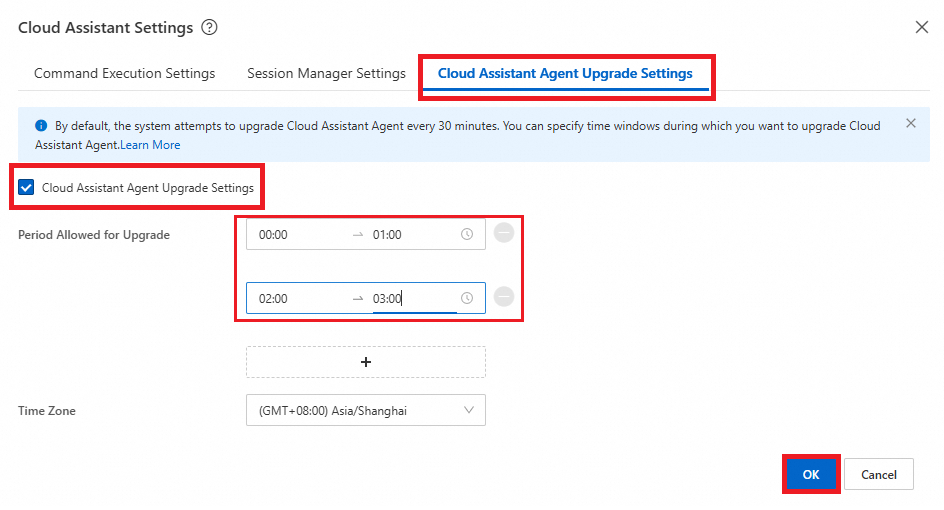
In the Cloud Assistant Settings dialog box, click the Cloud Assistant Agent Upgrade Settings tab.
Select the Cloud Assistant Agent Upgrade Settings check box, set Period Allowed for Upgrade and Time Zone, and then click OK.
NoteYou can specify up to five time periods. The interval between any two time periods must be at least 1 hour.
Disable automatic upgrades
To disable automatic upgrades for a specific version of the Cloud Assistant Agent, you can create configuration files to disable automatic upgrades or rename the automatic upgrade program.
To disable automatic upgrades for all versions of the Cloud Assistant Agent, you must create configuration files to disable automatic upgrades.
Rename the automatic upgrade program
You can rename the aliyun_assist_update file to disable automatic upgrades for the Cloud Assistant Agent.
VERSION is the version number of the Cloud Assistant Agent. For information about how to view the version number, see Install the Cloud Assistant Agent.
Windows Server: In PowerShell, run the following command to rename the
aliyun_assist_updateautomatic upgrade program toaliyun_assist_update.bk.Rename-Item -Path 'C:\ProgramData\aliyun\assist\VERSION\aliyun_assist_update.exe' -NewName 'C:\ProgramData\aliyun\assist\VERSION\aliyun_assist_update.exe.bk'Linux: Run the following command to rename the
aliyun_assist_updateautomatic upgrade program toaliyun_assist_update.bk.mv /usr/local/share/aliyun-assist/VERSION/aliyun_assist_update /usr/local/share/aliyun-assist/VERSION/aliyun_assist_update.bk
To resume automatic upgrades, rename the file back to aliyun_assist_update.
Windows Server:
Rename-Item -Path 'C:\ProgramData\aliyun\assist\VERSION\aliyun_assist_update.exe.bk' -NewName 'C:\ProgramData\aliyun\assist\VERSION\aliyun_assist_update.exe'Linux:
mv /usr/local/share/aliyun-assist/VERSION/aliyun_assist_update.bk /usr/local/share/aliyun-assist/VERSION/aliyun_assist_update
Create configuration files to disable automatic upgrades
For Cloud Assistant Agent 2.2.1.140 or later on Linux and Cloud Assistant Agent 2.1.1.140 or later on Windows, you can use the Cloud Assistant Agent to create a configuration file in a specified path that prevents the Cloud Assistant Agent from being upgraded:
Step 1: Disable the Cloud Assistant Agent from checking for upgrades on startup
To disable the startup upgrade check for the current version of the Cloud Assistant Agent, create the disable_bootstrap_update file in the config directory of the Cloud Assistant Agent installation directory. To disable the check for all versions of the Cloud Assistant Agent on the instance, create the file in the shared config directory. The disable_bootstrap_update file does not require any content.
Windows Server: In PowerShell, run the following command.
# For example, the following command disables the Cloud Assistant Agent from checking for upgrades at startup for a specific version.
New-Item -Path 'C:\ProgramData\aliyun\assist\<span class="var-span" contenteditable="true" data-var="VERSION">VERSION\config\disable_bootstrap_update'</span>
# For example, the following command disables the Cloud Assistant Agent from checking for upgrades at startup for all versions.
New-Item -Path 'C:\ProgramData\aliyun\assist\config\disable_bootstrap_update'
Linux: Run the following command.
# The following command disables the startup upgrade check for a specific version of the Cloud Assistant Agent.
touch /usr/local/share/aliyun-assist/VERSION/config/disable_bootstrap_update
# The following command disables the startup upgrade check for all versions of the Cloud Assistant Agent.
touch /usr/local/share/aliyun-assist/config/disable_bootstrap_update
VERSION is the version number of the Cloud Assistant Agent. For information about how to view the version number, see Install the Cloud Assistant Agent.
Step 2: Disable automatic update checks for the Cloud Assistant Agent
To disable automatic upgrades for a specific version of the Cloud Assistant Agent, create the disable_update file in the config directory of the Cloud Assistant Agent installation directory. To disable automatic upgrades for all versions of the Cloud Assistant Agent on the instance, create the file in the config directory that is shared across all versions. The disable_update file does not require any content.
Windows Server: In PowerShell, run the following command.
# The following command disables automatic upgrades for a specific version of the Cloud Assistant Agent.
New-Item -Path C:\ProgramData\aliyun\assist\VERSION\config\disable_update
# The following command disables automatic upgrades for all versions of the Cloud Assistant Agent.
New-Item -Path C:\ProgramData\aliyun\assist\config\disable_update
Linux: Run the following command.
# The following command disables automatic upgrades for a specific version of the Cloud Assistant Agent.
touch /usr/local/share/aliyun-assist/VERSION/config/disable_update
# The following command disables automatic upgrades for all versions of the Cloud Assistant Agent.
touch /usr/local/share/aliyun-assist/config/disable_update
VERSION is the version number of the Cloud Assistant Agent. For information about how to view the version number, see Install the Cloud Assistant Agent.
To resume automatic upgrades, delete the disable_update and disable_bootstrap_update configuration files.
Windows Server: In PowerShell, run the following command.
Remove-Item -Path C:\ProgramData\aliyun\assist\VERSION\config\disable_update
Remove-Item -Path C:\ProgramData\aliyun\assist\config\disable_update

Remove-Item -Path C:\ProgramData\aliyun\assist\VERSION\config\disable_bootstrap_update
Remove-Item -Path C:\ProgramData\aliyun\assist\config\disable_bootstrap_update
Linux: Run the following command.
rm /usr/local/share/aliyun-assist/VERSION/config/disable_update
rm /usr/local/share/aliyun-assist/config/disable_update

rm /usr/local/share/aliyun-assist/VERSION/config/disable_bootstrap_update
rm /usr/local/share/aliyun-assist/config/disable_bootstrap_update
Manual upgrade
For information about the features that Cloud Assistant supports and the minimum agent versions required, see Supported features and versions.
Upgrade using public commands
If automatic upgrades fail, you can run public commands to upgrade the agent.
The following steps use the console as an example. For information about how to run public Cloud Assistant commands by calling OpenAPI or using the command-line interface (CLI), see View and run public commands.
On the Cloud Assistant page, click the Common Commands tab.
Find the latest version of one of the following public commands and click Run.
Linux instances:
ACS-ECS-UpdateAliyunAssist-linux.sh.Windows instances:
ACS-ECS-UpdateAliyunAssist-windows.ps1.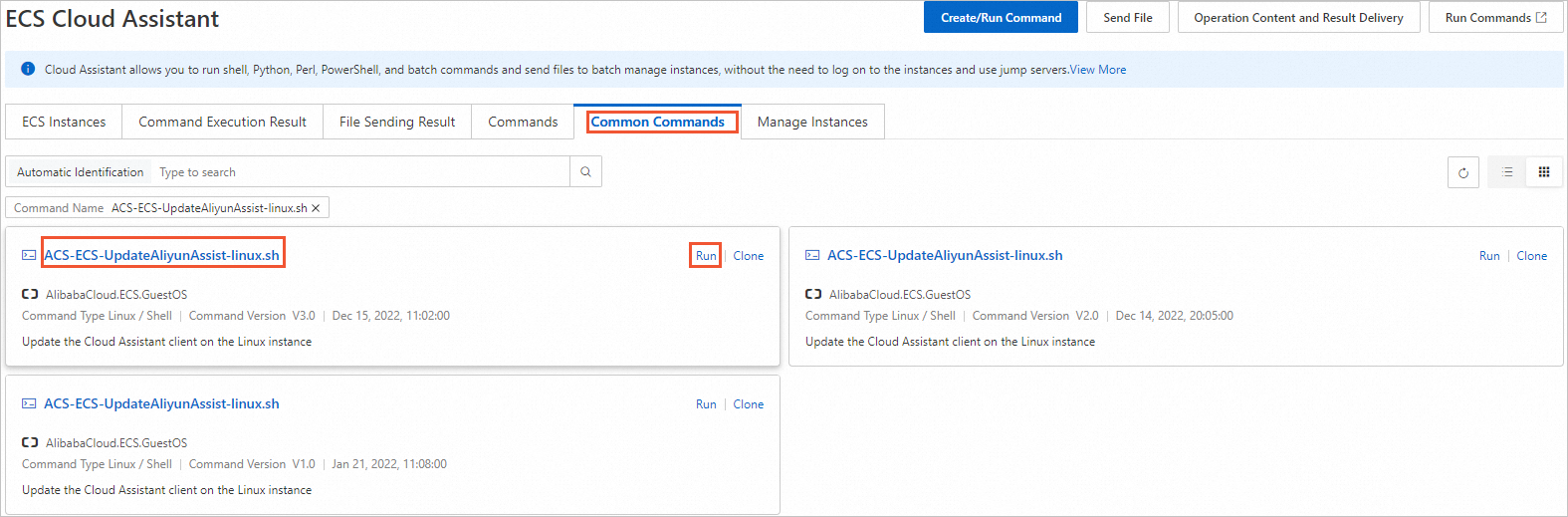
In the Run Command panel, configure the parameters as prompted and click Run.
Execution Plan: Select a time to run the command. For more information, see Execution plan details.
Select Instance: Select the instances on which to upgrade the Cloud Assistant Agent. The selected instances must be in the Running state and have the Cloud Assistant client installed.
For more information about the parameters, see View and run public commands.
If the execution result is similar to the one in the following figure, the Cloud Assistant Agent was successfully upgraded.
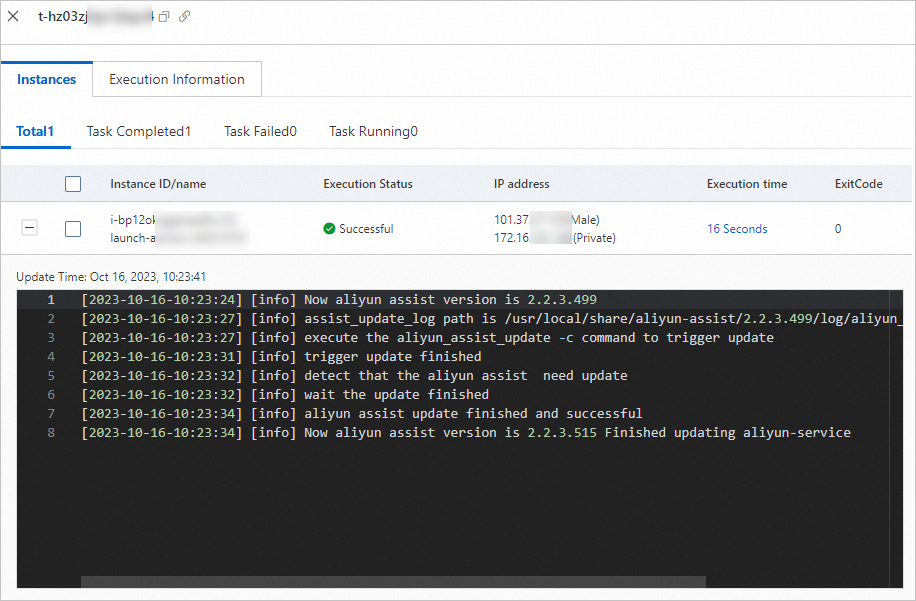
If the public command fails, view the error message and resolve the issue based on the diagnostic information. For more information, see Common errors and troubleshooting for failed executions.
Upgrade by manually downloading the installation package
You can also manually download the latest installation package to upgrade the agent. For more information about installation methods, see Install the Cloud Assistant Agent.
Example: On a Linux instance that uses the x86 architecture, run the following command to download and install the latest Cloud Assistant Agent installation package using an RPM Package Manager (RPM) package.
wget "https://aliyun-client-assist.oss-accelerate.aliyuncs.com/linux/aliyun_assist_latest.rpm" && sudo rpm -ivh --force aliyun_assist_latest.rpmHighest upgradeable Cloud Assistant Agent versions for specific kernel versions
Instance kernel version | Highest upgradeable Cloud Assistant Agent version |
Linux kernel version earlier than 2.6.32 |
|
FreeBSD 11 or earlier (kernel version earlier than 12.x) | 2.3.3.529 |