You can purchase an exclusive resource group for DataService Studio with specifications that meet your business needs to support high-concurrency and high-frequency API calls. This topic describes how to purchase and use an exclusive resource group for DataService Studio.
If you did not activate DataWorks in any region before June 10, 2024, you can only purchase and use serverless resource groups after activation. Legacy resource groups are not supported. If you are an existing DataWorks user and want to switch to serverless resource groups, see Switch from legacy resource groups.
Exclusive resource groups for DataService Studio are not recommended
DataWorks no longer recommends using exclusive resource groups for DataService Studio. Use serverless resource groups instead. Serverless resource groups include the core features of earlier versions of resource groups, such as exclusive resource groups for scheduling, exclusive resource groups for Data Integration, exclusive resource groups for DataService Studio, and public resource groups. You can use a single serverless resource group to perform operations such as data synchronization, task scheduling and execution, and API service calls and management.
Prerequisites
Before you purchase and use an exclusive resource group for DataService Studio:
Understand the specifications, performance (queries per second, or QPS, supported by different specifications), and billing of an exclusive resource group for DataService Studio. This helps you plan the specifications and subscription duration for the resource group based on your business requirements. For more information, see Billing of exclusive resource groups for DataService Studio.
When you purchase an exclusive resource group for DataService Studio, you must configure its network settings. You must attach the resource group to a VPC and a vSwitch in the VPC's corresponding zone to connect to your target data source. The system automatically adds a route to the entire CIDR block of the VPC. To view the network information of your data source, see How do I view the network environment of a data source?.
API calls may involve interactions with data sources in different network environments. You must understand how an exclusive resource group for DataService Studio connects to these data sources. For more information, see Network connectivity and whitelist configuration.
Limitations
Exclusive resource groups for DataService Studio are available only in the China (Shanghai) region.
Step 1: Purchase a resource group
Log on to the DataWorks console.
In the left-side navigation pane, click Resource Group to go to the Resource Groups page. On the Exclusive Resource Groups tab, click Create Resource Group For DataService Studio Of Old Version to go to the purchase page. On the purchase page, configure the required parameters. Key parameters are described below.
Region and Zone: Select the region where you want to use the exclusive resource group.
NoteZones are distinct physical locations within the same region. Zones in the same region are connected through a low-latency internal network.
An exclusive resource group cannot be used across regions. For example, a resource group in the China (Shanghai) region can only be used by a workspace in the China (Shanghai) region.
A legacy resource group is being phased out. If you did not activate DataWorks in any region before June 10, 2024, you can only purchase and use a Serverless resource group. You cannot purchase or use a legacy resource group. For more information about the release of Serverless resource groups, see Announcement on the Launch of DataWorks Serverless Resource Groups.
VPC: From the drop-down list, select the VPC to attach. The list shows all VPCs in your account.
vSwitch: From the drop-down list, select a vSwitch within the selected VPC.
Exclusive Data Service Resources: Select the specifications for the exclusive resource group for DataService Studio.
Resource Group Name: Enter a name for the resource group. The name must be unique within your tenant. A duplicate name causes an error.
Description: Provide a brief description of the resource group.
You can configure other parameters, such as Duration, based on your business plan.
Click Buy Now and complete the payment as prompted. DataWorks then starts to initialize the exclusive resource group. After the resource group is initialized, its status changes to Running in the console.
NoteThe initialization of an exclusive resource group takes about 20 minutes. Wait for the status to become Running.
After the exclusive resource group is created, you must attach it to a workspace to use it in API configurations.
Step 2: Attach a workspace
An exclusive resource group for DataService Studio must be attached to a workspace before it can be used. A single exclusive resource group can be attached to multiple workspaces, but it cannot be used across regions. For example, an exclusive resource group in the China (Shanghai) region can only be attached to a workspace in the China (Shanghai) region. To attach a resource group to a workspace, follow these steps:
Log on to the DataWorks console.
On the Resource Groups page, click the Exclusive Resource Groups tab. In the Actions column of the target resource group, click Attach Workspace.
On the Attach Workspace page, find the target workspace and click Attach in the Actions column.
Step 3: Configure network connectivity and whitelists
When you use an exclusive resource group for DataService Studio to access a data source, you must ensure network connectivity between them. DataWorks provides connectivity solutions for various network environments, such as the internet, Alibaba Cloud VPCs, and on-premises data centers. In different scenarios, you may need to add the IP addresses of the resource group to the whitelist of your database. For more information, see Network connectivity and whitelist configuration.
Step 4: Test network connectivity
After configuration, test connectivity between the resource group and the data source.
Go to the Data Sources page.
Log on to the DataWorks console. In the top navigation bar, select the desired region. In the left-side navigation pane, choose . On the page that appears, select the desired workspace from the drop-down list and click Go to Management Center.
In the left-side navigation pane of the SettingCenter page, click Data Sources.
Find the data source and click Edit in the Actions column.
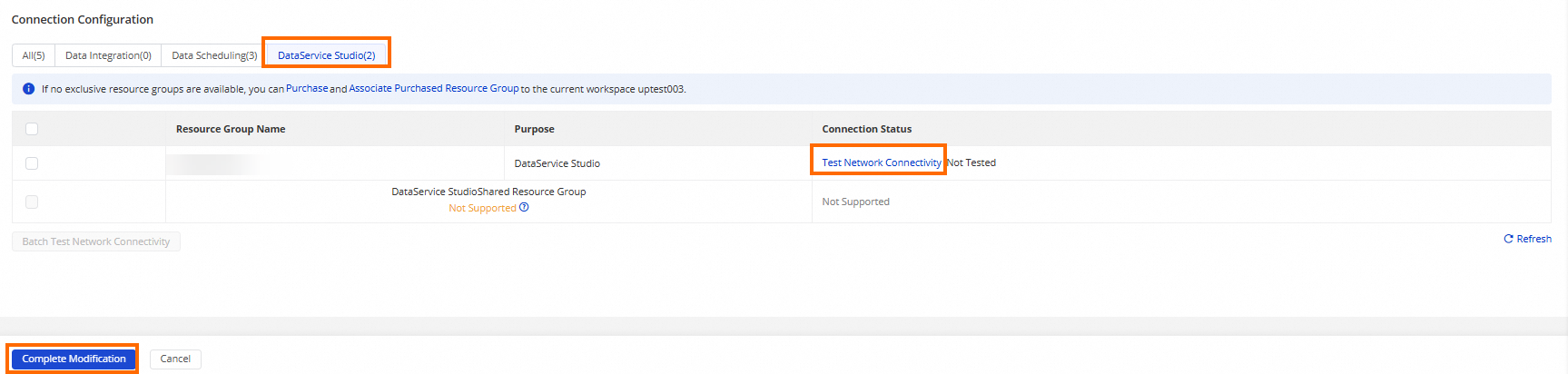
On the DataService Studio tab, find the target resource group and click Test Connectivity in the Actions column. A status of Connected indicates a successful connection.
 Note
NoteWhen you purchase an exclusive resource group for DataService Studio, you must select the network environment for connection. If your database uses a whitelist for access control, add the IP addresses of the resource group to the whitelist. For more information, see Network connectivity and whitelist configuration.
Click Complete Modification.
Use the exclusive resource group in DataService Studio
Currently, only the Generate API feature in DataService Studio supports using an exclusive resource group for DataService Studio.
In the DataService Studio panel, double-click the name of an API in the directory tree to open its configuration page.
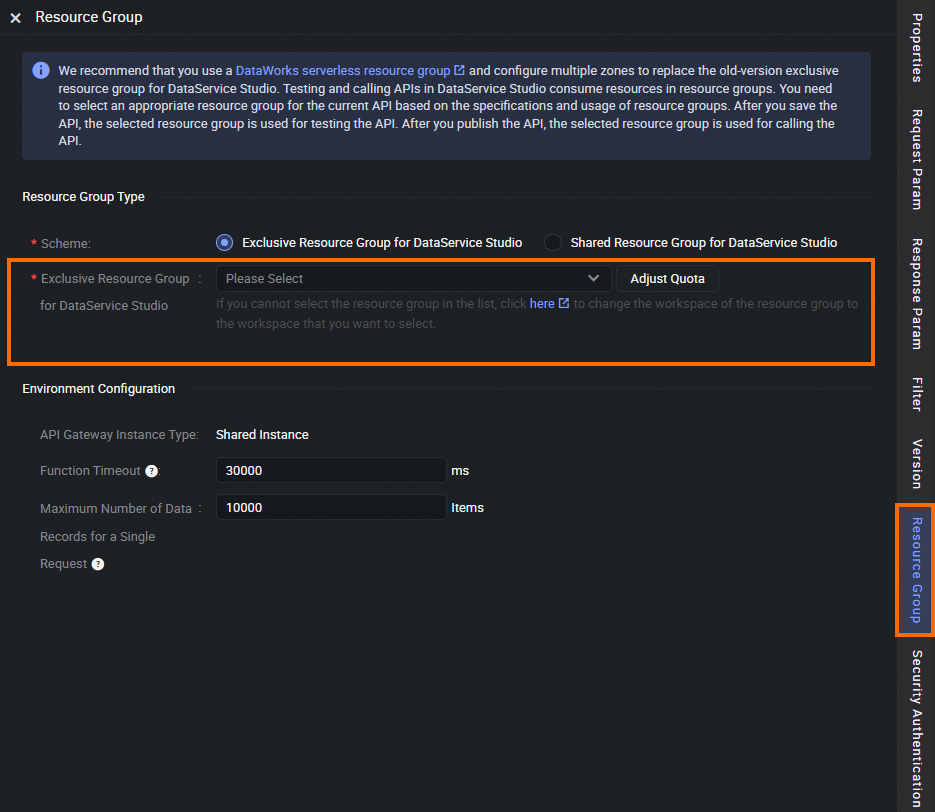
In the right-side pane, click Service Resource Group. Set Scheme to Exclusive Service Resource Group and select the desired resource group from the drop-down list. This resource group will be used for API calls. For more information, see Generate an API in wizard mode and Generate an API in script mode.
(Optional) Change the zone of a resource group
To change a resource group's zone, follow these steps:
Log on to the DataWorks console.
In the left-side navigation pane, click Resource Group. On the Resource Groups page, click the Exclusive Resource Groups tab and find the resource group with a Purpose of DataService Studio.
Click the
 icon in the Actions column of the resource group and select Change Zone. The Change Zone For Resource Group dialog box appears.
In the Change Zone For Resource Group dialog box, select the Current Zone and the Number Of Machines. Then, select the New Zone and specify the Number Of Machines To Replace.
Click Confirm Replacement to complete the zone change for the resource group.
Changing the zone of a resource group may cause network changes:
The CIDR block of the resource group: Each zone in a resource group corresponds to an independent CIDR block. Therefore, whether the CIDR block changes depends on whether the zones within the resource group have changed. If the zones change, the corresponding CIDR block is also adjusted.
The primary ENI IP address of the resource group: The primary ENI IP address of the replaced instance changes. A new IP address is assigned from the CIDR block of the target zone.
The ENIs attached to the resource group: If you have added the CIDR block of the vSwitch to the whitelist, this change has no impact. However, if you have whitelisted the individual IP addresses of the ENIs, you must update the whitelist to maintain access.