Large Language Models (LLMs) have strong inference and generation capabilities. However, they expose the shortcoming of short-term memory when moving toward autonomous agents. LLMs are inherently stateless. Even if the context becomes longer, interactions are difficult to accumulate into long-term cognition. To address this,PolarDB for MySQL developed by the ApsaraDB team launched the managed Mem0 service. It integrates a kernel-level vector database and graph engine. It is 100% compatible with open source ecosystems. It reduces memory refinement and storage costs by over 30%. This helps agents achieve continual learning and evolution to deliver personalized and intelligent experiences.
On the evolution path of AI agents, perception (multimodal), thinking (inference), and tool execution (function calling) are gradually improving. However, they still lack time continuity. Mem0 (Memory Layer for AI) was created as a personal memory layer for LLMs. Mem0 on PolarDB for MySQL is its cloud-native managed version. It provides one-stop integration of memory storage, fetching, and retrieval into the ApsaraDB ecosystem.
· Agents without long-term memory treat every conversation as a first meeting. They require repeated prompts to maintain settings.
· Agents with Mem0 on PolarDB for MySQL fetch structured facts from conversations and continually evolve.
It does not simply save chat records. Instead, it fetches core facts from raw expressions. For example, it fetches key facts from a statement such as "I want to buy a pink unicorn gift for my daughter, but money is tight right now":
If you ask "Where to take the kids this weekend" a month later, the agent recommends a suitable low-cost plan based on these facts. This is long-term memory. It gives agents the continuity to understand user needs. It is a key step toward artificial general intelligence (AGI).
Mem0 on PolarDB for MySQL is more than storage. It builds a digital twin for each user in the database. The following outlines the common scenarios of long-term memory across five realms:
1. Intelligent customer service
Mem0 stores user device models, repair records, and communication preferences. This lets the agent ask questions such as "Mr. Wang, is your previous projector issue resolved?" This upgrades the continuous experience from a cold program to a dedicated assistant.
2. Personalized education
Mem0 records information such as difficult knowledge points, question types, and accuracy rates for students. It pushes incorrect questions from three days ago during review. This achieves dynamic teaching and prevents blind practice.
3. Healthcare
Mem0 stores medical histories, allergy histories, and treatment plans. When a patient consults about new symptoms, the agent associates diagnostics data from six months ago. It provides in-depth historical advice and warns of drug conflicts to deliver full-lifecycle medical services.
4. Emotional companionship
Mem0 stores information such as emotional fluctuations, anniversaries, and family relationships. When a user feels down, the agent initiates topics such as "I remember you were happy for a long time after completing the last project. Is it going well now?" This provides empathetic support.
5. Artificialintelligence recommendation
Mem0 records interest evolution and purchase motives based on long-term customer interests. It builds dynamic interest graphs and actively recommends follow-up products at the right time to deliver proactive services.
In the past, to achieve long-term AI memory, developers had to manually maintain vector databases, handle complex prompt fetch logic, and worry about data consistency. Mem0 on PolarDB for MySQL transforms memory from a complex development job into a native database service.
1. 100% compatible with open source ecosystems and out-of-the-box
The PolarDB for MySQL Mem0 managed service is 100% compatible with the open source Mem0 frame. Developers can use the mature open source community ecosystem. Achieve seamless migration using simple RESTful APIs without modifying the existing agent code logic.
2. Resource elasticity and low cost
PolarDB for MySQL Mem0 supports two billing models: pay-by-memory (Standard Edition) and pay-by-resource (Enterprise Edition). The memory cost of the Standard Edition is 50% of the Mem0 commercial edition. In addition, PolarDB for MySQL supports Serverless Auto Scaling. For typical peak and valley traffic scenarios such as AI agents, this helps enterprises reduce cloud resource costs by about 50%.
3. Low latency and high accuracy
PolarDB for MySQL Mem0 is optimized by professional AI algorithms. Compared with self-managed open source Mem0 solutions, the accuracy increases by more than 50% and latency decreases by more than 30% on the standard test dataset.
4. Multimodal retrieval capabilities for vectors, full-text indexes, and graphs
PolarDB for MySQL Mem0 natively integrates vectors, graphs, and full-text indexes. It supports complex entity relationship inference. It deeply integrates the Lakebase lakehouse architecture to achieve intelligent tiering of hot and cold data. Hot data can be instantly accessed within seconds. Cold data is automatically archived to Object Storage Service (OSS). This solves the storage problem of multi-database stacking.
· Vector retrieval: Quickly retrieve memories with similar semantics, such as associating "sports" with "running".
· Graph inference: Understand character and entity relationships, such as "Adam is John's father" and reminding Adam to follow up when John is sick. This is difficult to achieve using a pure vector solution.
· Full-text index: Accurately hit specific keywords.
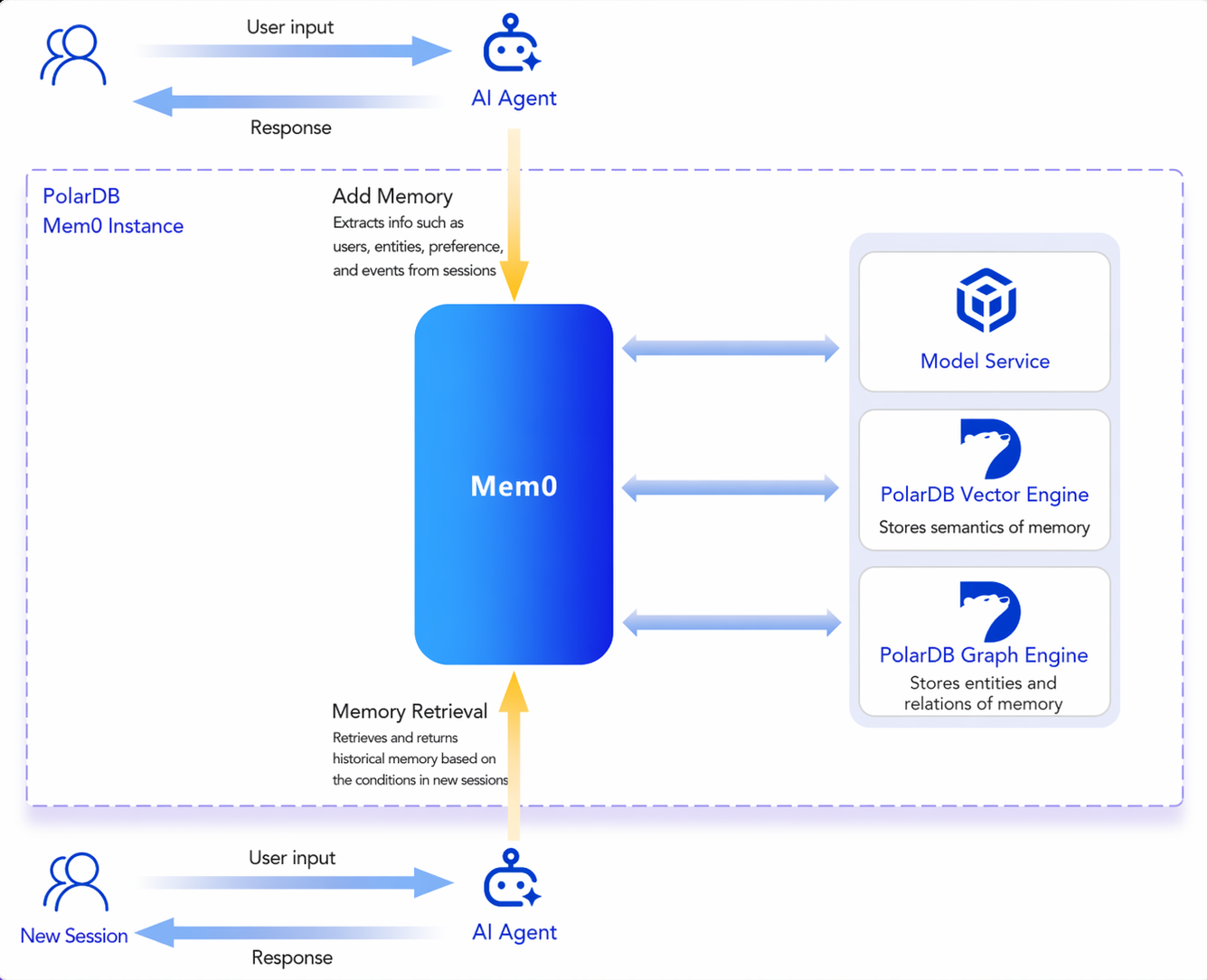
PolarDB for MySQL Mem0 long-term memory architecture
How PolarDB for MySQL Mem0 works is not simple storage, but a dynamic evolution procedure:
1. Memory fetch and storage: From unstructured text to knowledge units
PolarDB for MySQL Mem0 does not just store original conversations. It supports invoking semantic fetch models to deeply deconstruct information. The system automatically detects entities (person, object, or place) and performs semantic compression. It removes redundant information and retains only core facts. The system uses the PolarDB for MySQL hybrid engine to synchronously store structured facts and high-dimensional vectors. This achieves a balance between storage efficiency and retrieval performance.
2. Memory retrieval: Semantic-based multi-way retrieval
The retrieval of PolarDB for MySQL Mem0 does not rely only on single vector matching. It uses a three-way parallel mechanism of vectors, graphs, and metadata. Semantic retrieval accurately locates concepts. The graph engine fills logic gaps, such as relational inference from "spicy" to "gastritis history". Metadata filtering achieves second-level filtering based on user_id or time dimensions in massive data. This ensures accurate and deep retrieval.
3. Memory conflict handling: Memory metabolism and logical consistency
It simulates human forgetting and correction mechanisms. It imports a time-series weight attenuation function to give new information a higher confidence level. It automatically triggers conflict detection in the write logic. If new and old information contradict each other, such as changing from "single" to "married", the system executes a delta update or logical overwrite. This ensures that AI memory always conforms to current facts.
4. Multi-level fencing: The bulletproof vest for security and privacy
The system builds a leveled metadata index system to natively support three-level fencing for user_id, agent_id, and run_id. This fine-grained physical and logical control ensures that memories between different applications and users are completely independent. This provides strict privacy protection for enterprise-level AI applications. Agent ID corresponds to agent or application-level fencing. This ensures that AI logic of different features is independent. User ID corresponds to the user level. This protects personal privacy and achieves personalization. Run ID corresponds to the session or job level. This provides short-term context fencing for specific jobs.
PolarDB for MySQL Mem0 is now integrated into PolarDB for MySQL. You can access it in the following steps:
Create a Mem0 instance on the PolarDB for MySQL Mem0 purchase page. Note that the application whitelist and cluster whitelist are independent of each other. Configure the IP address whitelist or security group separately to ensure that Elastic Compute Service (ECS) or local servers have access permissions.
Use system-built or custom prompt policies to guide the LLM to fetch memory. It supports session summary policies to retain the overall dialogue background, and semantic memory policies to fetch discrete facts, such as medical signs or finance preferences. This adapts to different business scenarios.
PolarDB for MySQL Mem0 provides a RESTful API reference (accessible through the console endpoint). Use the standard RESTful API to seamlessly integrate memory capabilities into the AI agent code:
· Add (/v1/memories): Send the conversation content. The system automatically executes semantic analysis and fact persistence.
· Search (/v2/memories/search): Retrieve the TopK related memories and their metadata based on the query text. Backfill them as context to the LLM.
· Maintenance: Perform exact updates based on memory_id or batch cleanup based on user_id. This implements fine-grained memory management.
The launch of the PolarDB for MySQL Mem0 managed service provides enterprises with a new data infrastructure choice to build AI applications. In the wave of LLM and agent technologies, data is no longer cold row and column records. Instead, data is a cognitive carrier that empowers machines with intelligence.
This managed service deeply integrates the flexibility of open source Mem0 and the extreme performance of PolarDB for MySQL. It solves the "amnesia" problem of AI agents. It also reduces costs, increases efficiency, performs security hardening, and deepens scenario applications. This provides a solid foundation for enterprises to build next-generation intelligent applications. As the PolarDB "AI Lakebase" architecture matures, the collaboration between databases and LLMs becomes closer. PolarDB for MySQL Mem0 is an important tool for every developer committed to creating an ultimate user experience. It helps realize the vision of "making AI remember everything."
ApsaraDB - June 24, 2026
ApsaraDB - May 11, 2026
Alibaba Cloud Native Community - January 21, 2026
Apache Flink Community - April 16, 2026
Apache Flink Community - June 23, 2026
ApsaraDB - June 21, 2026
 Alibaba Cloud Model Studio
A one-stop generative AI platform to build intelligent applications that understand your business, based on Qwen model series such as Qwen-Max and other popular models
Learn More Alibaba Cloud for Generative AI
Accelerate innovation with generative AI to create new business success
Learn More Qwen
Qwen
Full-range, open-source, multimodal, and multi-functional
Learn More PolarDB for PostgreSQL
Alibaba Cloud PolarDB for PostgreSQL is an in-house relational database service 100% compatible with PostgreSQL and highly compatible with the Oracle syntax.
Learn MoreMore Posts by ApsaraDB


