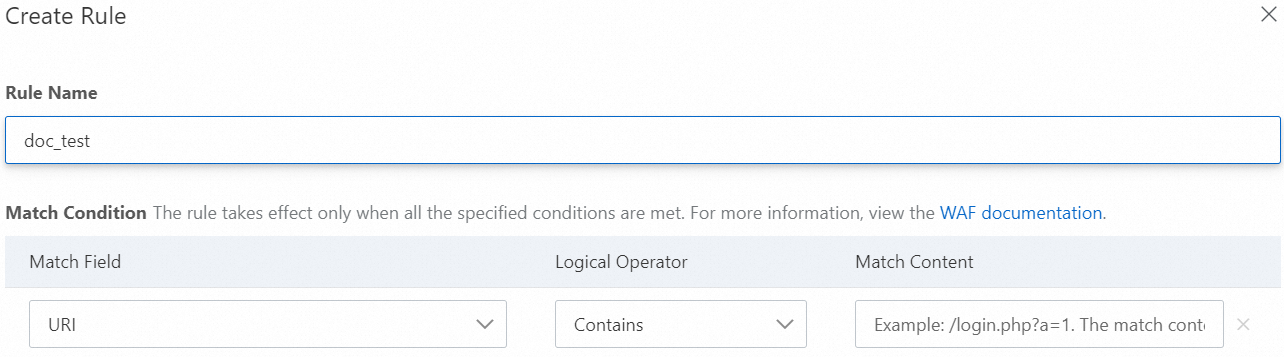
Match field | Description | Supported logical operators |
URI | The Uniform Resource Identifier (URI) of a request. The URI specifies the path of the requested resource. In most cases, the URI is a combination of the URI Path and the Query String. The path must start with / and not include a domain name. For example, /login.php. | Equals, Does Not Equal, Equals One of Multiple Values, and Does Not Equal Any Value Contains, Does Not Contain, Contains One of Multiple Values, and Does Not Contain Any Value Length Equal To, Length Greater Than, and Length Less Than Prefix Match and Suffix Match Regular Expression Match and Regular Expression Mismatch
Important Protection rules of the custom rule module that contain the logical operators are considered advanced rules. The billing rules of advanced rules are different from the billing rules of basic rules. For more information, see Billable items.
|
IP | The source IP address of a request. This is the IP address of the client that initiates the request. The match content must meet the following requirements: IPv4 addresses (for example, 1.XX.XX.1) and IPv6 addresses (for example, 2001:db8:ffff:ffff:ffff:ffff:ffff:ffff) are supported. IP address CIDR blocks are supported. Example: 1.XX.XX.1/16. Press Enter after you enter an IP address. You can add a maximum of 100 IP addresses.
|
Note A single protection rule can contain a maximum of 100 IP addresses or IP address CIDR blocks. For example, if a protection rule contains two match conditions where the match field is IP, the total number of IP addresses or IP address CIDR blocks in the two match conditions cannot exceed 100. Separate multiple IP addresses or IP address CIDR blocks with a comma (,). |
Referer | The source URL of a request. This indicates the page from which the request is redirected. | Equals, Does Not Equal, Equals One of Multiple Values, and Does Not Equal Any Value Contains, Does Not Contain, Contains One of Multiple Values, and Does Not Contain Any Value Exists and Does Not Exist Empty Length Equal To, Length Greater Than, and Length Less Than Prefix Match and Suffix Match Regular Expression Match and Regular Expression Mismatch
Important Protection rules of the custom rule module that contain the logical operators are considered advanced rules. The billing rules of advanced rules are different from the billing rules of basic rules. For more information, see Billable items.
|
User-Agent | Information about the client browser that initiates the request, such as the browser identifier, rendering engine, and version. | Equals, Does Not Equal, Equals One of Multiple Values, and Does Not Equal Any Value Contains, Does Not Contain, Contains One of Multiple Values, and Does Not Contain Any Value Exists and Does Not Exist Empty Length Equal To, Length Greater Than, and Length Less Than Prefix Match and Suffix Match Regular Expression Match and Regular Expression Mismatch
Important Protection rules of the custom rule module that contain the logical operators are considered advanced rules. The billing rules of advanced rules are different from the billing rules of basic rules. For more information, see Billable items.
|
Query String | The query string in a request. This refers to the part that follows the question mark (?) in a URL. | Equals, Does Not Equal, Equals One of Multiple Values, and Does Not Equal Any Value Contains, Does Not Contain, Contains One of Multiple Values, and Does Not Contain Any Value Exists and Does Not Exist Length Equal To, Length Greater Than, and Length Less Than Prefix Match and Suffix Match Regular Expression Match and Regular Expression Mismatch
Important Protection rules of the custom rule module that contain the logical operators are considered advanced rules. The billing rules of advanced rules are different from the billing rules of basic rules. For more information, see Billable items.
|
Cookie | The cookie information in a request. | Equals, Does Not Equal, Equals One of Multiple Values, and Does Not Equal Any Value Contains, Does Not Contain, Contains One of Multiple Values, and Does Not Contain Any Value Exists and Does Not Exist Length Equal To, Length Greater Than, and Length Less Than Regular Expression Match and Regular Expression Mismatch
Important Protection rules of the custom rule module that contain the logical operators are considered advanced rules. The billing rules of advanced rules are different from the billing rules of basic rules. For more information, see Billable items.
|
Content-Type | The content type of the HTTP request, which is specified in the request header. This refers to the Multipurpose Internet Mail Extensions (MIME) type. | Equals, Does Not Equal, Equals One of Multiple Values, and Does Not Equal Any Value Contains, Does Not Contain, Contains One of Multiple Values, and Does Not Contain Any Value Length Equal To, Length Greater Than, and Length Less Than Regular Expression Match and Regular Expression Mismatch
Important Protection rules of the custom rule module that contain the logical operators are considered advanced rules. The billing rules of advanced rules are different from the billing rules of basic rules. For more information, see Billable items.
|
Content-Length | The number of bytes in the request body. Valid values: 0 to 2,147,483,648. | |
X-Forwarded-For | The originating IP address of the client that sends the request. X-Forwarded-For (XFF) is an HTTP request header field that is used to identify the originating IP address of a client that connects to a web server through an HTTP proxy or a Server Load Balancer instance. Only requests that are forwarded by an HTTP proxy or a Server Load Balancer instance contain this field. | Equals, Does Not Equal, Equals One of Multiple Values, and Does Not Equal Any Value Contains, Does not contain Does not exist Length Equal To, Length Greater Than, and Length Less Than
|
Body | The content of a request body.
Important Custom rules that use this match field are advanced rules. The billing standards for advanced rules and basic rules are different. For more information, see Billing. | |
Http-Method | The request method, such as GET, POST, DELETE, PUT, OPTIONS, CONNECT, HEAD, TRACE, or PATCH. | |
Header | A header in a request. You can specify custom header fields. | Equals, Does Not Equal, Equals One of Multiple Values, and Does Not Equal Any Value Contains, Does Not Contain, Contains One of Multiple Values, and Does Not Contain Any Value Exists and Does Not Exist Length Equal To, Length Greater Than, and Length Less Than Regular Expression Match and Regular Expression Mismatch
Important Protection rules of the custom rule module that contain the logical operators are considered advanced rules. The billing rules of advanced rules are different from the billing rules of basic rules. For more information, see Billable items.
|
URI Path | The URI path of a request. | Equals, Does Not Equal, Equals One of Multiple Values, and Does Not Equal Any Value Contains, Does Not Contain, Contains One of Multiple Values, and Does Not Contain Any Value Length Equal To, Length Greater Than, and Length Less Than Prefix Match and Suffix Match Regular Expression Match and Regular Expression Mismatch
Important Protection rules of the custom rule module that contain the logical operators are considered advanced rules. The billing rules of advanced rules are different from the billing rules of basic rules. For more information, see Billable items.
|
Query String Parameter | The name of a parameter in the query string. The query string is the part of a URL that follows the question mark (?). For example, in www.aliyundoc.com/request_path?param1=a¶m2=b, param1 and param2 are the names of request parameters.
Note The value you enter for a custom query string parameter is case-sensitive. | Equals, Does Not Equal, Equals One of Multiple Values, and Does Not Equal Any Value Contains, Does Not Contain, Contains One of Multiple Values, and Does Not Contain Any Value Exists and Does Not Exist Empty Length Equal To, Length Greater Than, and Length Less Than Prefix Match and Suffix Match
|
Server-Port | The server port. | |
File Extension | The file extension in the request path, such as .png or .php. | Equals, Does Not Equal, Equals One of Multiple Values, and Does Not Equal Any Value Contains, Does Not Contain, Contains One of Multiple Values, and Does Not Contain Any Value Exists and Does Not Exist Empty Length Equal To, Length Greater Than, and Length Less Than Prefix Match and Suffix Match Regular Expression Match and Regular Expression Mismatch
Important Protection rules of the custom rule module that contain the logical operators are considered advanced rules. The billing rules of advanced rules are different from the billing rules of basic rules. For more information, see Billable items.
|
Filename | The name of the file at the end of the request path. For example, in /abc/index.php, index.php is the filename. | Equals, Does Not Equal, Equals One of Multiple Values, and Does Not Equal Any Value Contains, Does Not Contain, Contains One of Multiple Values, and Does Not Contain Any Value Exists and Does Not Exist Empty Length Equal To, Length Greater Than, and Length Less Than Prefix Match and Suffix Match Regular Expression Match and Regular Expression Mismatch
Important Protection rules of the custom rule module that contain the logical operators are considered advanced rules. The billing rules of advanced rules are different from the billing rules of basic rules. For more information, see Billable items.
|
Host | The requested domain name. | Equals, Does Not Equal, Equals One of Multiple Values, and Does Not Equal Any Value Contains, Does Not Contain, Contains One of Multiple Values, and Does Not Contain Any Value Exists and Does Not Exist Empty Length Equal To, Length Greater Than, and Length Less Than Prefix Match and Suffix Match Regular Expression Match and Regular Expression Mismatch
Important Protection rules of the custom rule module that contain the logical operators are considered advanced rules. The billing rules of advanced rules are different from the billing rules of basic rules. For more information, see Billable items.
|
Cookie Name | The name of a cookie key. For example, in the cookie acw_tc:111, acw_tc is the cookie name.
Note The value you enter for a custom cookie name is case-sensitive. | Equals, Does Not Equal, Equals One of Multiple Values, and Does Not Equal Any Value Contains, Does Not Contain, Contains One of Multiple Values, and Does Not Contain Any Value Exists and Does Not Exist Empty Length Equal To, Length Greater Than, and Length Less Than Prefix Match and Suffix Match Matches regular expression
Important Protection rules of the custom rule module that contain the logical operators are considered advanced rules. The billing rules of advanced rules are different from the billing rules of basic rules. For more information, see Billable items.
|
Body Parameter | The name of a parameter in the request body. For example, if the request body contains the string a=1&b=2, a and b are parameter names. When you use this field, the match content must be longer than four characters for the rule to detect traffic correctly.
Note The value you enter for a custom body parameter is case-sensitive.
Important Custom rules that use this match field are advanced rules. The billing standards for advanced rules and basic rules are different. For more information, see Billing. | Equals, Does Not Equal, Equals One of Multiple Values, and Does Not Equal Any Value Contains, Does Not Contain, Contains One of Multiple Values, and Does Not Contain Any Value Exists and Does Not Exist Empty Length Equal To, Length Greater Than, and Length Less Than Prefix Match and Suffix Match Matches regular expression
Important Protection rules of the custom rule module that contain the logical operators are considered advanced rules. The billing rules of advanced rules are different from the billing rules of basic rules. For more information, see Billable items.
|