source_url: https://www.alibabacloud.com/help/en/sls/manage-an-alert-monitoring-rule title: Simple Log Service:Manage an alert rule site_lang: intl-en product: SLS downloaded_at: 2026-02-19 18:57:12 ---
After you create an alert rule in Simple Log Service (SLS), you can view, modify, enable, disable, copy, or delete the rule and control its notifications.
Disabled versus notifications suspended
| State | Data checks | Alert notifications | When to use |
|---|---|---|---|
| Enabled | Run on schedule | Sent when trigger condition is met | Normal operation. |
| Disabled | Stopped | Not sent | The rule is no longer needed, such as during decommissioning or extended maintenance. |
| Notifications suspended | Run on schedule | Not sent, even if trigger condition is met | Suppress noise during a planned maintenance window while still collecting alert history. |
View the details of an alert rule
Log on to the Simple Log Service console.
In the Projects section, click the target project.

In the left-side navigation pane, click Alerts.
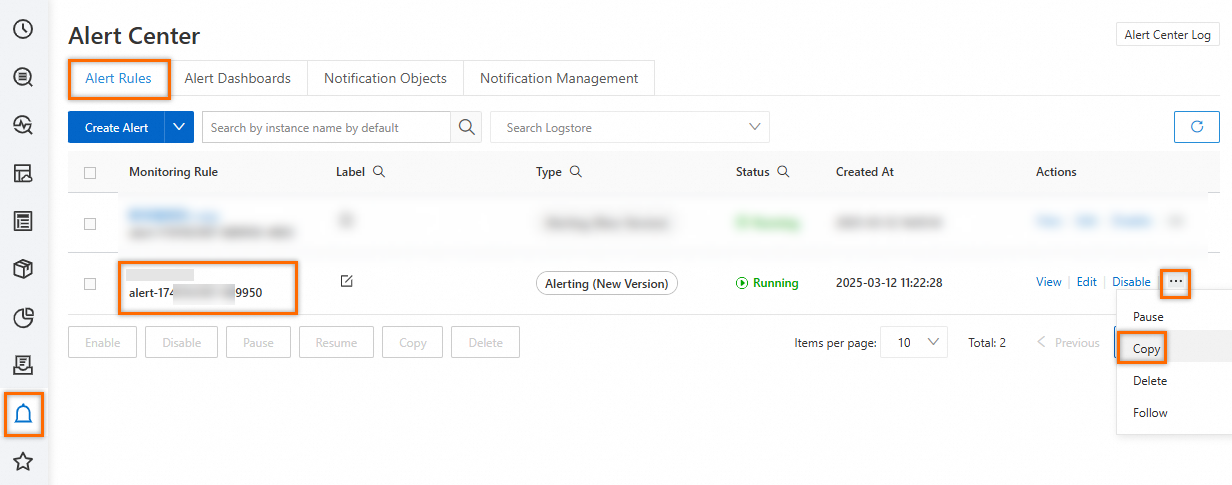
On the Alert Center page, click the Alert Rule tab, and then click the target alert rule.
On the Alert Overview page, view the following information: The Alert History Statistics section displays charts that show the history of alerts triggered by this rule.
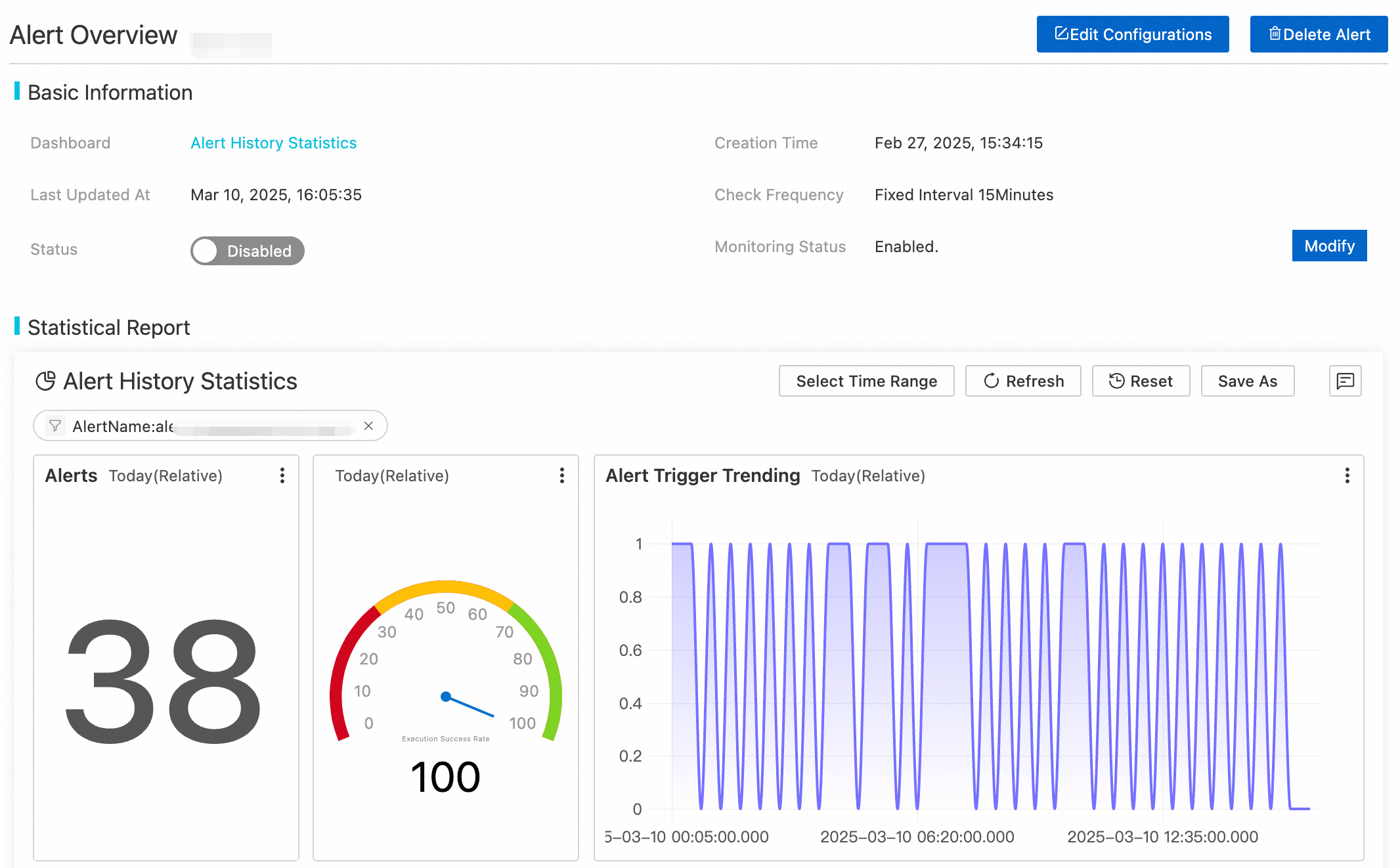
Dashboard: the dashboard associated with the alert rule.
Created At: the time when the rule was created.
Last Updated At: the time when the rule was last modified.
Check Frequency: how often SLS evaluates the rule.
Status: whether the rule is enabled or disabled.
Monitoring Status: whether alert notifications are active or suspended.
Modify an alert rule
Go to the Alert Overview page of the alert rule. For details, see View the details of an alert rule.
Click Edit Configurations.
Modify the parameters as needed. The parameters are the same as those used when you create an alert monitoring rule.
Click OK to save the changes.
Enable or disable an alert rule
Go to the Alert Overview page of the alert rule. For details, see View the details of an alert rule.
In the Basic Information section, toggle the alert rule on or off.

After you disable an alert rule, SLS no longer checks log data or sends alert notifications based on the rule.
Suspend or resume alert notifications
Suspend notifications
Notifications can be suspended only when the monitoring status of an alert rule is Enabled.
Go to the Alert Overview page of the alert rule. For details, see View the details of an alert rule.
Click Modify to the right of Monitoring Status.
In the Disable Alert Notifications panel, configure Disabled Duration to specify how long notifications are suppressed.
Resume notifications
After you suspend notifications, check the Monitoring Status value on the Alert Overview page to see when notifications are scheduled to resume automatically.
To resume notifications before the scheduled time:
On the Alert Overview page, click Modify to the right of Monitoring Status.
In the message that appears, click OK.

When notifications are suspended, SLS continues to check data on schedule. However, no alert notifications are sent, even if the trigger condition is met.
Delete an alert rule
Go to the Alert Overview page of the alert rule. For details, see View the details of an alert rule.
Click Delete Alert.
Confirm the deletion.
Deleted alert rules cannot be restored. Proceed with caution.
Copy an alert rule
Copy an alert rule to a different project to apply the same alerting logic without reconfiguring the rule from scratch.
Before you begin
Dashboard overwrite risk: If the alert rule is associated with a dashboard, the dashboard is also copied. If the destination project already contains a dashboard with the same ID, the existing dashboard is overwritten.
Logstore matching: If you do not select a destination Logstore, the system searches for a Logstore in the destination project with the same name as the source. If no matching Logstore exists, a
LogStoreNotExisterror occurs.
Procedure
Log on to the Simple Log Service console.
In the Projects section, click the target project.
In the left-side navigation pane, click Alerts.
On the Alert Rules tab of the Alert Center page, find the target alert rule. In the Actions column, click Copy.
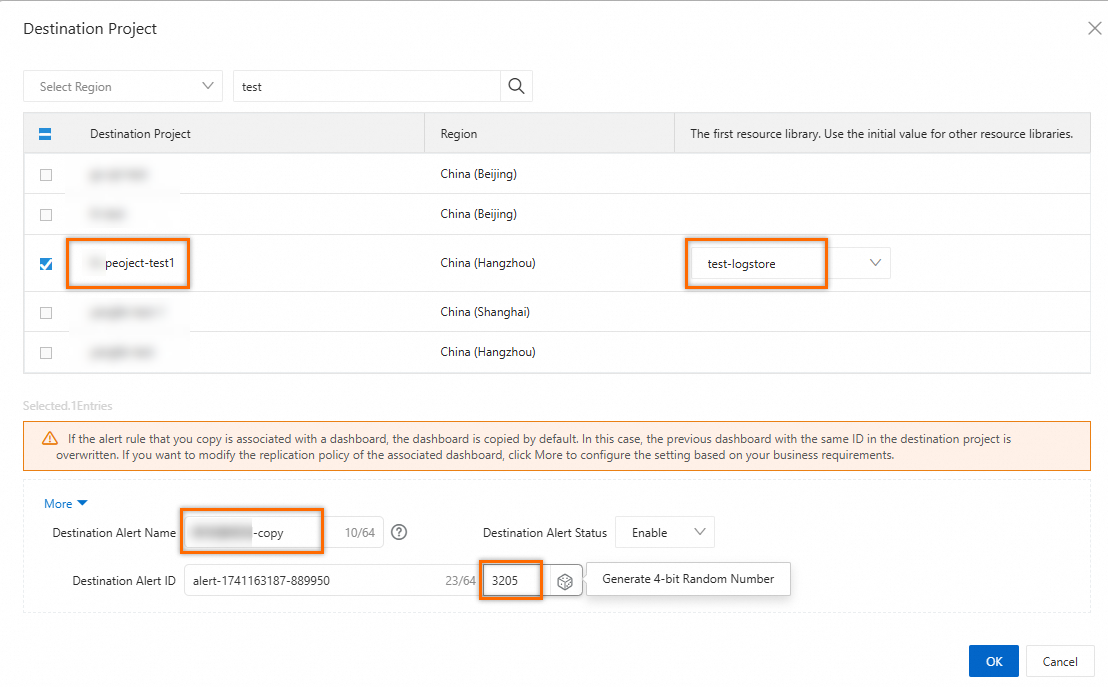
On the Destination Project page, select a destination project and Logstore. In the More section, modify the following fields as needed:
Destination Alert Name
Destination Alert Status
Destination Alert ID
Click OK.
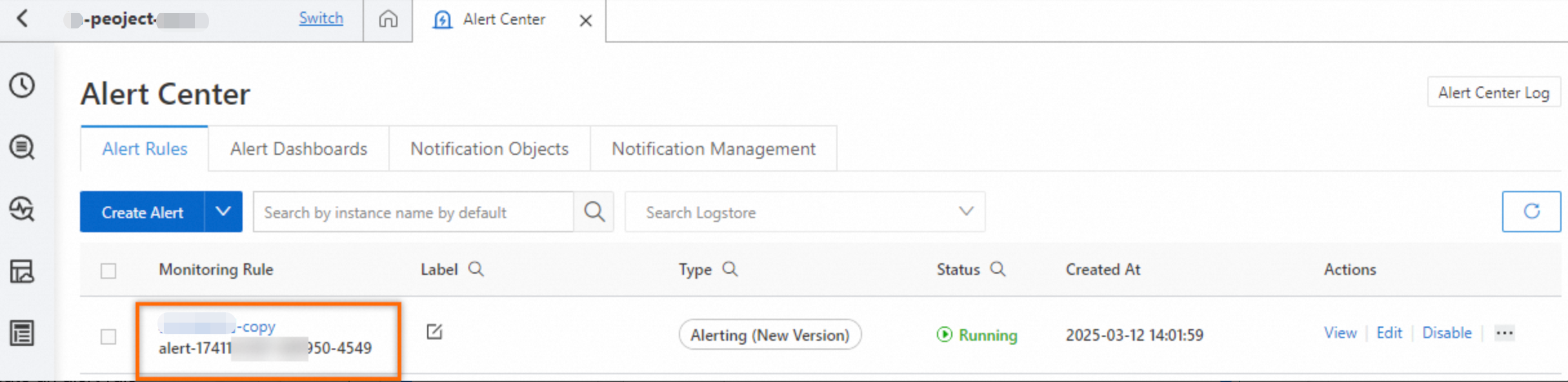
View the copy result.

Click the destination project and verify that the alert rule appears on the Alert Center page.