Serverless App Engine (SAE) helps you quickly migrate applications to the cloud. You do not need to manage or maintain the underlying infrastructure. SAE helps you reduce development and O&M costs. You can manage the lifecycle of an application in the SAE console. This topic describes how SAE helps a large-sized and state-owned enterprise to perform cloud-native transformation. SAE helps the enterprise resolve multiple issues that are related to scalability, O&M, and team collaboration.
Background information
Guizhou Hotel Group Co., Ltd. (hereinafter referred to as Guizhou Hotel Group) was registered and established on February 28, 2019. Guizhou Hotel Group is a province-managed and large-sized enterprise approved by the Guizhou Provincial People's Government and sponsored by the provincial State-owned Assets Supervision and Administration Commission of the State Council (SASAC). The enterprise has 23 wholly-owned and holding subsidiaries, more than 80 self-operated and commissioned hotels (projects), and approximately 13,000 guest rooms.
Guizhou Hotel Group builds a "1 + N" business structure that consists of the core business sector (hotel operation and management) and multiple supporting business sectors (tourism and commodities, education and training, conferences and exhibitions, e-commerce technology, and Guizhou cuisine catering). Guizhou Hotel Group plans to build a tourism industry cluster that contains hotels, specialty catering, and education and training.
In 2020, Guizhou Le Lv Network Technology Co., Ltd. (hereinafter referred to as Le Lv Network) was established. Le Lv Network aims to build a modern information system for Guizhou Hotel Group. In the early stage, the Le Lv Network R&D team was composed of only a few developers who quickly built an information system for internal and external business. As the business grows and market demand changes, the number of developers of Le Lv Network increases from three or four to a dozen and more system modules are released. The information system of Guizhou Hotel Group was initially deployed on Elastic Compute Service (ECS) instances. The system was split into multiple components based on the microservices architecture and developed based on the ASP.NET Core framework. To meet development requirements, Le Lv Network and Alibaba Cloud formed a strategic partnership to build the information platform of version 2.0 based on Alibaba Cloud.
Challenges
The following table describes the challenges faced by Le Lv Network when it performed development and O&M operations on the original information platform. The table also describes the benefits of the information platform 2.0 that uses SAE.
Challenge | Benefit |
Low scalability of components: The business loads of Guizhou Hotel Group have obvious fluctuations (peaks and troughs). Le Lv Network launches activities on the information platform on a regular basis. In this case, unpredictable traffic peaks may occur, and the existing scaling and estimation methods of the information platform may fail to provide accurate estimation and scale backend resources. | SAE provides multiple types of auto scaling policies. For example, you can configure a scheduled auto scaling policy or an auto scaling policy that is triggered based on cloud-native metrics such as CPU and memory and business-related metrics such as QPS and response time (RT). The resource pool is maintained by SAE and you do not need to perform O&M operations. SAE provides a high-availability solution with fine-grained capacity control, elastic scalability, and throttling and bandwidth degradation. SAE helps you efficiently handle peak traffic based on the solution. |
Low system stability: The system stability-related issues become more prominent during peak hours because the original architecture that is used by the information system provides low scalability. The R&D team also needs to handle large amounts of business requirements and development tasks, and has insufficient O&M engineers. | You do not need to manage or maintain the underlying infrastructure, such as IaaS, Kubernetes, microservices components, and application performance monitoring (APM) components. You also do not need to use self-managed ZooKeeper, Eureka, Consul, or SkyWalking. SAE helps you reduce development and O&M costs, and maximize resource utilization to perform application lifecycle management. SAE ensures the stability of applications that you want to commercialize. |
Incomplete multi-environment construction: The offline test environment is isolated from the online production environment. Specific scenarios in the offline test environment are not suitable for the online production environment. In this case, unexpected errors may occur when an offline-tested component is released in an online environment. A specified version of a faulty component cannot be quickly restored because the original system does not provide the version management capability that can ensure code assets. | SAE provides applications with network environments that are logically isolated based on virtual private clouds (VPC) and namespaces. After you create an application, you can upgrade the application by using the canary release method or phased release method. If an issue occurs on the new version, you can roll back the application to an earlier version with a few clicks to ensure the security and stability of the application. |
Low team collaboration efficiency: The entire system contains multiple modules that are separately managed by different R&D teams. Each team must maintain an ECS instance. In most cases, issues and tasks are followed up mainly by offline communication. The release process of an application requires collaboration between upstream and downstream services, and the application must be released in the order of dependencies. A release process requires a long period of time to complete and team collaboration is difficult to perform. | SAE provides an enterprise-level permission management system. You can use the SAE permission management system to isolate applications, resources, and data, and implement access control. This ensures the security of applications. |
Incomplete monitoring system: The original system does not provide a unified observation platform during application runtime. If an error occurs, the R&D team must check each subsystem to troubleshoot the error without appropriate tools. | SAE is seamlessly integrated with Application Real-Time Monitoring Service (ARMS) to monitor and diagnose applications in a visualized manner. You can efficiently identify slow SQL statements, slow methods, and method-call stacks. You can also analyze, troubleshoot, and resolve online issues and configure alerts. |
Solution
The following figure shows the solution that is used by Guizhou Hotel Group. 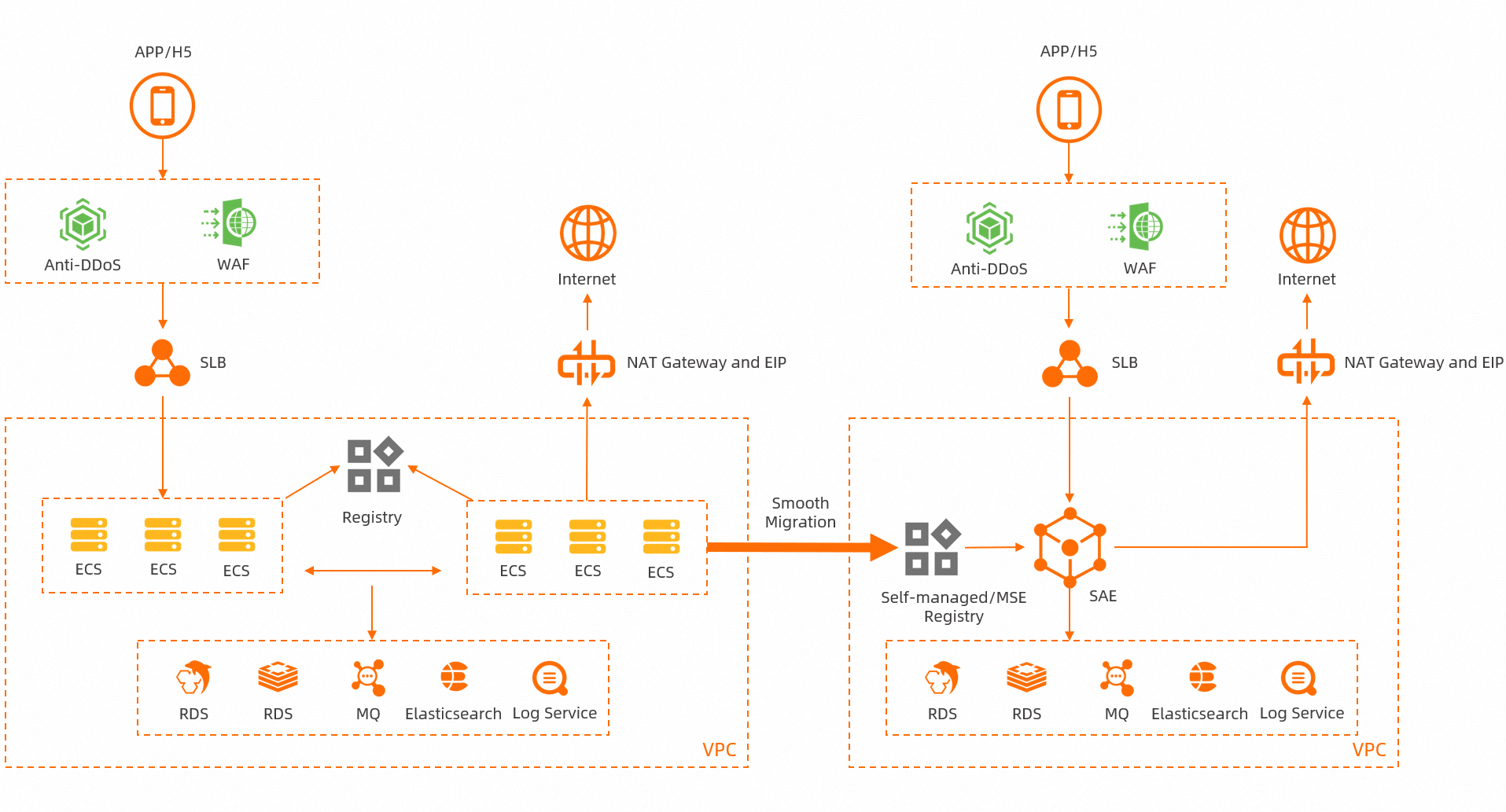
The original system of Guizhou Hotel Group was developed based on the microservices architecture. The components that are deployed on ECS instances can be converted to different applications and smoothly migrated to SAE without the need to significantly modify code. SAE provides multiple capabilities such as underlying resource scheduling, application deployment, canary release, microservices governance, and monitoring and diagnostics. Guizhou Hotel Group can manage the full lifecycle of applications in the SAE console with a few clicks. This simplifies the O&M process. The auto scaling feature of SAE allows Guizhou Hotel Group to dynamically perform scaling operations on applications within seconds based on traffic to minimize idle resources. This ensures that the business of Guizhou Hotel Group is stable during peak hours and helps Guizhou Hotel Group reduce resource costs during off-peak hours. SAE is integrated with Resource Access Management (RAM) to provide namespace-level and application-level permission isolation capabilities. SAE helps Guizhou Hotel Group efficiently manage applications, start and stop applications with a few clicks, improve application security, and reduce the costs of idle resources.
Effect
The project team builds the information platform 2.0 that combines the preceding SAE capabilities without the need to significantly modify code and the information platform 2.0 meets the initial requirements. The project team has built a process specification in development, O&M, and collaboration, and caught up with its competitors.
The project team completed the overall cloud migration in February 2022. After the new system was released, the difficulties in O&M operations were significantly reduced by using the SAE console. The project team performs auto scaling by using hybrid auto scaling policies that are triggered based on the RT metric and specific scheduled time. No O&M engineers are required and repeated work is reduced.
The project team uses RAM to manage permissions. This way, the developers, test engineers, and O&M engineers can complete different types of jobs by using different user identities in the SAE console. This improves team collaboration efficiency. After the SAE-based system is released, the development efficiency is increased by more than 50%, the server costs are decreased by 20%, the O&M labor costs are decreased by 60%, and the scaling speed is ten times faster than before. The initial requirements are met. After the first phase of the project is completed, the project team plans to optimize more technical points in the information platform by collaborating with the R&D team of SAE.