When applications run on Kubernetes clusters, tracking pod-level resource consumption helps identify performance bottlenecks and capacity issues. Enterprise Distributed Application Service (EDAS) integrates with Prometheus and provides a built-in Grafana dashboard that displays CPU, memory, and network metrics for each pod in your application. You can also modify dashboard properties such as the time interval and refresh rate.
Prerequisites
Before you begin, make sure that you have:
An application deployed on a Kubernetes cluster in EDAS
Open the Prometheus dashboard
Log on to the EDAS console.
In the left-side navigation pane, choose Application Management > Applications.
In the top navigation bar, select a region and select a microservices namespace from the Microservices Namespace drop-down list.
Select Kubernetes Cluster from the Cluster Type drop-down list, and then click the name of the target application.
In the left-side navigation pane, choose Monitor > Prometheus. The Kubernetes Container Replica page opens in Grafana.
Dashboard metrics
The dashboard organizes metrics into five categories. Use the pod selector at the top of the page to switch between pods and view metrics for different pods.
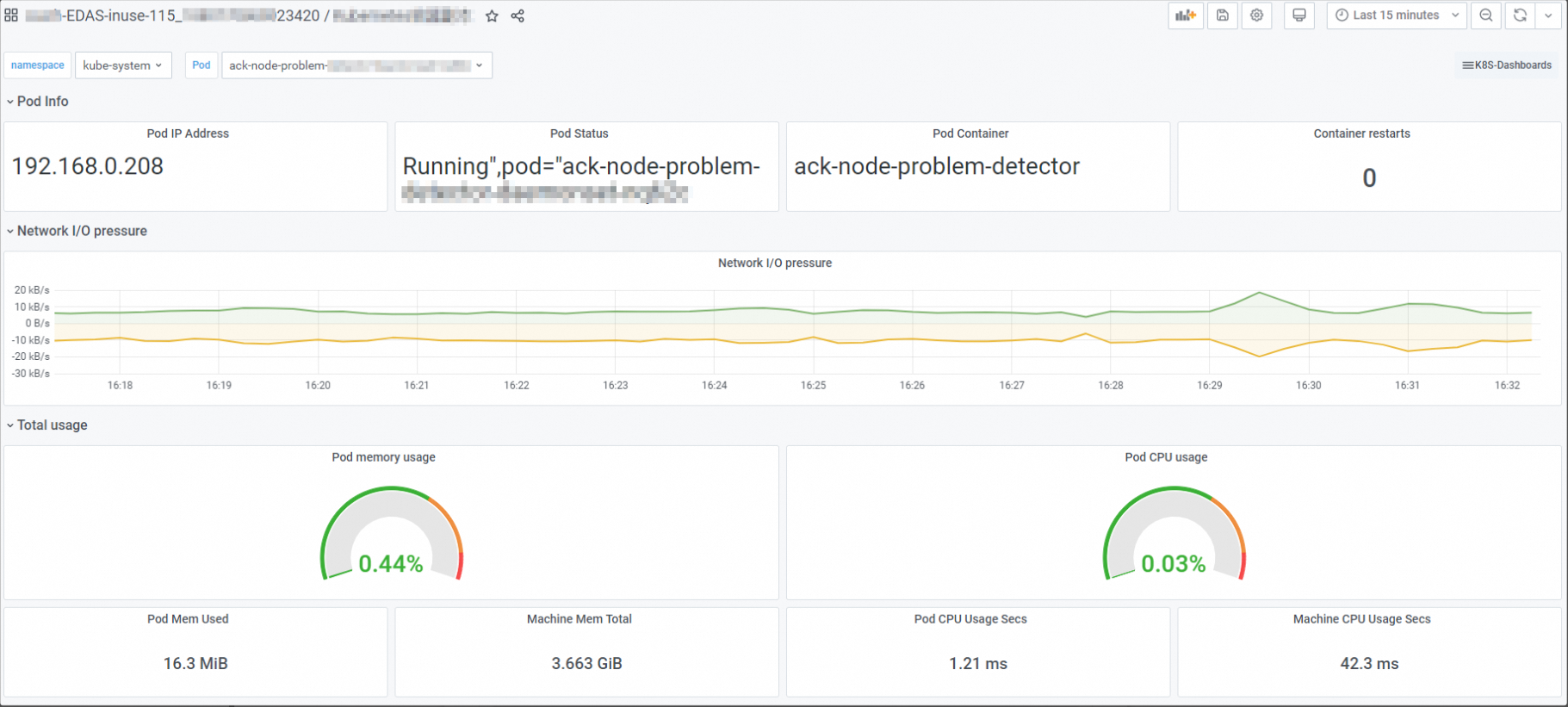
Pod information
| Metric | Description |
|---|---|
| Pod IP Address | The IP address assigned to the pod |
| Pod Status | The current status of the pod |
| Pod Container | The containers running inside the pod |
| Container restarts | The number of container restarts |
Overall resource usage
| Metric | Description |
|---|---|
| Pod CPU usage | Total CPU consumed by the selected pod across all its containers |
| Pod memory usage | Total memory consumed by the selected pod across all its containers |
CPU metrics
| Metric | Description |
|---|---|
| Pods CPU usage | Aggregated CPU consumption across all pods in the application |
| All processes CPU usage | Total CPU consumption of all processes |
Memory metrics
| Metric | Description |
|---|---|
| Pods memory usage | Aggregated memory consumption across all pods in the application |
| All processes memory usage | Total memory consumption of all processes |
Network metrics
| Metric | Description |
|---|---|
| Network I/O pressure | Overall network load indicator for the pod |
| Pods network I/O | Inbound and outbound network traffic for all pods in the application |
| All processes network I/O | Total network traffic for all processes |
Interact with dashboard panels
Click a panel title to open a context menu with the following actions.
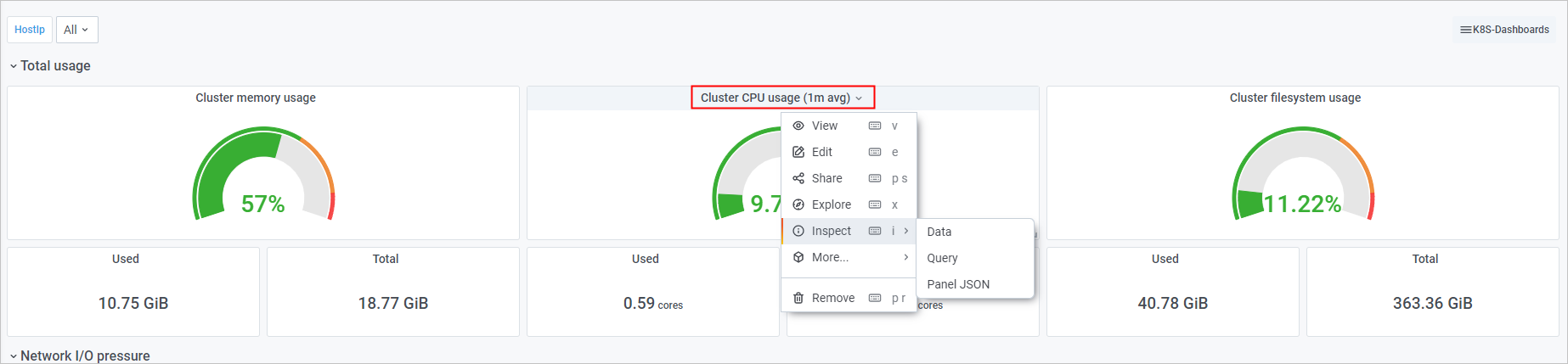
View and edit panels
| Action | Steps | Keyboard shortcut |
|---|---|---|
| View in full screen | Click View or press V. Press V or Esc to exit full screen. | V |
| Edit a panel | Click Edit, modify panel settings on the Edit Panel page, and then click Apply in the upper-right corner. | E |
| Explore metric data | Click Explore to open the Explore page where you can check metrics, troubleshoot issues, or explore data. | X |
Share and export panels
| Action | Steps | Keyboard shortcut |
|---|---|---|
| Share a panel | Click Share to get a sharing link, embedded link, or snapshot link in the Share Panel dialog box. | P then S |
| Export data as CSV | Choose Inspect > Data, and then click Download CSV. | -- |
| View query details | Choose Inspect > Query to see the request and response. | -- |
| Copy panel JSON | Choose Inspect > Panel JSON, and then copy the JSON from the JSON tab. | -- |
Duplicate or copy panels
| Action | Steps | Keyboard shortcut |
|---|---|---|
| Duplicate to current dashboard | Choose More > Duplicate. | P then D |
| Copy to clipboard | Choose More > Copy. | -- |