This document describes how to view the fees for your Elastic Compute Service (ECS) resources and export bills from the Bill Details page.
View billing details
Fees for some resources associated with ECS are not included in the ECS bill. These fees are recorded in the bills for their respective products. For example, fees for independently created data disks and snapshots are recorded in the bills for Elastic Block Storage and Snapshot, respectively. Fees for a static public IP address are included in the ECS bill. If you attach an Elastic IP Address (EIP) to your instance or enable Cloud Data Transfer (CDT), you must query the bandwidth or traffic fees in the bills for products such as CDT or EIP.
Subscription and pay-as-you-go instances
On the Bill Details page, select ECS from the Product Name filter.
Select a billing month and click Query.
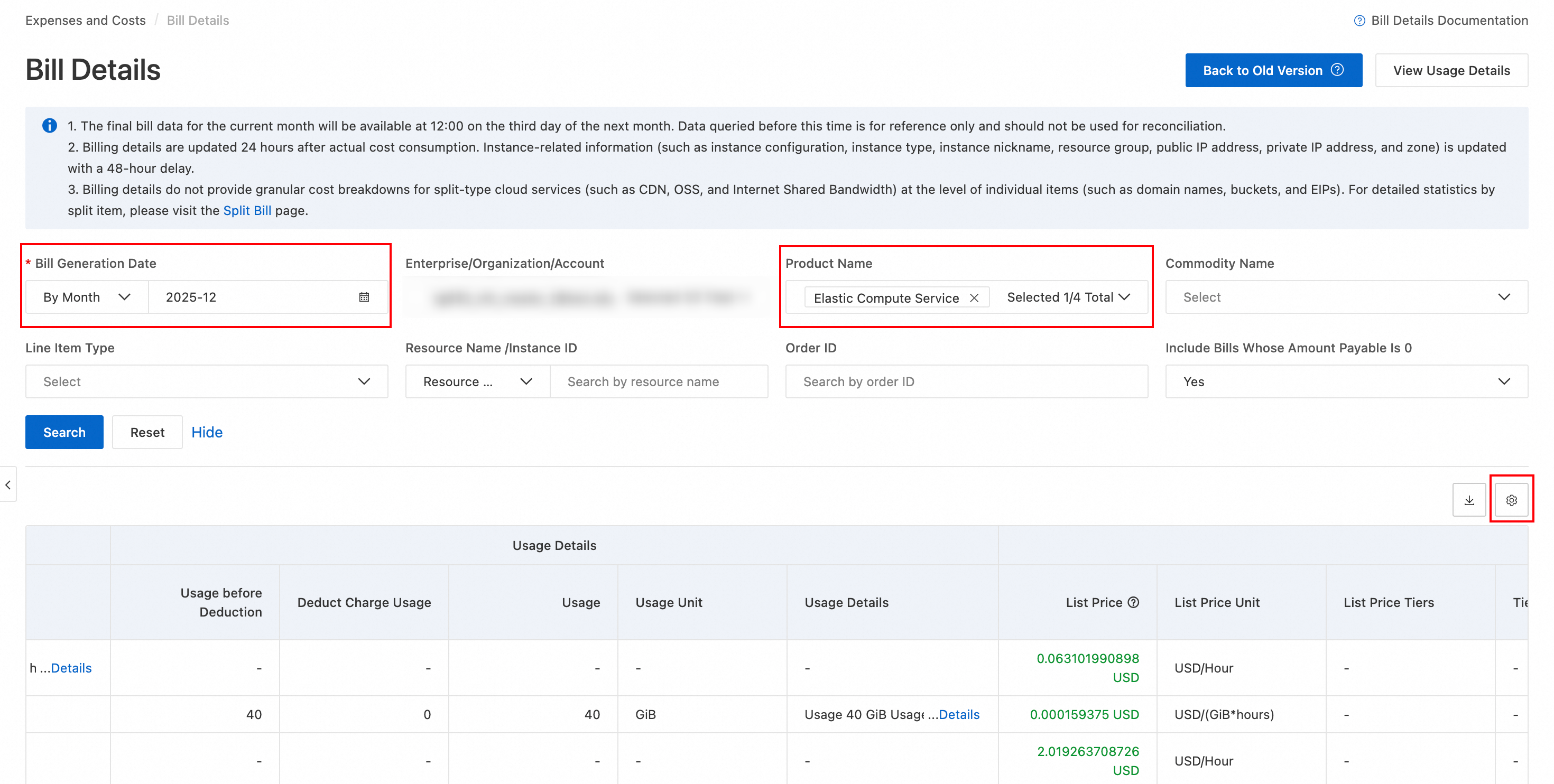
(Optional) On the results page, perform the following operations:
Customize columns: To view more information, such as instance tags, click the
 icon in the upper-right corner and select the columns.
Export for batch analytics: Click the
 icon in the upper-right corner to export the current query results as a CSV file for batch analytics.
Spot instances
Spot instances are offered at a discount compared to pay-as-you-go instances. The system tag key:acs:ecs:payType value:spot is automatically attached to all spot instances that you create. In the exported bill, you can filter for ECS instances by this tag to summarize the charges and discount amounts. Perform the following steps:
Enable the acs:ecs:payType cost allocation tag.
Log on to the Expenses and Costs console.
In the navigation pane on the left, choose .
In the Tag Key text box, enter acs:ecs:payType and click Search.
Click Enable in the Actions column for the acs:ecs:payType tag.
Choose .
To query by billing item, set Statistic Item to Billable Item and Statistical Period to Billing Period. Then, view the bill for the spot instance.
Before you query, click the
 icon in the upper-right corner to .
View the bill for a single spot instance.
In the instance ID text box, enter the spot instance ID and click Search to view the bill for that spot instance.
View the bills for multiple spot instances in a batch.
Filter by the commodity name ECS (Pay-As-You-Go).
Click
and select Instance Tag from the column list.Click
to export a CSV file of the current selection.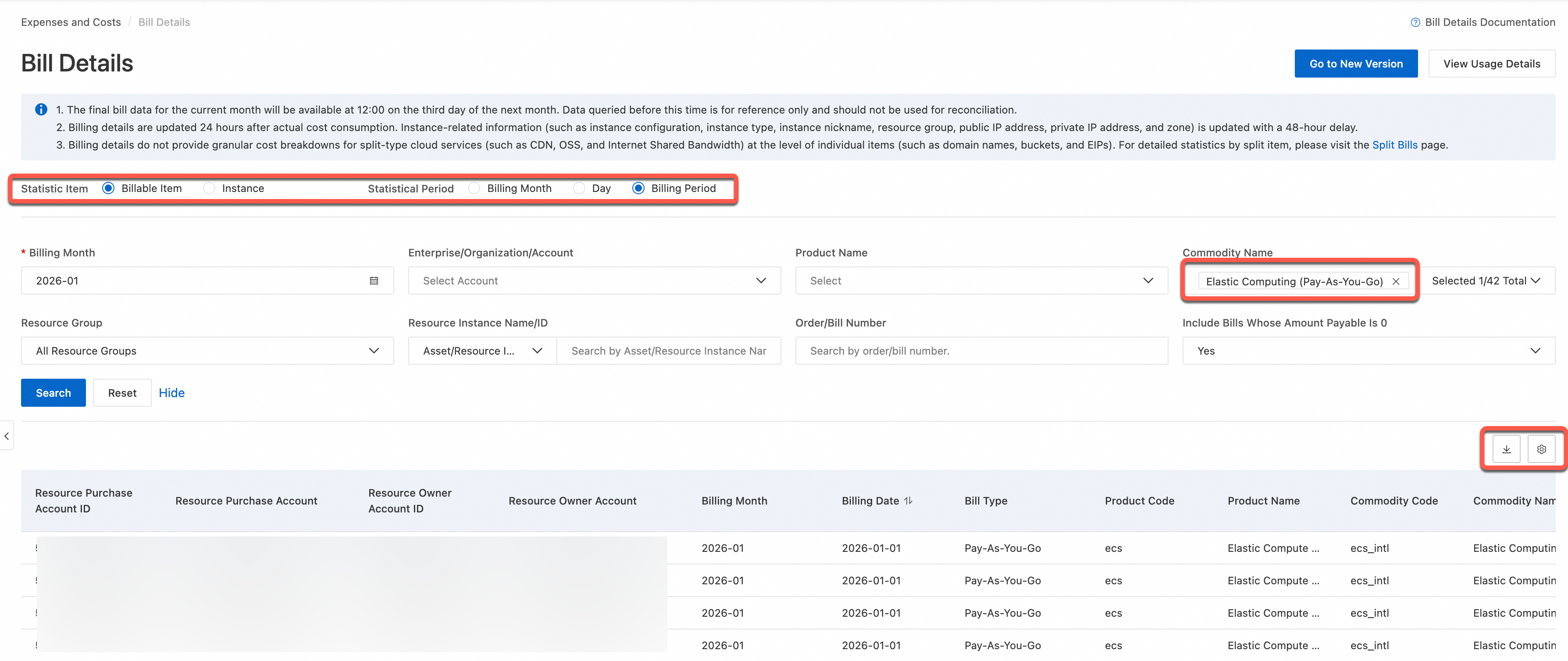
In the exported bill, filter for spot instances by the tag
key:acs:ecs:payType value:spotin the Instance Tag column.
Query usage details
You must export usage details to a CSV file to view them. Go to the Bill Details page and click View Usage Details in the upper-right corner. Configure the following parameters and click Export CSV.
Parameter | Description |
Time Period | Select the time range to query. You can query and export usage details for the last 12 months. To query usage details from more than 12 months ago, submit a ticket. You can query usage only within a single calendar month. For example, if the start time is 2024-07-01, the end time can be no later than 2024-07-31. You cannot select 2024-08-01. |
Commodity Name | Select ECS (Subscription), ECS (Pay-As-You-Go), or Snapshot. |
Billable Item | The available options vary by product. See the page for details. |
Billable Item | The available options vary by product. See the page for details. |
Time Unit | Select Hour. |
FAQ
Why am I still charged for my ECS instance after it is stopped?
Whether you are charged for a stopped instance depends on its billing method and status:
Pay-as-you-go instances: Charges stop only after you release an instance.
Normal stop mode (the economical mode is not enabled): Even when the instance is stopped, you are still charged for the instance type (including compute resources such as vCPU, memory, and GPU), disks, images, and public bandwidth.
Economical mode enabled: You are no longer charged for resources such as the vCPU, memory, GPU, FPGA, and static public IP address of the instance, or for the image license. However, you are still charged for the instance's disks (system and data disks).
Subscription instances: You pay for these instances upfront. Stopping the instance does not affect the fees you have already paid, and no refund is provided.
Why does my subscription ECS instance generate pay-as-you-go bills?
A subscription instance can generate pay-as-you-go bills if you enable pay-as-you-go features when you purchase the instance, or if you change its configuration or attach pay-as-you-go resources to it later. Common scenarios include the following:
You configured the subscription ECS instance in one of the following ways at purchase, or you changed the instance configuration to one of the following ways after purchase:
You selected the pay-by-traffic billing method when you configured public bandwidth.
The system disk or data disk is an ESSD AutoPL disk with provisioned performance configured.
If the system disk or data disk is an ESSD AutoPL disk with performance burst enabled, you are charged for performance bursts on a pay-as-you-go basis.
If you configure an automatic snapshot policy for the instance, you are charged for snapshot storage when snapshots are created.
The instance is a burstable instance with unlimited mode enabled. If the instance uses more CPU credits than it has, extra credit fees are incurred.
You performed one of the following operations on the subscription instance:
You attached a pay-as-you-go data disk.
You attached pay-as-you-go public network products, such as pay-as-you-go elastic IP addresses (EIPs), Server Load Balancer, or NAT Gateway.
You can create a custom image or a manual snapshot.
To switch these pay-as-you-go resources to the subscription billing method, see Switch between billing methods.
Why can't I view the historical traffic usage for an ECS instance that uses the pay-by-bandwidth billing method?
For an ECS instance that uses the pay-by-bandwidth billing method, the fee is fixed and independent of the actual traffic usage. Therefore, the billing system does not record detailed traffic usage data. You can view real-time bandwidth monitoring graphs in CloudMonitor, but you cannot query historical traffic usage from your bill.