The data transmission service allows you to synchronize data between data sources in real time. It is applicable to business scenarios such as active geo-redundancy, remote disaster recovery, data aggregation, and real-time data warehousing.
To create and manage a data synchronization task, perform the steps shown in the following figure.
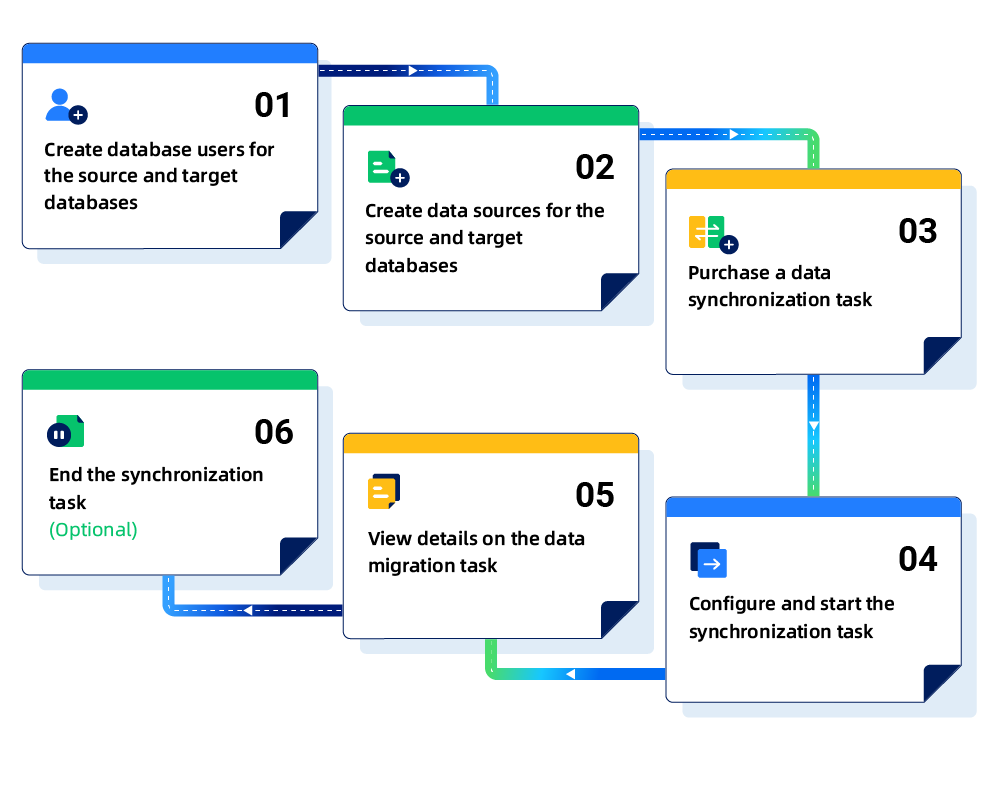
Prepare for data synchronization to make sure that the following conditions are met:
The data transmission service has the privilege to access cloud resources. For more information, see Grant privileges to roles for data transmission.
You have created dedicated database users for data synchronization in the source and target databases and granted corresponding privileges to the users. For more information, see Create a database user.
Create data sources.
In the left-side navigation pane, choose Data Transmission > Data Source Management. On the page that appears, create source and target data sources. For more information, see Create a data source.
Purchase a data synchronization task.
Purchase a data synchronization task of the corresponding type based on your business needs. For more information, see Purchase a data synchronization task.
Configure the data synchronization task and start it after the precheck is passed.
For more information, see the topics for data synchronization tasks of the corresponding types.
View the status of the data synchronization task.
After the data synchronization task is started, it will be executed based on the selected synchronization types. For more information, see View details of a data synchronization task.
(Optional) Stop the data synchronization task.
After the data synchronization task is completed, if data no longer needs to be synchronized from the source database to the target database, you can stop the current data synchronization task. For more information, see Stop a data synchronization task.