By Tongyi Lab
Agents are no longer research demos. Today they write code, browse the web, manipulate files, and complete multi-step workflows.
But when an agent fails, it’s surprisingly difficult to answer a simple question:
Was the model not capable enough—or did the harness fail to support it properly?
To answer that question, the AgentScope team introduced PawBench, a benchmark designed specifically for evaluating the combined performance of models and agent harnesses.
PawBench is part of the OpenJudge ecosystem. It inherits OpenJudge’s philosophy of evaluation-driven optimization, with a specific focus on the joint effect of LLM × Harness.
Most benchmarks evaluate models in isolation. Real-world agents, however, are never deployed that way.
In practice, the model determines what an agent could potentially do; while the harness determines whether that capability can reliably translate into successful task execution.
Agent Performance = f(Model, Harness)
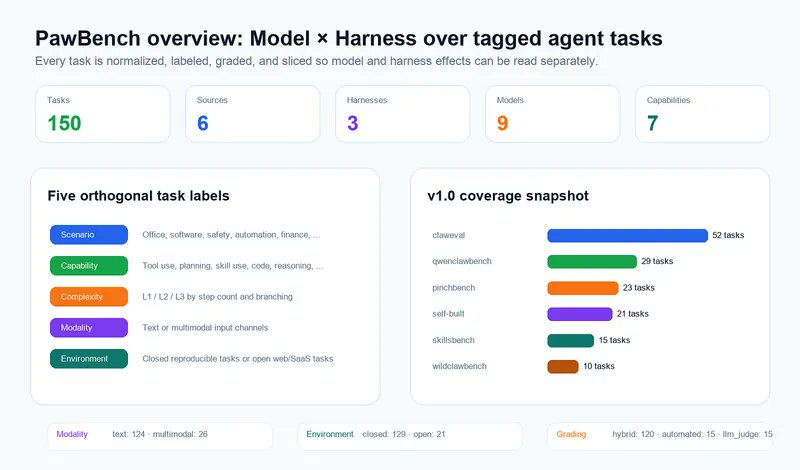
PawBench v1.0 contains:
The benchmark evaluates every combination:
9 Models × 3 Harnesses × 150 Tasks = 4,050 test cells
The 150 tasks were curated from six high-quality agent benchmarks: claweval, qwenclawbench, pinchbench, qwenpawbench, skillsbench, and wildclawbench.
Each task is tagged along five dimensions: application scenario, atomic capability, complexity, input modality, and runtime environment.
All tasks run inside Docker sandboxes and is fully traceable, making it possible to connect benchmark scores back to actual execution behavior.
The final score combines automated graders, including rule checks and sub-assertions, with LLM-as-judge for more semantic outputs. Scores are normalized to the 0–1 range and reported as percentages in this article.
Start with the text-task matrix.
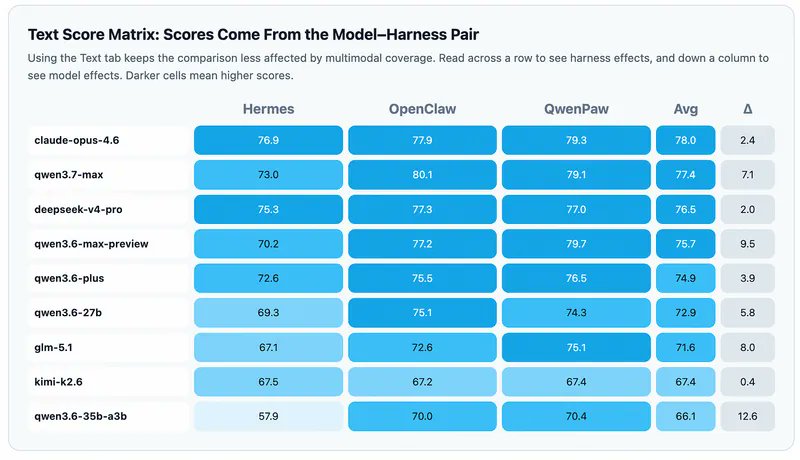
The takeaway is simple:
Model capability still matters, but harnesses can introduce measurable performance differences.
The leaderboard is only the starting point. The more interesting question is:
Where do those missing points actually come from?
Where Models Differ: Strengths and Weaknesses by Slice
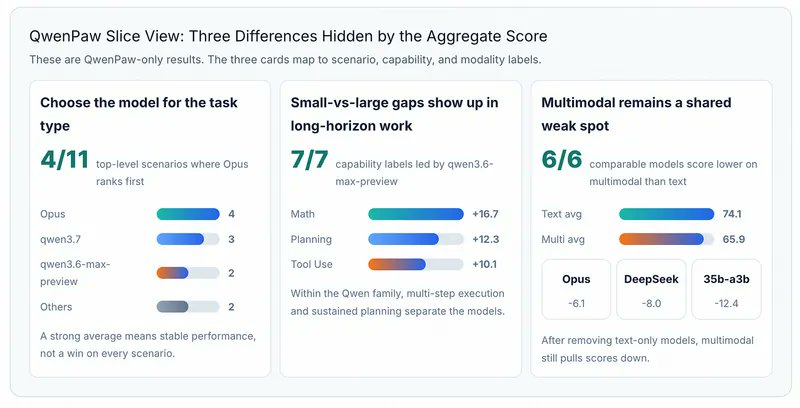
Across 4,050 cells, a clear pattern emerges: models don’t just differ in score—they fail in different ways.
To focus on model-side differences first, we fix the harness to QwenPaw and slice the same submissions by task labels.
Fixing the harness clarifies model differences. The next question is how these gaps change across different harness designs.
PawBench can slice the 4,050 cells by model size, modality, task type, skill domain, and more, then compare those slices against execution traces. This shows how model capability and harness behavior interact.
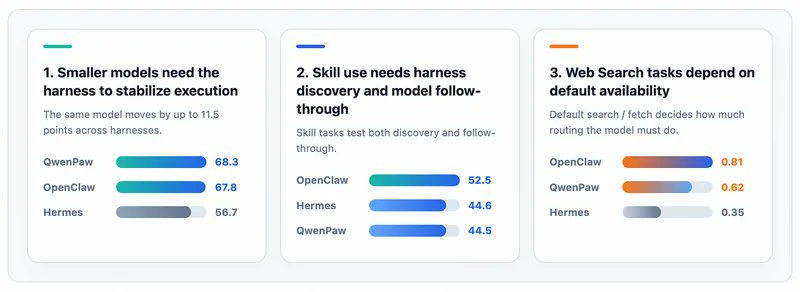
Start with two extremes. claude-opus-4.6 is stable across harnesses (2.3-point spread), while qwen3.6-35b-a3b shifts by 11.5 points depending only on the harness.

This gap shows a clear pattern: larger models can compensate for missing context: they infer paths, filter a larger tool list, and check whether artifacts were actually produced. Smaller models are more brittle. They lose track of current working directory, misjudge whether a file was written, or choose the wrong first tool when the tool list is too large.
Trace analysis points to three common failure sources:
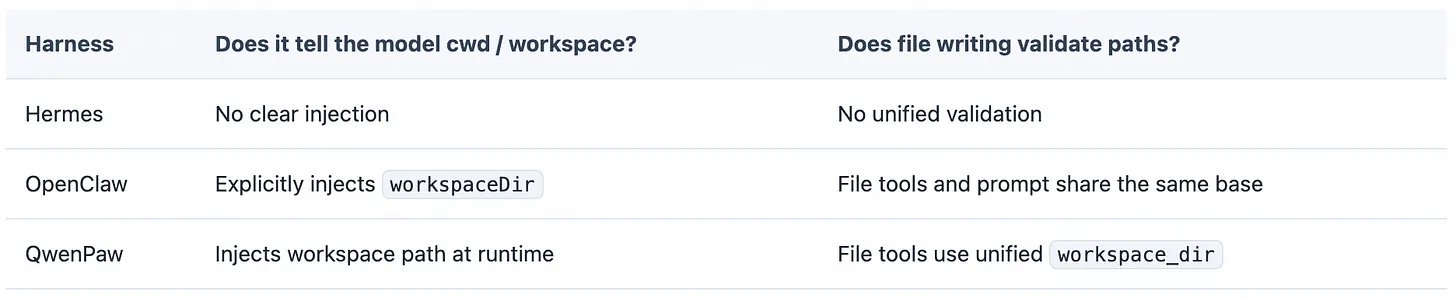
The takeaway is not that small models are weak, but that they rely more on harness structure.
Many developers store project-specific skills directly inside their workspace. PawBench simulates this setup to evaluate whether harnesses can discover and utilize them.
Across all three harnesses, Skill-related tasks were consistently more difficult than categories such as tool use, planning, or reasoning.
Two issues stand out:
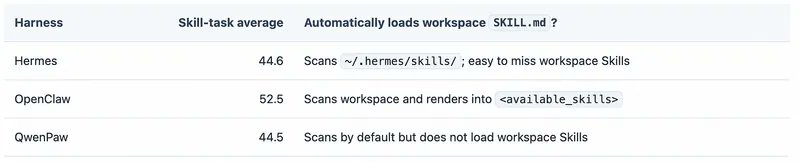
So success requires both: the harness must surface Skills clearly (name, scope, usage), and the model must reliably decide to invoke them.
If either side breaks, the model bypasses the Skill and tries to solve the task with general reasoning.
Web Search tasks test the model’s ability to search the web, fetch content, and do deeper research. PawBench does not assume the best-case setup where every search API key is configured. Instead, it recreates the default developer experience: clone a fixed version, add the LLM key, and run.
What we found:
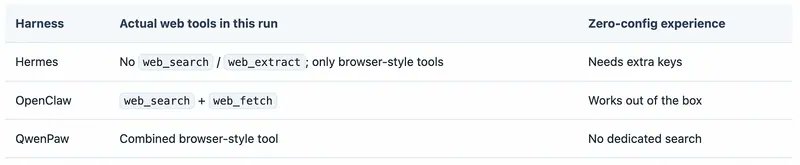
Importantly, results reflect both the model’s capabilities and whether the harness makes search usable by default.
Trace behavior shows a split:
In other words, strong models can route around missing tools; weaker models depend on the harness keeping the search path stable and explicit.
Based on the benchmark results, we believe effective harnesses should follow four simple principles:
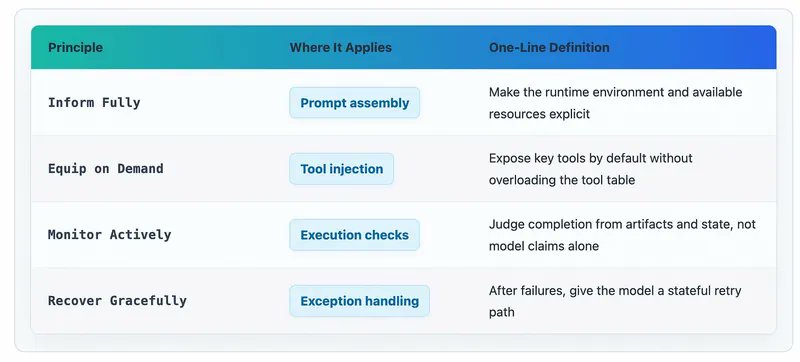
Models cannot act on information they do not have. Tell the model where it is, what resources exist, and what outputs are expected. Never assume the model will infer these details.
Tooling should be both sufficient and efficient. Provide the tools that matter, make sure critical tools are usable by default, but avoid overwhelming the model with unnecessary options.
Do not rely solely on what the model says. Verify artifacts, files, outputs, and execution results instead of just relying on agent self-reporting.
Many failures are recoverable if the framework provides useful feedback and retry opportunities. Provide critical information such as current state, missing requirements, and existing artifacts, and give the model a structured opportunity to recover.
PawBench helps agent users identify the best model–harness combination for their workload, and gives harness developers a way to measure and improve the systems.
The most important result from PawBench isn’t which model ranks first. It’s that agent performance is not a property of the model alone.
PawBench v1.0 is fully open source, and we welcome new harnesses, models, tasks, and contributions from the community.
Qwen-Image-Bench: Beyond Basic Generation — Evaluating T2I Models in Complex Scenarios

1,495 posts | 509 followers
FollowAlibaba Cloud Community - July 17, 2026
Alibaba Cloud Community - May 21, 2026
Alibaba Cloud Native Community - July 20, 2026
Alibaba Cloud Native Community - October 31, 2025
Alibaba Cloud Community - August 5, 2026
CloudSecurity - April 21, 2026
1,495 posts | 509 followers
Follow Alibaba Cloud Model Studio
A one-stop generative AI platform to build intelligent applications that understand your business, based on Qwen model series such as Qwen-Max and other popular models
Learn More Qwen
Qwen
Full-range, open-source, multimodal, and multi-functional
Learn More
Token Plan
Build more, spend less. One plan, every modality.
Learn More Alibaba Cloud for Generative AI
Accelerate innovation with generative AI to create new business success
Learn MoreMore Posts by Alibaba Cloud Community

