Now that your business is AI-driven, is your cybersecurity still stuck in the manual rule configuration phase?
Alibaba Cloud has been exploring AI technologies for intelligent DDoS protection for a long time. Through years of continuous refinement, we have established a mature defense system in traffic feature modeling and automated scrubbing, safeguarding traffic for massive numbers of customers.
However, as customers embark on AI-driven exploration, business traffic models are becoming increasingly complex. If security protection relies solely on identifying traffic features and lacks business context understanding, a one-size-fits-all "collateral damage" security operation will become the norm.
Cybersecurity defense systems cannot become business bottlenecks; the next round of evolution is born from real-world business scenarios. AI technology empowers traditional security, and Large Models drive the construction of a business-aware, thinking DDoS defense system.
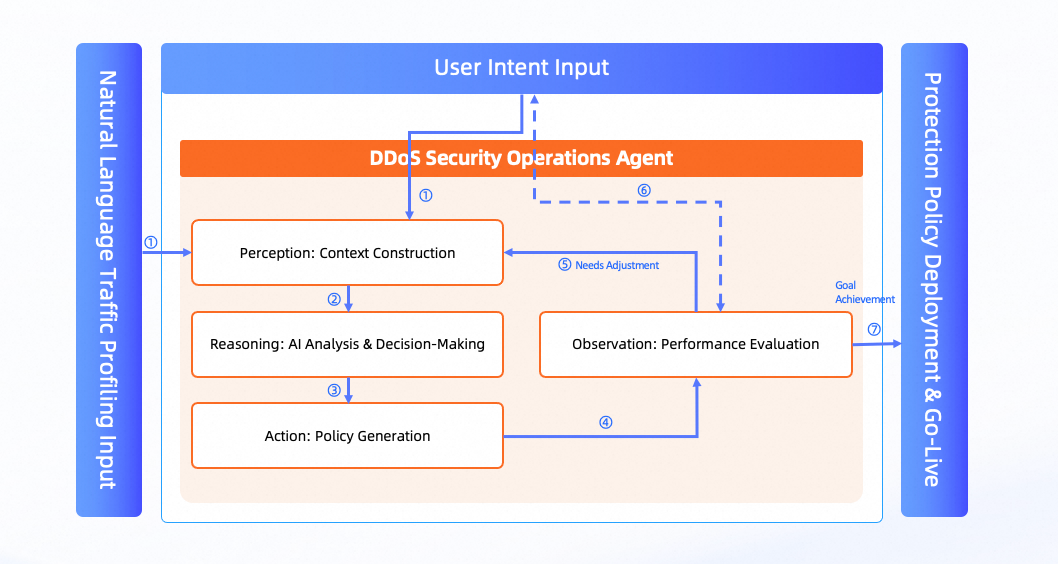
Powered by Large Language Models (LLMs), this cloud-native security agent supports natural language interaction, enabling the automated generation of protection policies.
● Natural Language Business Onboarding: Users describe business requirements in natural language (e.g., "Ensure homepage availability during the big sale"), and the system automatically identifies and converts them into executable options.
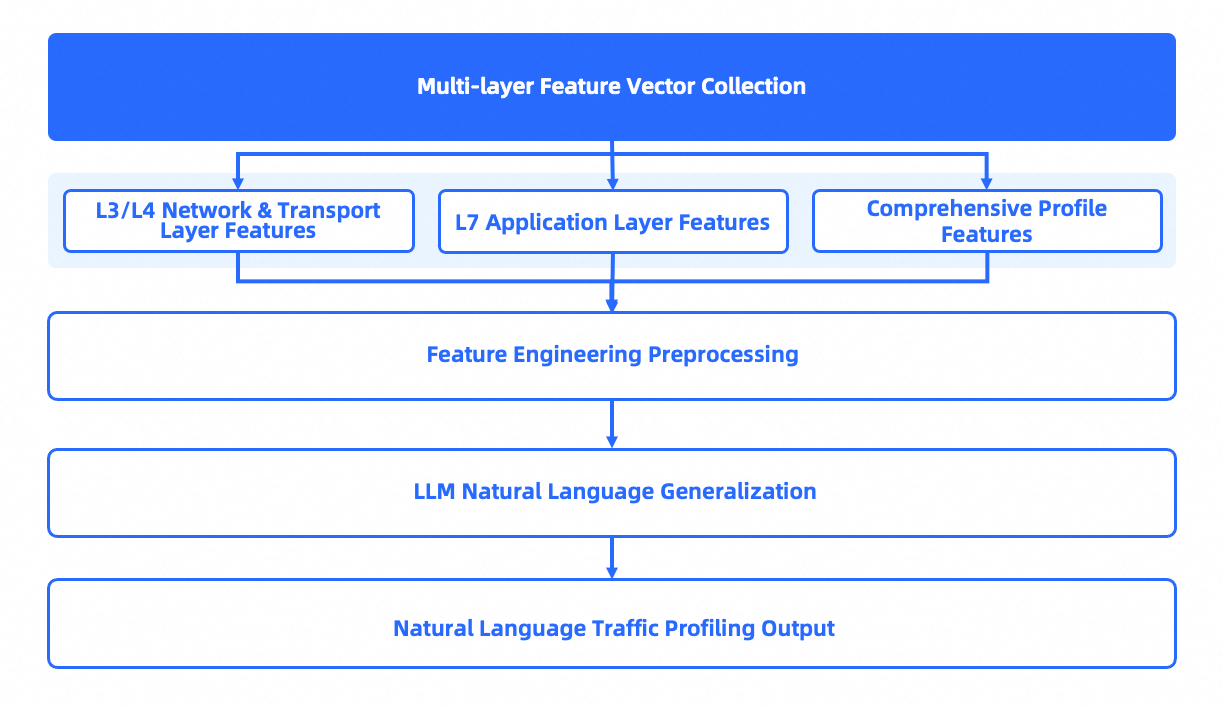
● Multi-Source Data Integration for Rich Context: Integrates multi-dimensional data such as IP/domain traffic, sessions, assets, and historical attacks. Through feature engineering and natural language generalization, it builds a dynamic context profile.
● Agentic Native Security Reasoning & Decision Making: Based on the Qwen Large Model, it combines "natural language profiling + intent recognition" to deduce threat scenarios in real-time and output interpretable mitigation strategies.
● Automated Execution via Multi-Module Orchestration: Orchestrates modules like log auditing, automated extraction, data masking, policy validation, and sandbox verification to ensure strategies are compliant and effective before deployment.
● Human Decision + Agent Execution: Supports "Direct Execution" or "Authorized Execution," retaining human intervention rights at critical nodes.
● AI-Driven Precision: Performance Monitoring → Policy Evaluation → Model Iteration. This forms a self-learning closed loop, becoming more precise with use.
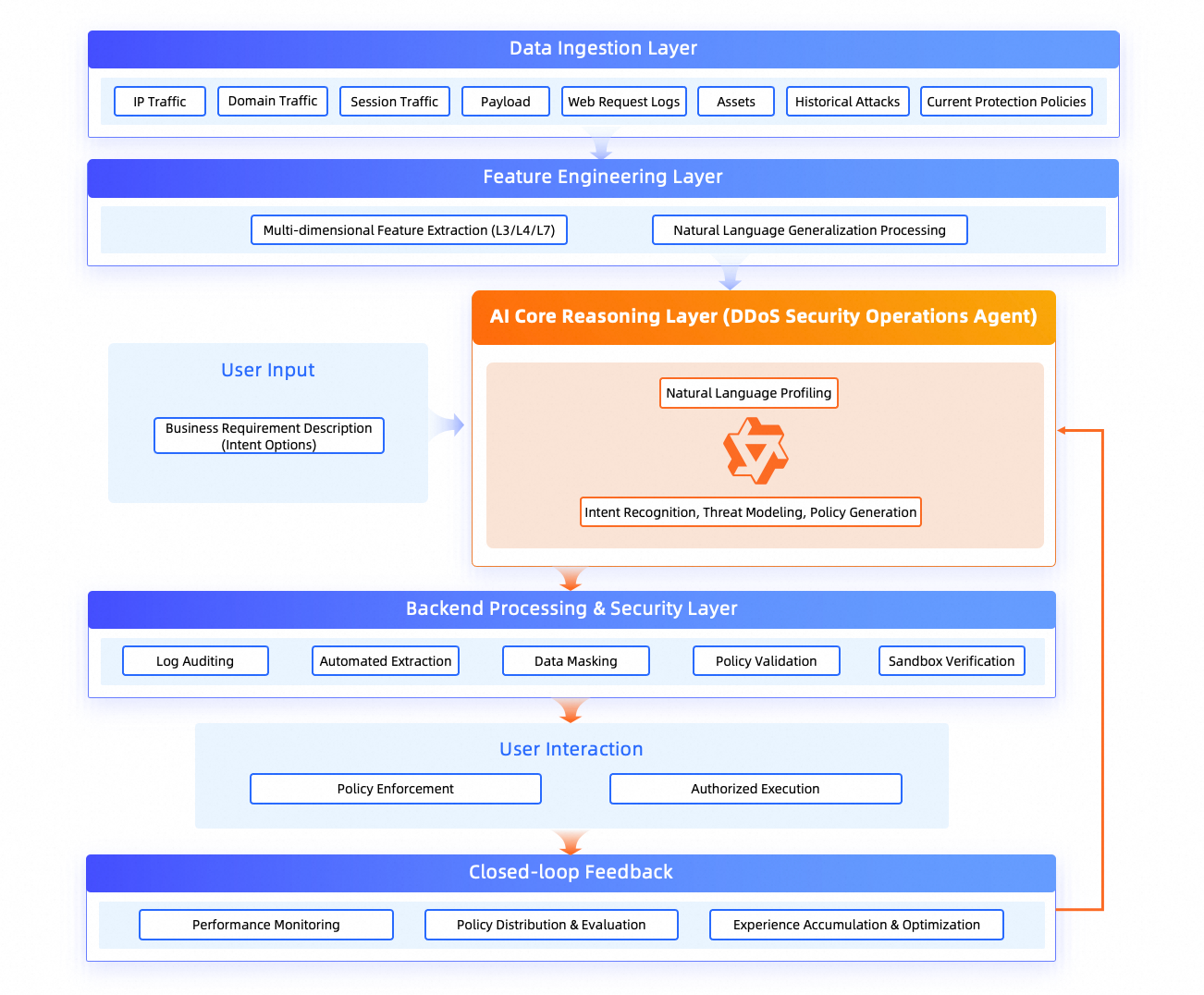
The most significant evolution in product capability lies in the "AI Core Reasoning Layer" — unlike a rules engine, it understands business intent, fuses multi-dimensional data, and dynamically deduces threats. It generates optimal protection strategies based on massive practical data, realizing the Agentic evolution of DDoS protection.
The Alibaba Cloud DDoS Security Operations Agent (Anti-DDoS SecOps Agent) uses "Business Intent" as its core engine. Through four key advantages, it breaks the bottlenecks of traditional protection experiences:
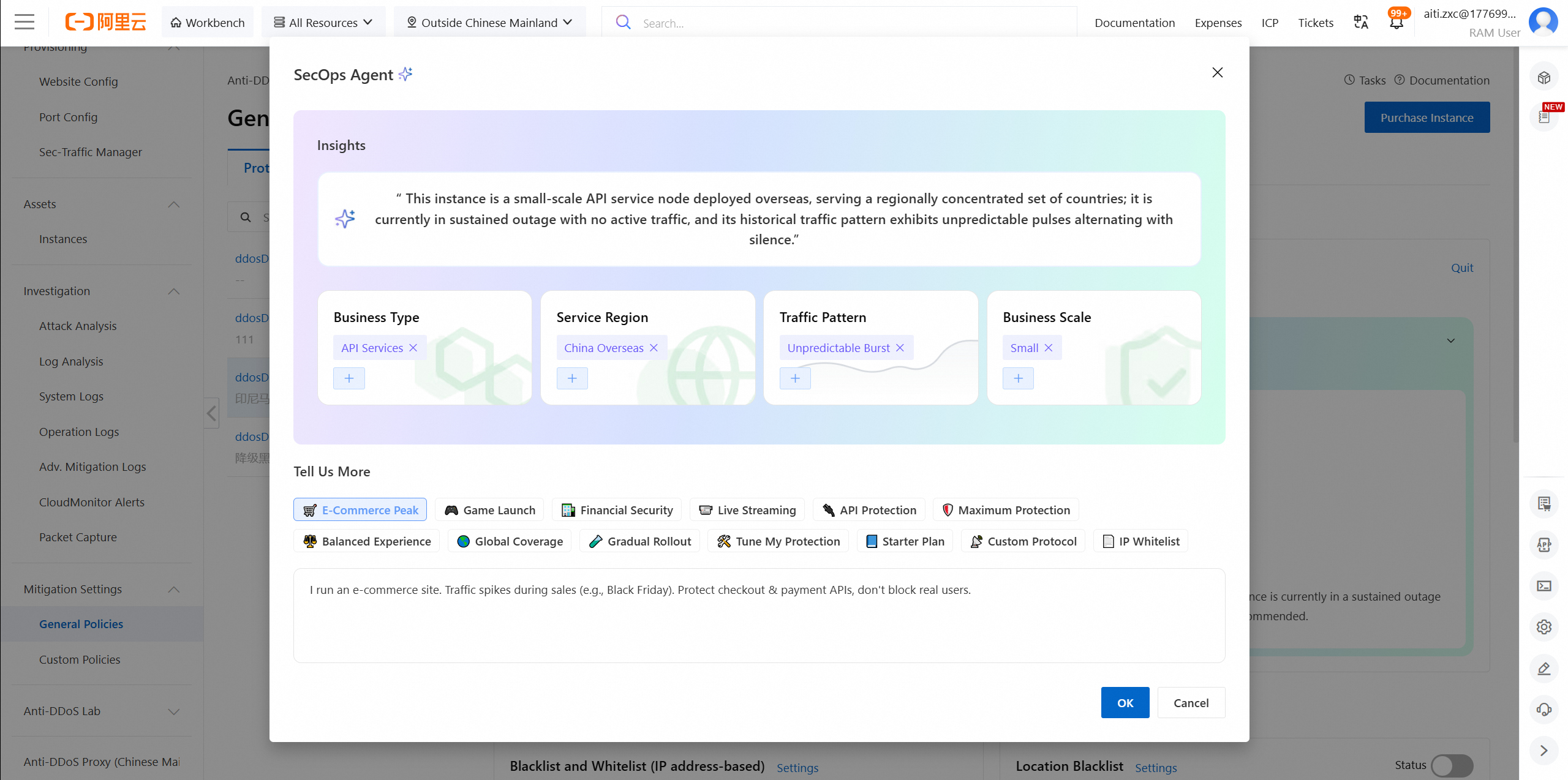
Say goodbye to dropdown menus and threshold sliders. Simply input a business goal description via a prompt (e.g., "Ensure payment availability"), and the DDoS Security Operations Agent will parse regional characteristics, protection intensity, and false-positive tolerance. It automatically generates differentiated, executable strategies, significantly lowering the barrier to entry while retaining human authorization at critical nodes.
Security operations are evolving from "parameter configuration" to "business communication."
Traditional protection relies solely on single traffic feature analysis. The DDoS Security Operations Agent, however, integrates multi-dimensional data sources through natural language generalization technology. This enables a cognitive upgrade for the system, moving from simple "traffic statistics" to sophisticated "threat intent recognition."
With this upgraded analytical capability, the system can precisely distinguish business logic: Is this a normal flash sale during a big promotion? A surge of players for a new game launch? Or an attacker probing in disguise? It goes beyond traditional security data dimensions that merely detect "anomalies" in traffic, and leverages business understanding to explain "why" the traffic is anomalous.
Traditional protection relies on the mechanical logic of "selecting the closest fit from various built-in templates." The DDoS Security Operations Agent, however, leverages the Qwen Large Model to establish an AI Core Reasoning Engine.
It performs real-time causal reasoning for DDoS attack scenarios, comprehensively evaluating attack vectors, business impact, and mitigation costs to dynamically generate optimized, interpretable mitigation strategies. Furthermore, the Agent introduces a policy validation sandbox mechanism, completing legality and effectiveness verification before strategy deployment. This realizes a technological paradigm upgrade from "preset template matching" to "dynamic intelligent decision-making."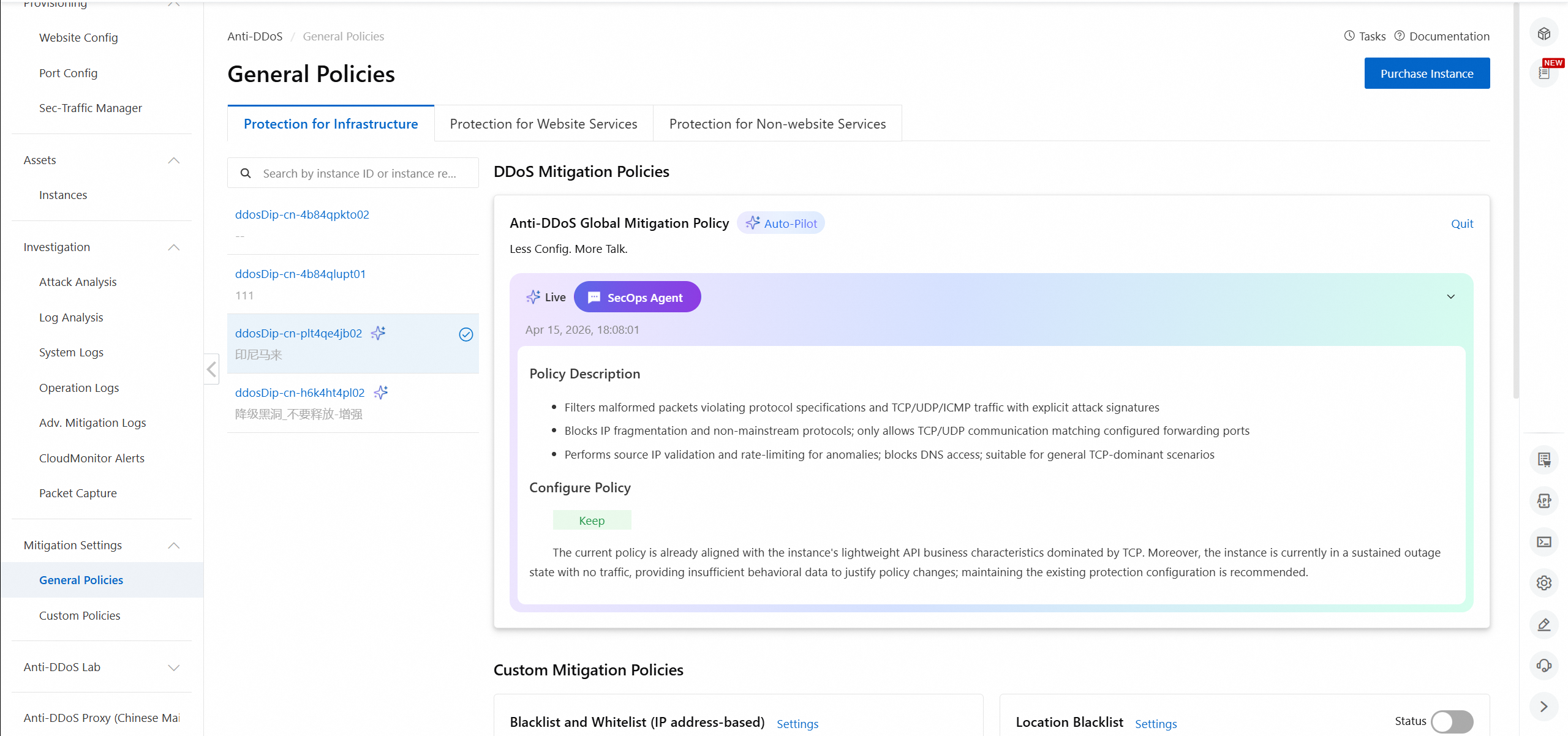
Day 1: Establishes business baselines.
Day 7: Understands your risk tolerance.
Day 30: Anticipates needs for major protection scenarios.
Day 90: Becomes a security partner that proactively offers optimization suggestions.
Traditional systems only analyze "traffic." The DDoS Security Operations Agent, however, transforms every handling result into business knowledge through a "Monitor → Evaluate → Accumulate" closed loop. Unlike traditional protection that makes decisions from scratch, the DDoS Security Operations Agent can retrieve historical experience to assist reasoning. As usage time increases, business profiling and strategy preferences become continuously more precise, achieving true self-evolution.
In high-frequency interaction scenarios like voice communication, NAT gateways, and game logins, normal traffic naturally exhibits characteristics such as fragmented packets, ACK checks, or short connection bursts. These "atypical" traffic patterns exceed the recognition boundaries of current traffic feature modeling, making them prone to being misidentified as attacks.
According to Alibaba Cloud statistics, such false positives account for approximately 15%-20% of protection-related support tickets. Furthermore, when bandwidth fluctuations occur due to business stress testing or natural traffic spikes, existing baseline mechanisms may trigger destination IP rate limiting, affecting the access experience for some legitimate clients.
For industries like gaming, cross-border e-commerce, and finance, the granularity of template options like "Loose/Normal/Strict" is insufficient to precisely match customer business models.
When generic strategies meet non-standard business requirements, finding the balance between protection strength and business experience becomes difficult—too strict, and legitimate requests might be blocked; too loose, and protection effectiveness is compromised. There is an urgent need for more flexible, scenario-based configuration capabilities to break through this bottleneck.
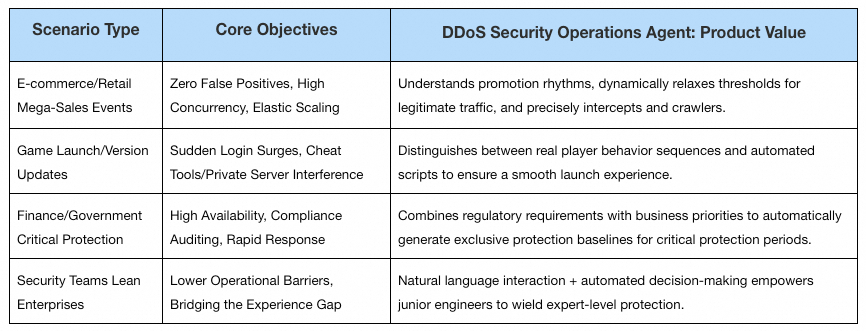
This client provides real-time battle game services (MOBA/MMO) globally. Facing the issue of high-frequency false positives and reconnection amplification caused by overly strict default protection during real-time battles, traditional manual parameter tuning was often lagging.
After introducing the DDoS Security Operations Agent, the system automatically learned the characteristics of "game long connections" and dynamically switched to adaptive strategies, completely replacing manual optimization. While maintaining the same level of protection intensity, it significantly improved TCP session stability, perfectly meeting the demand for "low latency and high reliability."
Operating in the financial payment sector, this client faced false positives on normal requests for high-frequency trading APIs. This was because generic templates failed to adapt to characteristics like "concentrated IPs and low retry tolerance," and manual custom templates struggled against sudden traffic spikes.
The Alibaba Cloud DDoS Security Operations Agent automatically identified "financial request characteristics" and entered "Autopilot Mode," dynamically adjusting policy tolerance based on connection features and time distribution. Ultimately, it achieved precise traffic scrubbing with zero manual intervention, fully ensuring high continuity and zero false positives for the core payment links.
This client focuses on smart cloud customer service solutions. They faced a dilemma: enabling SYN validation affected transmission efficiency, while disabling it led to massive transparent transmission attacks. The traditional manual mode struggled to balance acceleration and security.
The Alibaba Cloud DDoS Security Operations Agent integrated "high-risk confrontation characteristics" with "low latency" requirements to dynamically switch intelligent adaptive strategies. It finally broke the "acceleration means exposed" dilemma, achieving precise fake source protection while satisfying low-latency experience, ensuring high business availability.
Alibaba Cloud SASE 2.0 Upgrade: Comprehensive Monitoring of Agent Office Security
Alibaba Cloud Releases Agentic NDR,Ushering Threat Detection and Response into the Age of Agents

29 posts | 2 followers
FollowAlibaba Cloud Community - June 17, 2026
Alibaba Cloud Community - June 22, 2026
CloudSecurity - May 26, 2026
Amuthan Nallathambi - August 24, 2023
Alibaba Cloud Community - June 26, 2026
Alibaba Cloud Community - September 27, 2025
29 posts | 2 followers
Follow Qwen
Qwen
Full-range, open-source, multimodal, and multi-functional
Learn More Security Center
A unified security management system that identifies, analyzes, and notifies you of security threats in real time
Learn More Anti-DDoS
A comprehensive DDoS protection for enterprise to intelligently defend sophisticated DDoS attacks, reduce business loss risks, and mitigate potential security threats.
Learn More
Anti DDoS Basic
A cloud-based security service that protects your data and application from DDoS attacks
Learn MoreMore Posts by CloudSecurity

