By Shen Lin
This article is based on a talk by Shen Lin, Senior Technical Expert at Alibaba Cloud, at the 2026 GenAICon China Generative AI Conference.
As agents move from AI Coding to broader industry scenarios, an increasingly pressing question emerges: Why do agents in the software engineering realm advance so rapidly, while agents in many other industries have yet to truly take off?
A common answer is that model capabilities are not yet sufficient. However, based on extensive implementation experience, the real bottleneck often lies not only in the model, but also in the context supply capability: whether an agent can continuously, cost-effectively, and reliably connect to the real business world determines whether it can move from demo to production.
Based on Alibaba Cloud EventHouse practices, this article re-examines the enterprise-level agent context build problem from an "environmental engineering" perspective and discusses how to enable agents to connect to multi-source, real-time business environments more simply and reliably across five dimensions: info completeness, sensory management, knowledge reconciliation, change administration, and accessibility threshold.
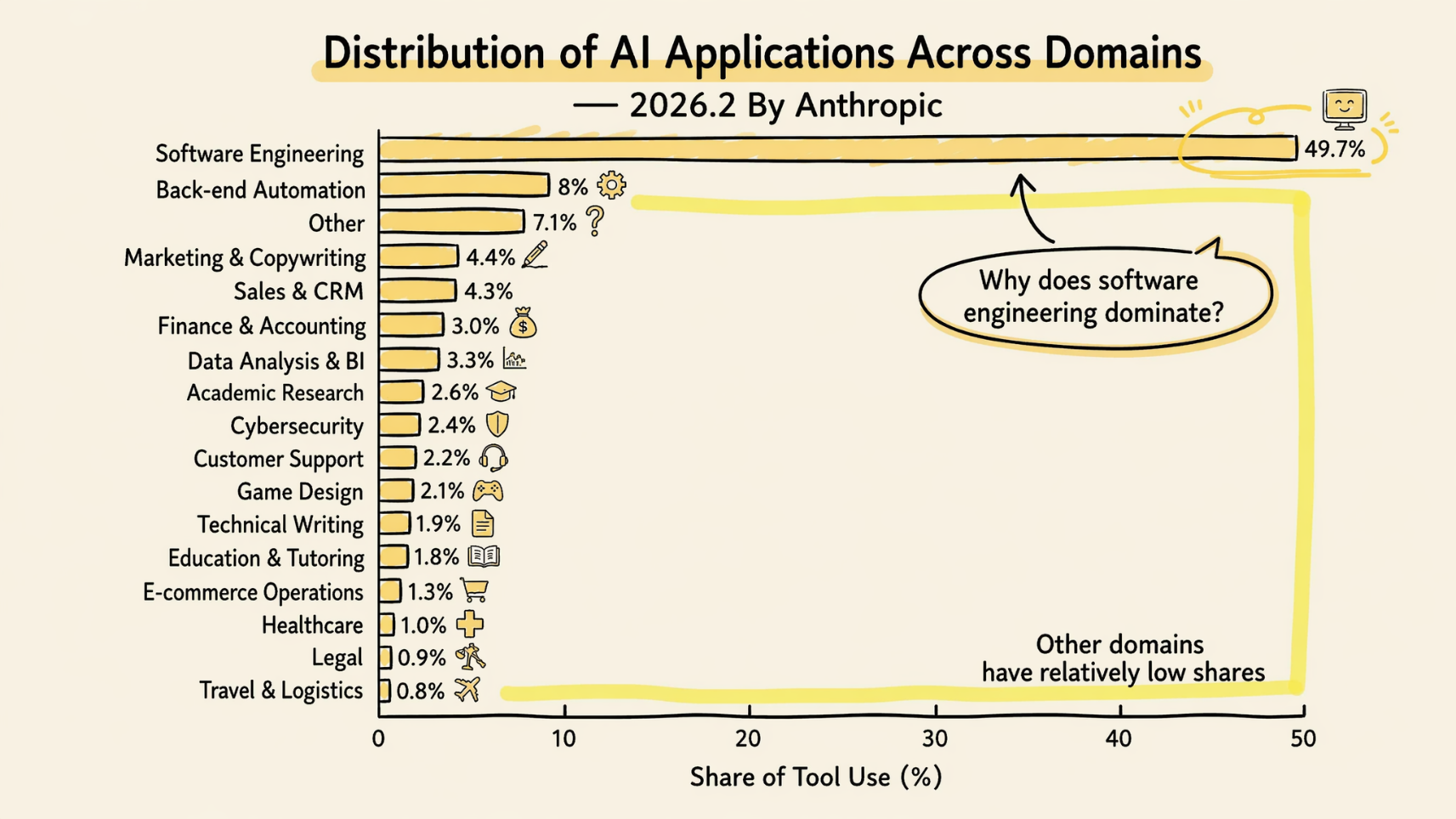
In February this year, Anthropic released an analysis report about AI invocations on its platform. The data shows that the software engineering industry accounts for as high as 49.7% of usage, nearly half.
This result illustrates one thing: the scenarios where Agents are most easily viable are precisely those realms that are already highly digitized with context naturally online. Software engineering is a typical example.
In the software development procedure, programmers naturally work in a digital world:
● Inputs include PRDs, interaction design, technical solutions, code, issues, and logs.
● Outputs can directly complete design, coding, testing, deployment, and other tasks.
In other words, programmers are already in an environment that can be "seen" by machines and "accessed" by systems. The root reason AI Coding can be quickly embedded is not that "code is more suitable for AI," but that its operating environment has already achieved digital expression.
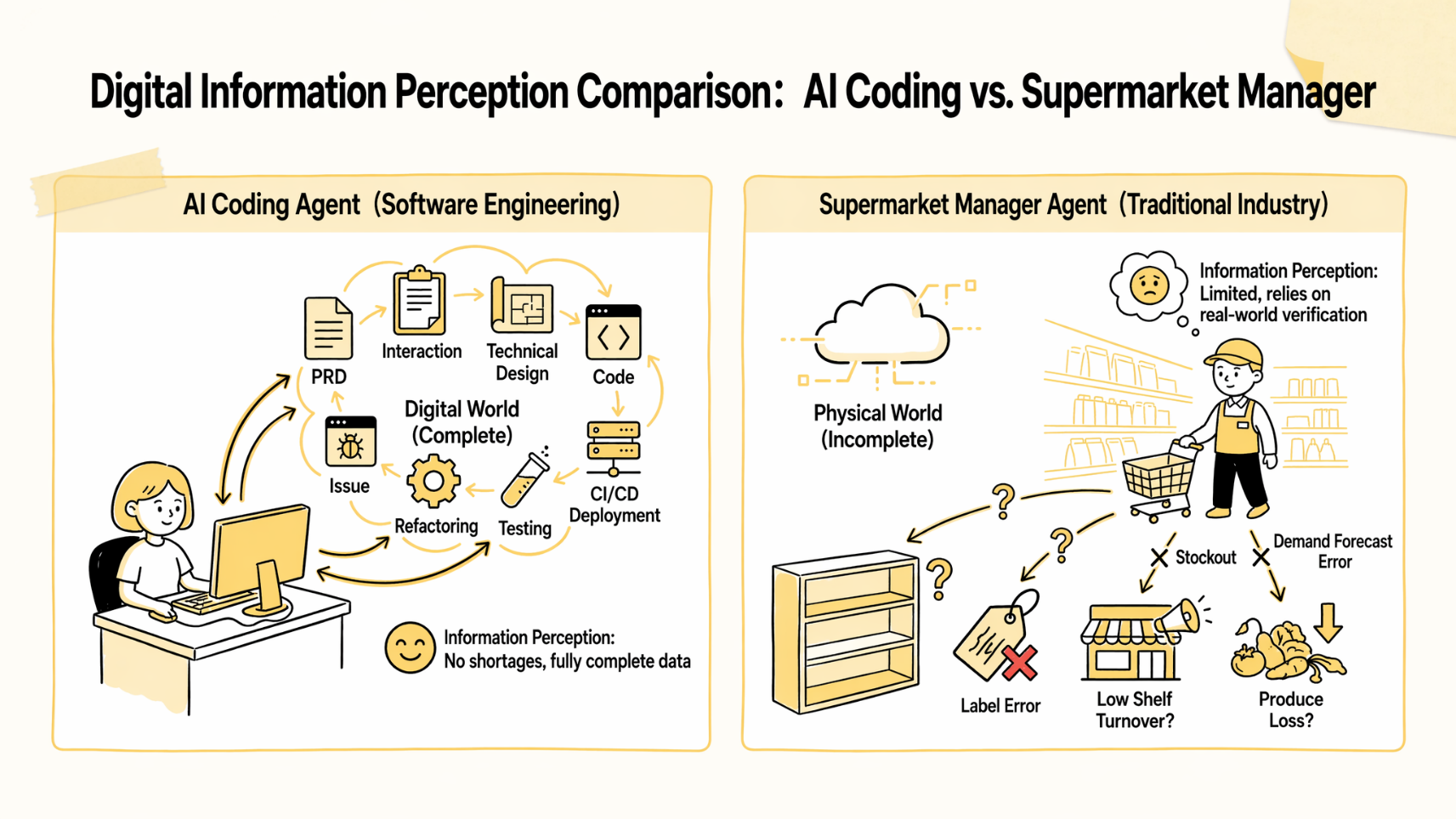
But if you switch the scenario to retail, manufacturing, finance, logistics, and other industries, the problem becomes different.
If a supermarket manager Agent doesn't know whether the shelves are empty, whether the product labels are incorrect, whether the neighboring outlet is running a promotion, or why today's fresh produce has high spoilage, then even if it's connected to the most powerful model, it can hardly make reasonable decisions. Because in such an environment, the Agent is actually still in a "half-blind" state — it cannot see what is really happening in the business.
Therefore, in the procedure of deploying enterprise-level Agents, a frequently underestimated yet unavoidable question is: How to simply and reliably build multi-source, real-time, and trusted context for Agent building?
To address this question, we have summarized five key insights.
A key reason why agents in many industries struggle to be truly effective is that they lack sufficient info perception capabilities.
This is actually straightforward. Whether for humans or agents, the upper limit of decision-making ability depends first on the ability to observe the environment. When key info is missing, problems may become logically unsolvable. In other words, if you can't see it, it's hard to judge it right.
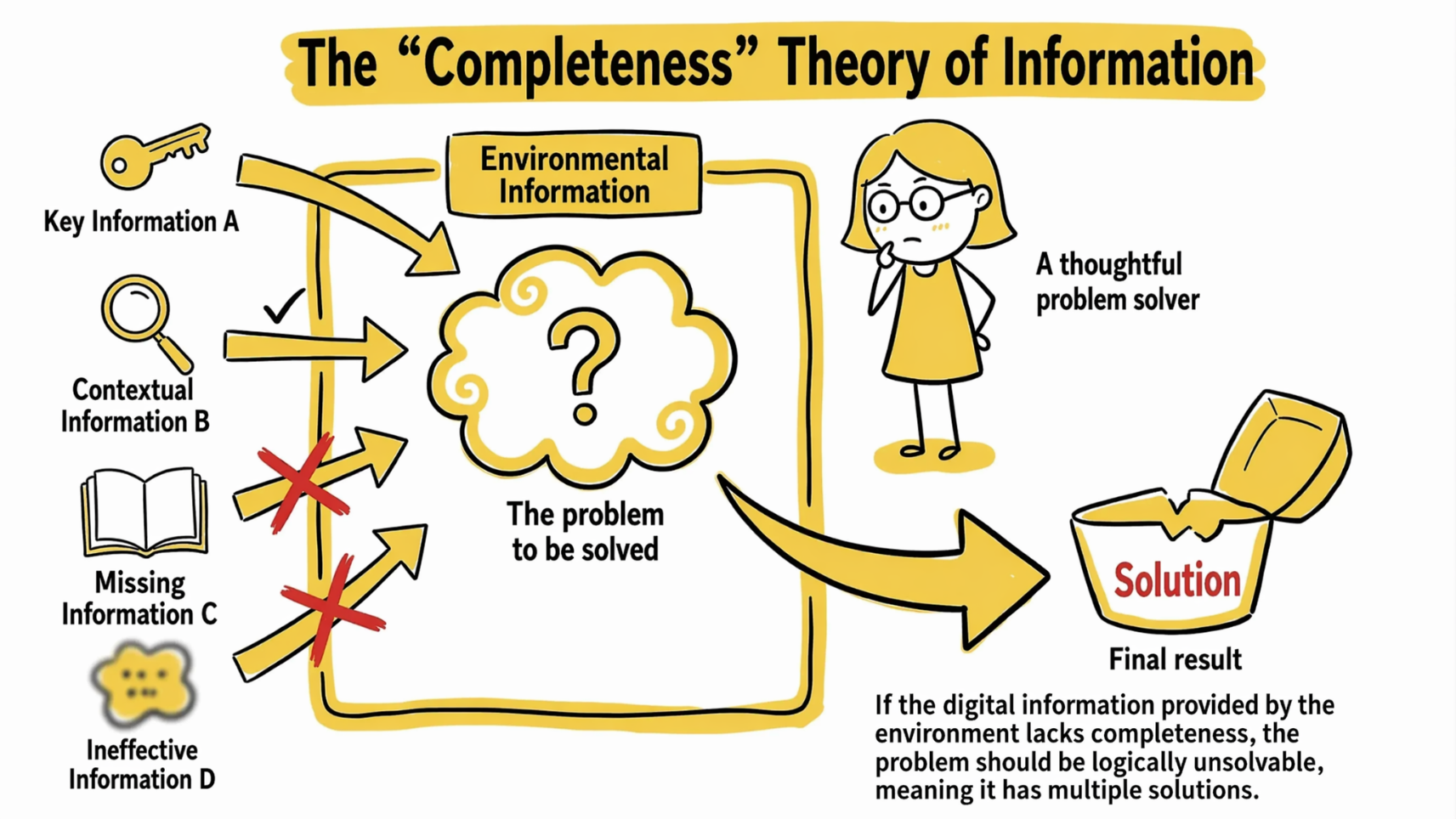
In the context of information theory, this can also be understood through "completeness": if the digital info provided by the observed environment is not sufficiently complete, many jobs become fundamentally unsolvable, or at least cannot be solved reliably.
Why is AI Coding more likely to succeed? Because programmers already work in a complete digital environment. Agents in many industries fail to take off because they can only see a very limited digital cross-section.
To bring agents into real business scenarios, the first step is not to keep tuning prompts, adding skills, or performing memory optimization — it is to solve the info perception problem.
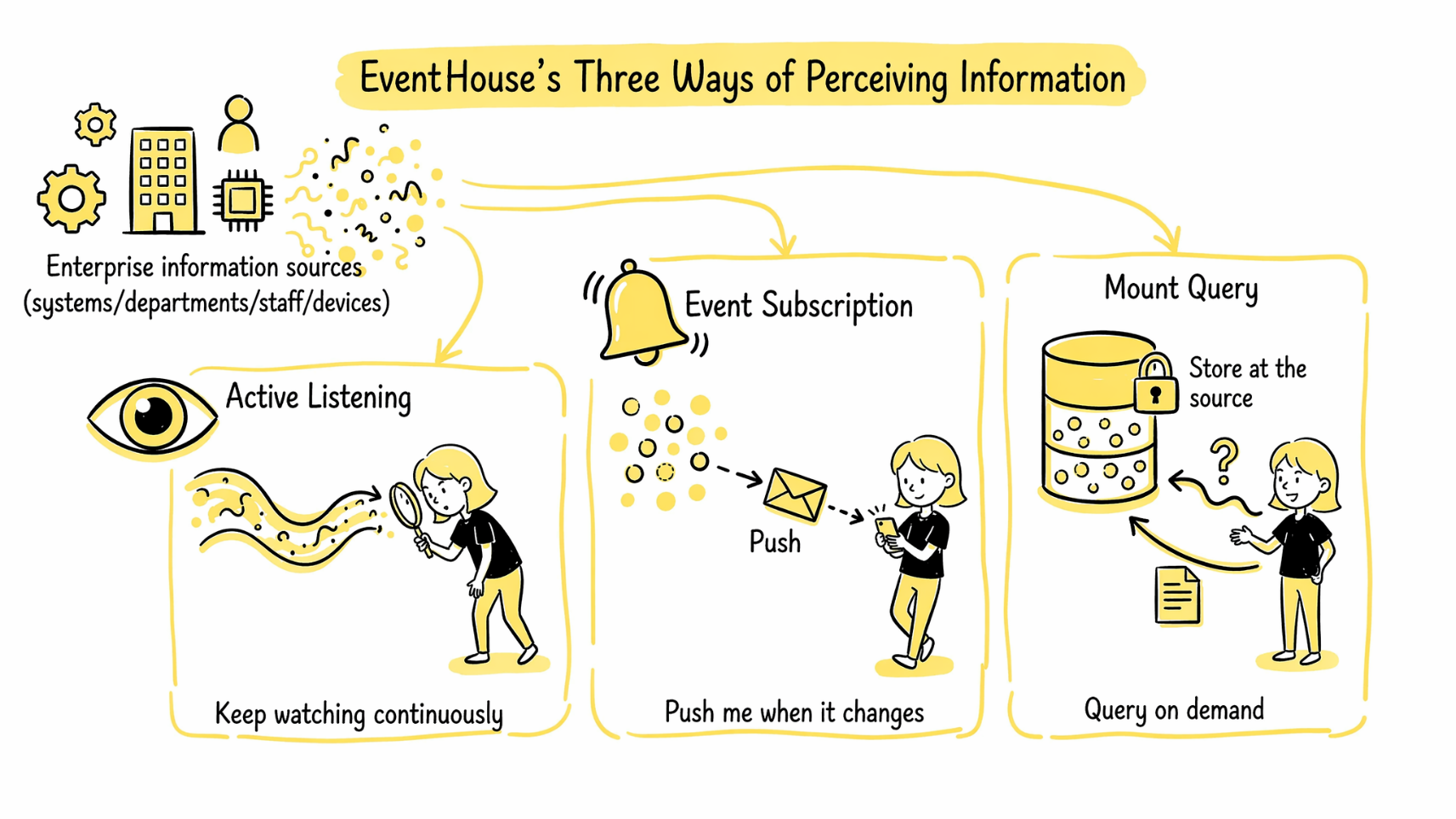
To address this, EventHouse provides three types of info perception methods:
● Active monitoring (Polling / Monitoring): Uses long polling or scheduled tasks to continuously monitor data sources and capture data changes as soon as they occur.
● Event Subscription: Based on event-driven architecture (EDA), when business events occur, they are proactively pushed to agents for asynchronous real-time response.
● Mount Query: For massive historical data or archived cold data, instead of full data migration, ad hoc queries are triggered on demand, allowing agents to access data on demand like mounting a disk.
Together, they solve the same problem: enabling agents to move beyond a static, fragmented info environment and continuously access the dynamic changes of real business.
Does information perception solve the problem? Not yet.
Although "completeness" of info is important, more info is not always better, nor should it be a 1:1 mechanical copy of the physical world.
On the one hand, this is simply impossible; on the other hand, it is unnecessary. The ability humans evolved is not to "receive all info" but to automatically filter out large amounts of irrelevant info and keep attention focused. Otherwise, so-called "sensory overload" occurs: too much input, but unclear focus, confused associations, and ultimately an inability to form effective judgments.
The same goes for agents.
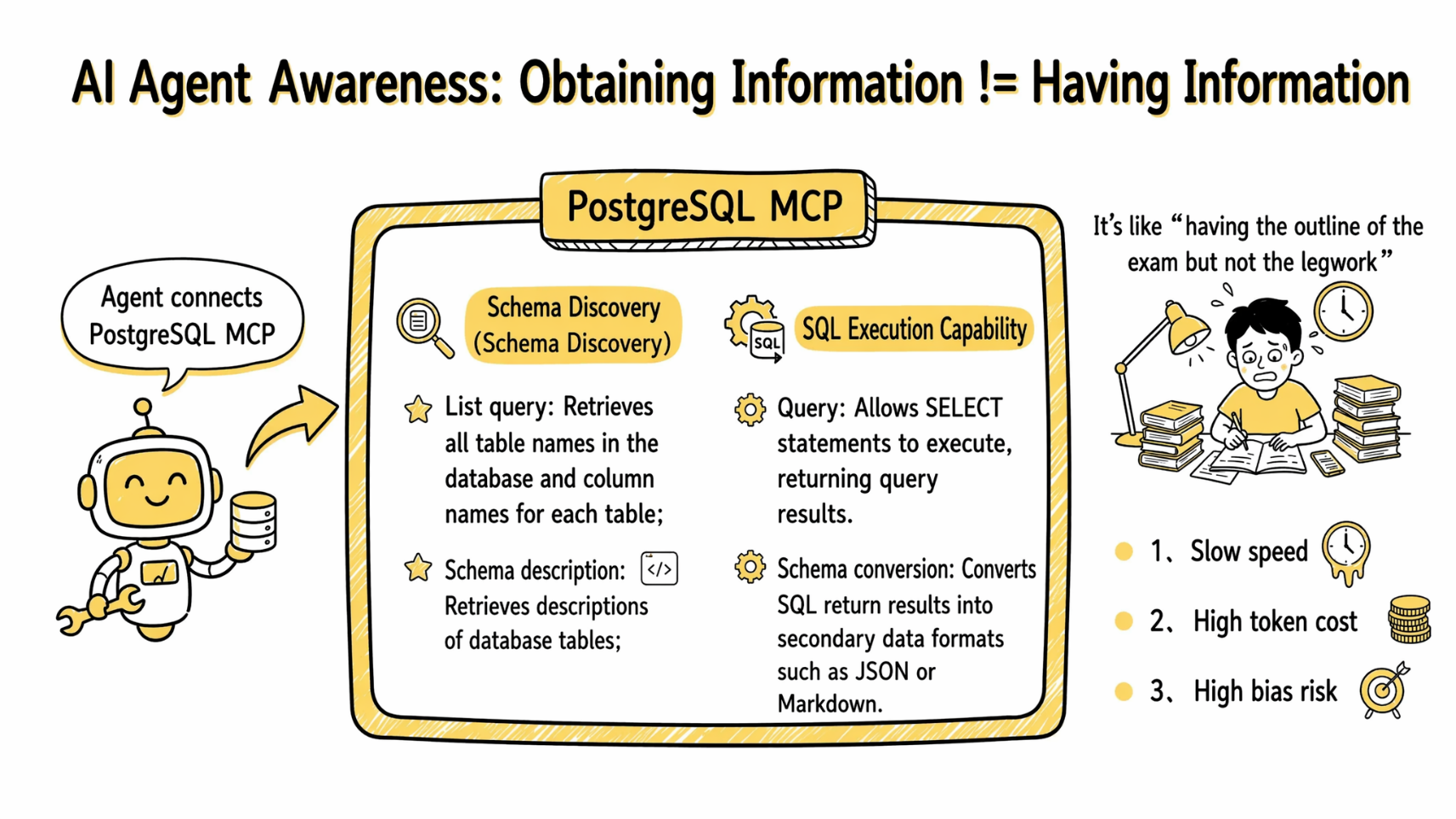
There is another problem that is more easily overlooked: The info an agent perceives is not the same as the agent truly possessing that info.
For example, if an agent is connected to a PostgreSQL MCP, it can theoretically know which tables, fields, and descriptions exist in the database and can execute SQL. But if it waits until a question arrives to temporarily check metadata, understand the table schema, and splice together a query, this approach is like "cramming before an exam": not only is it slow with high token consumption, but it is also prone to semantic bias.
Here's an apt analogy: it's like giving you a library. All the books are there, but without a directory system, you can only search layer by layer and shelf by shelf every time you need something — efficiency is very low, and it's easy to find the wrong thing. Furthermore, although a book in the corner belongs to you, if you don't even know it exists, then in practice it effectively doesn't exist.
Therefore, what an agent needs is not just more info, but a "library collection directory" that can be quickly located, continuously updated, and uniformly understood.
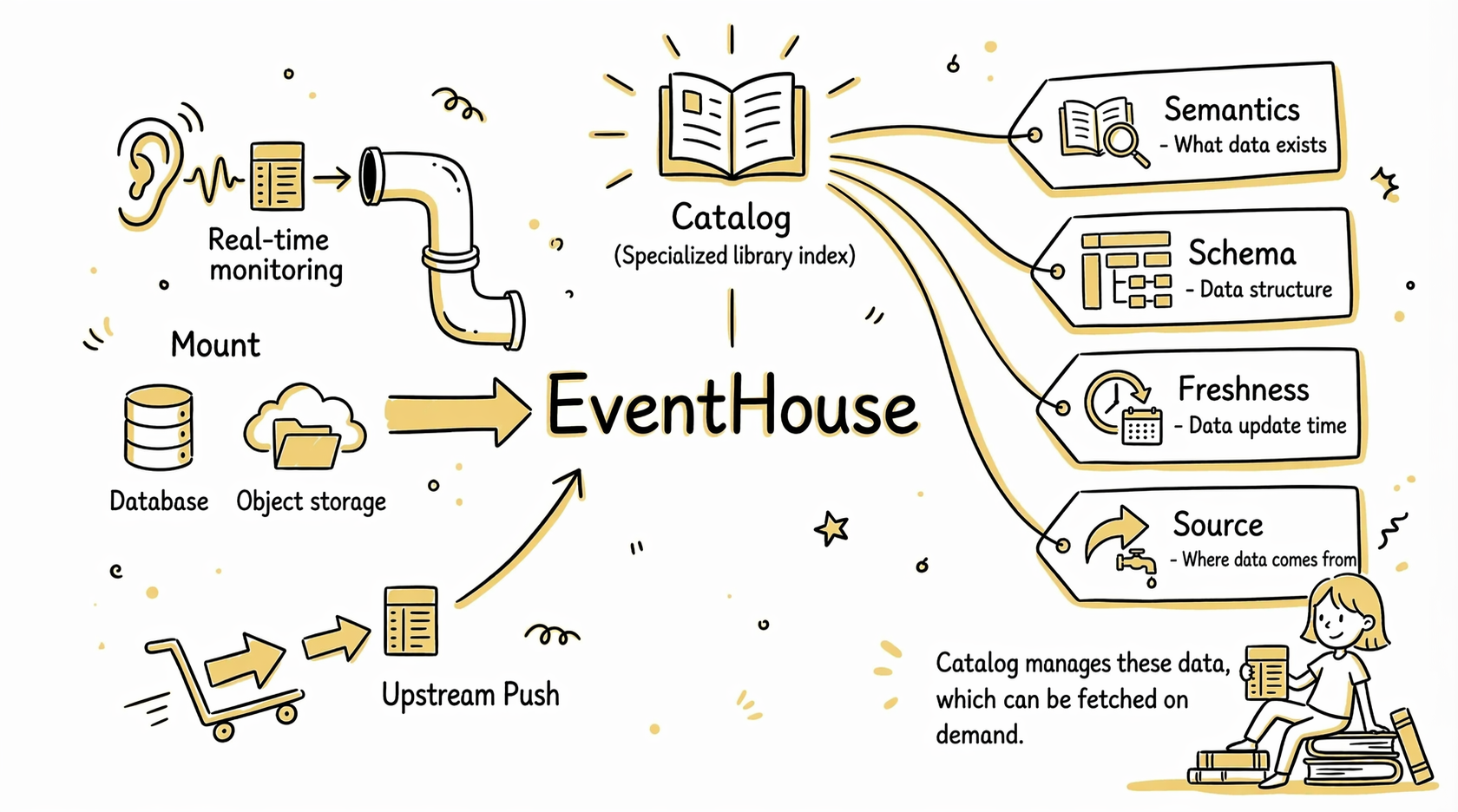
EventHouse uses a unified catalog to manage the info assets available to agents, recording and maintaining data semantics, schema, freshness, source, applicable scope, and associations in advance.
This way, agents can clearly know what info they have, what each class of info means, where to find it when needed, and what content is worth prioritizing.
If the first step addresses "whether context exists", then the unified catalog addresses "whether context can be correctly consumed".
Even with a unified catalog, the problem is not fully solved.
We don't assume that just because a person owns a library, they have judgment. Similarly, an Agent does not automatically become smarter by accessing more data sources. Whether info can be transformed into knowledge determines whether the Agent can truly make good use of these contexts.
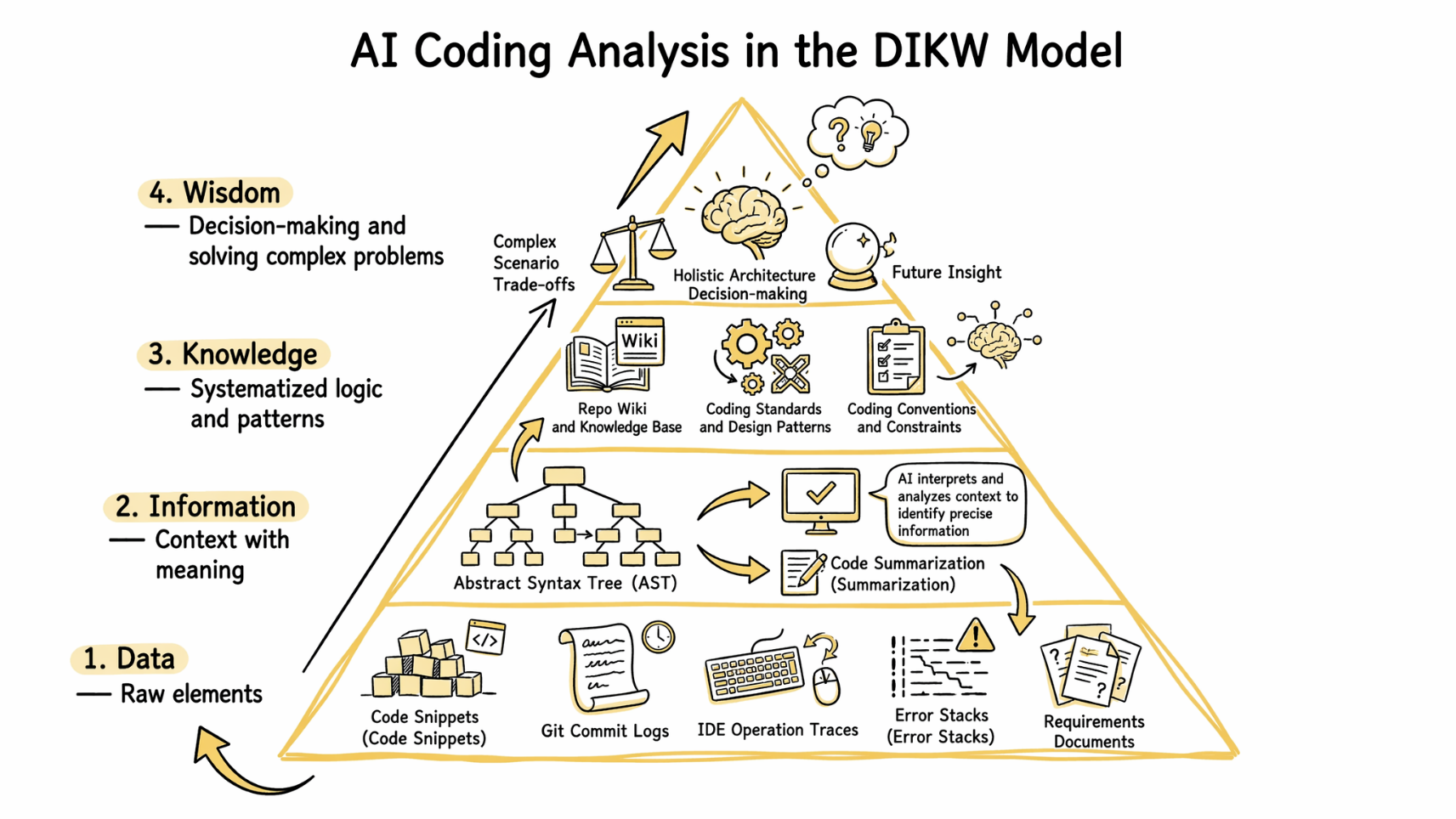
From the classic DIKW (Data-Information-Knowledge-Wisdom) model:
● Data: The original record of objective facts, a symbolic mapping of the real world;
● Information: Data given context and structure, used to answer "What", i.e., "what happened";
● Knowledge: Rules, experiences, and methods extracted from info, used to answer "How", i.e., "how to find, understand, and use this info";
● Wisdom: The comprehensive application and balancing of knowledge in complex situations, with clear goals and value orientations, to make sound decisions.
Back to the context construction problem of enterprise-level Agents, the real key is not just "getting more information", but forming a set of reusable, interpretable, and reviewable data retrieval and utilization mechanisms. In other words, the essence of knowledge is not information hoarding, but knowing how to accurately find the required information from multiple data sources and complete interpretation and action within the correct semantic borders.
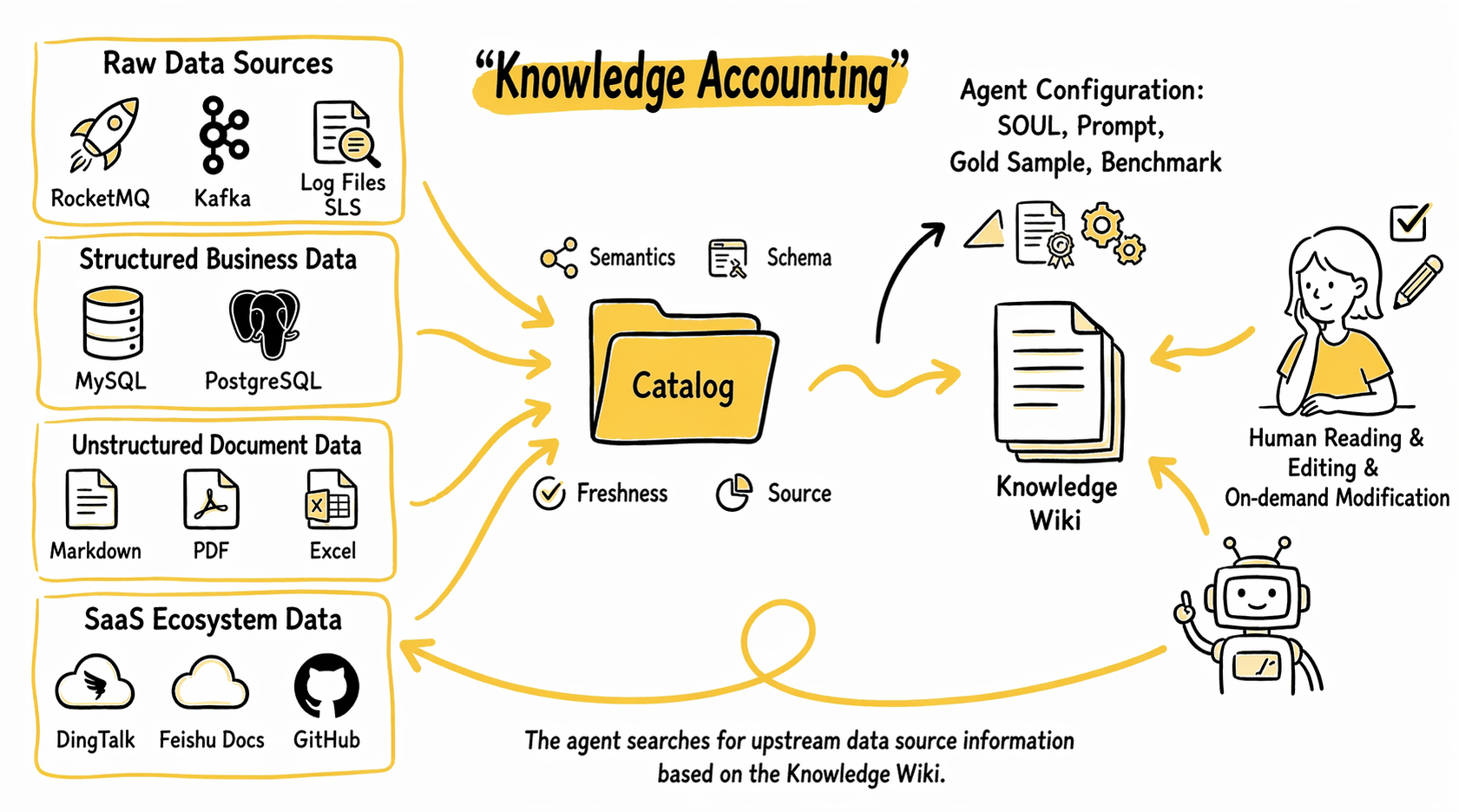
Around this point, EventHouse generates "knowledge" that Agents can use from two directions:
● On one hand, based on the data definitions, schema descriptions, and semantics info in the unified catalog;
● On the other hand, combined with the customer's business settings for the Agent, such as role settings (SOUL), Prompt, Gold Sample, Benchmark, and other configurations.
Ultimately, this content is organized into a readable, reviewable, and continuously iterative Knowledge Wiki.
This Wiki is crucial. It can be consumed by the Agent and reviewed by human experts, establishing a "knowledge reconciliation" mechanism between humans and the Agent: confirming whether the Agent's understanding of data retrieval logic is correct, rather than hiding all logic behind a black box.
The value of this step lies in: enabling the Agent not just to "connect to data", but to truly start "understanding data".
Agent knowledge is not a static asset, but a continuously evolving means of production.
Just as people need knowledge upgrades to grow, so do agents. Input data sources may change, schemas may update, customers may adjust the roles and goals of agents, and feedback accumulated during running will continue to grow. All these factors drive the continuous evolution of an agent's knowledge system.
The question is: Once a new Knowledge Wiki is generated, can it be directly published for agent use?
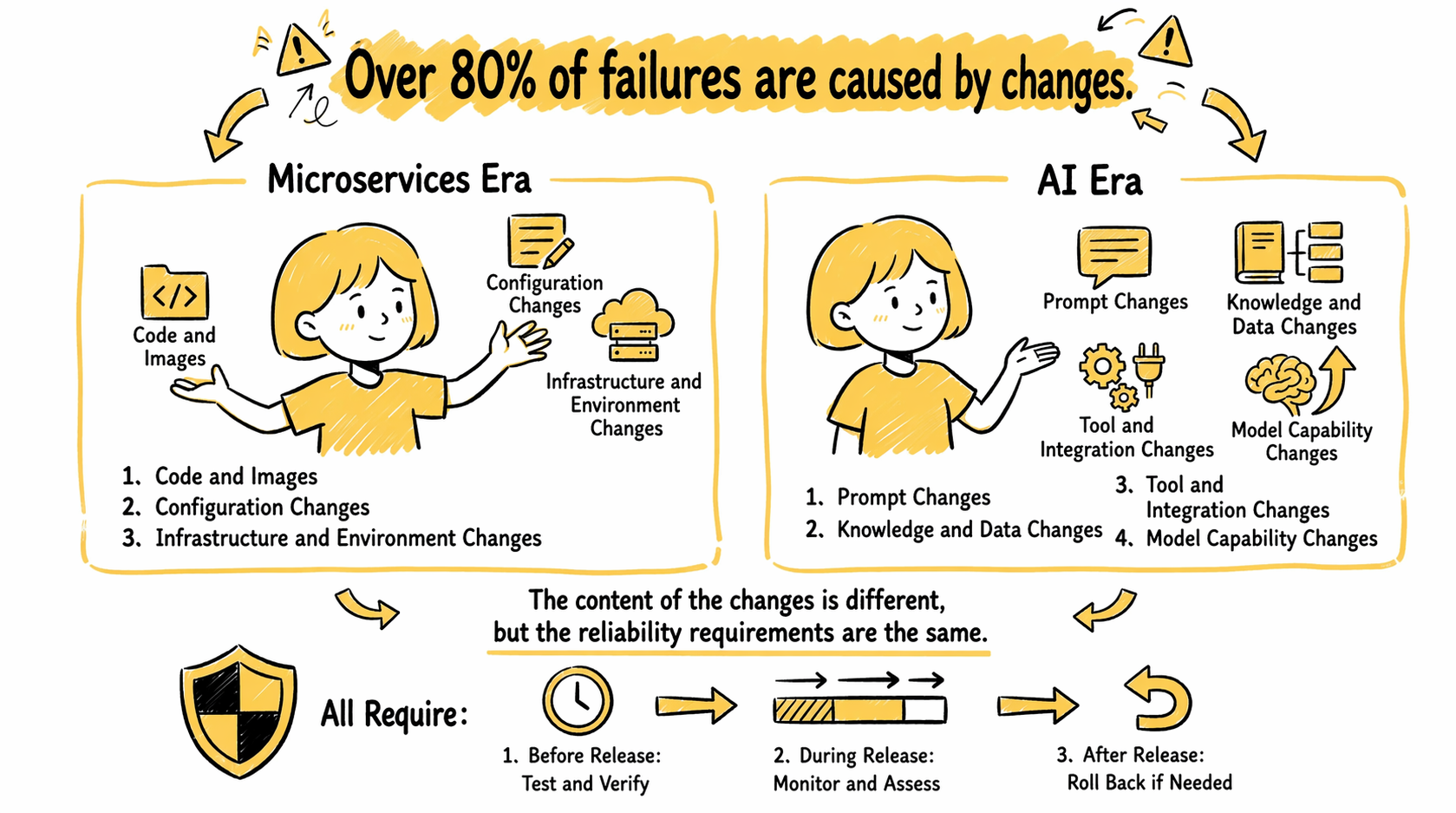
From the perspective of software engineering practice, a large number of production failures are related to changes. In the AI application era, this pattern has not disappeared — only the objects of change have shifted: from code, runtime images, configurations, and infrastructure, to Prompts, Knowledge Wikis, tools and plugins, model capabilities, and agent behavior policies.
Although the changes are different, the requirements for stability remain the same. Enterprise-level agents also need a complete set of change administration mechanisms: regression before release, grayscale during release, and rollback after release.
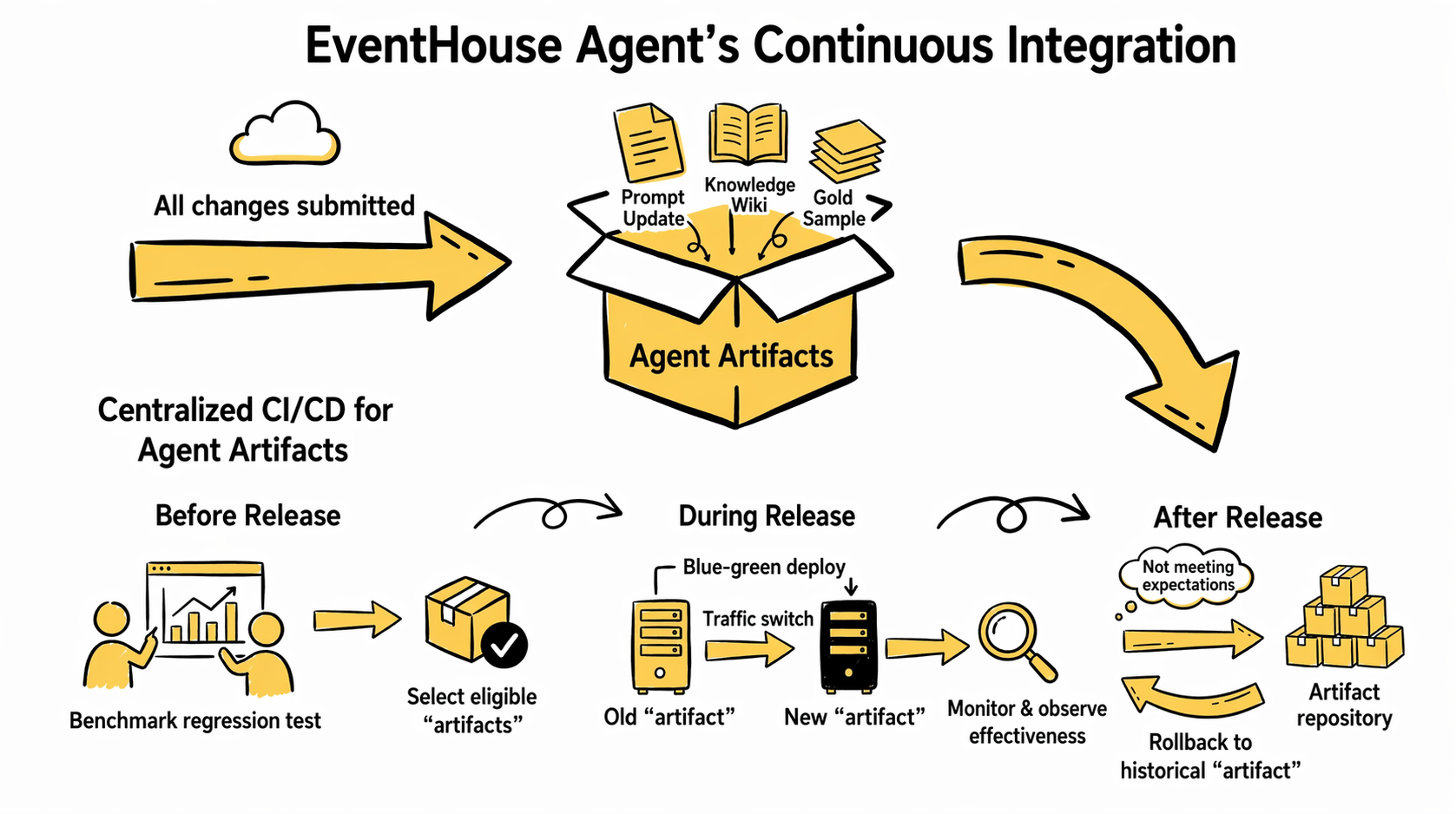
Based on this approach, EventHouse draws on CI/CD engineering methods to encapsulate an agent update into a manageable "artifact". This "artifact" can contain Prompts, Knowledge Wikis, Gold Samples, Benchmarks, and other key configurations related to agent behavior, and builds a complete continuous release flow around it:
● Pre-release: Perform benchmark regression testing on multiple artifacts and select a more appropriate version to release.
● During release: Use blue-green deployment to monitor and compare the online effects of new and old artifacts.
● Post-release: If the new artifact does not meet the standard, you can quickly roll back to a previous version from the artifact repository.
This mechanism supports both manual review and automated evolution. Its significance is not just enabling continuous updates for agents, but making the update itself something governable, authenticatable, and recoverable.
Looking back at the previous four points, whether it is multi-source info perception, unified Catalog, knowledge Wiki, or artifact-based release, they essentially serve two goals: simplicity and reliability.
Why are these two words so important?
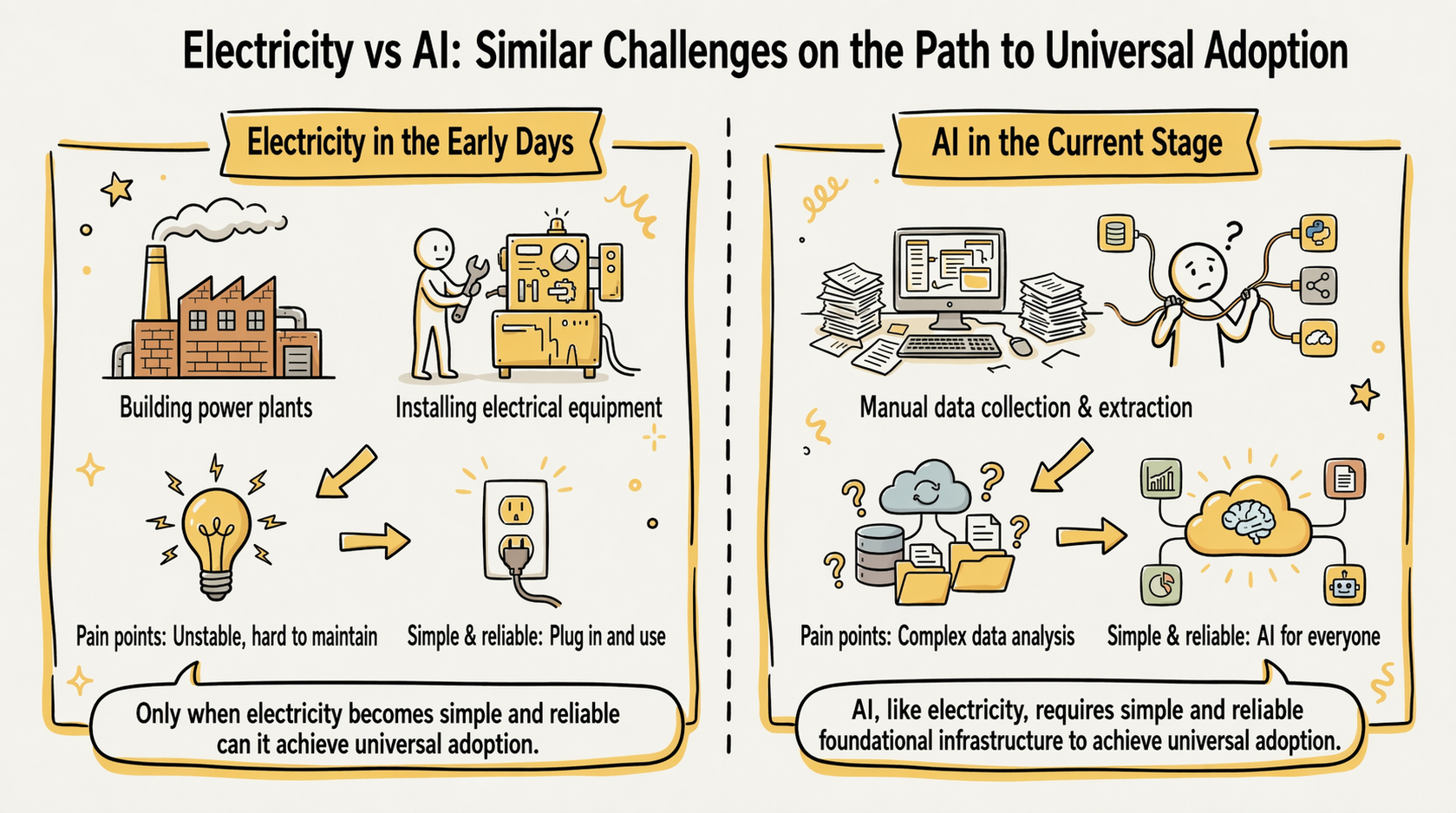
A good reference is the history of the spread of electricity. When electricity first appeared, not all enterprises could use it immediately. The problem was not that it had no value, but that the access threshold was too high: enterprises had to buy their own generators, allocate maintenance personnel, transform the plant layout, and bear the threat of unstable power supply. It was not until the power grid became a unified infrastructure, and factories only needed a standard socket to obtain stable power, that electrification truly changed from the ability of a few to the ability of the entire industry.
Today's AI, especially enterprise-level agents, is actually at a similar stage.
Many organizations don't lack the desire to build agents — they lack the ability to sustain the long-term effort of data integration, semantic alignment, architecture selection, change administration, and O&M assurance. If a set of capabilities can only be mastered by a few AI-native teams, then it cannot be called truly inclusive. Only when connecting agents to the business world becomes as low-threshold, standardized, and sustainable as plugging into the power grid can AI truly enter thousands of industries.
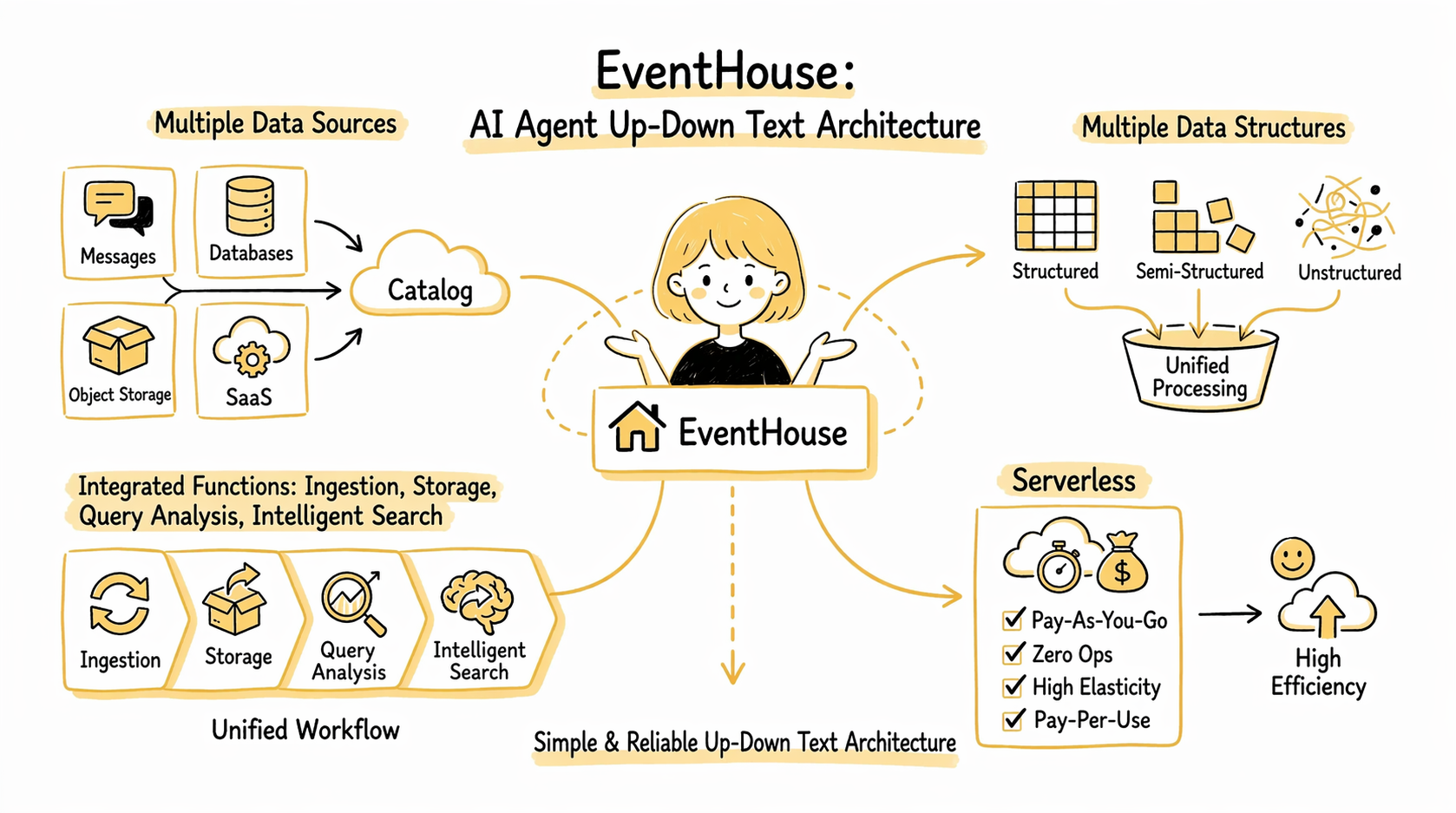
In this sense, what EventHouse aims to be is the "standard socket" for agents in the AI era:
● In terms of breadth: connects multiple source data access channels including message systems, databases, Object Storage Service, and Software as a Service, enabling agents to obtain sufficient information perception capabilities.
● In depth: Snap the semantics of structured, semi-structured, and unstructured data to build knowledge wikis.
● In flow: Integrate data integration, storage, query, and retrieval into a unified service.
● In form: Deliver a Serverless experience with pay-as-you-go billing, second-level elasticity, and zero O&M.
The goal is not to turn every enterprise into an infrastructure expert, but to lower the barrier for agents to access the real business world as much as possible.
In the second half of AI, the competition is not only about model parameters and inference capability, but also about who can continuously and accurately bring the real world into the digital system at lower cost and higher reliability.
From the "digital dividend" enjoyed by software engineering to the "contextual infrastructure" still missing from traditional industries, the true watershed for enterprise-level agents is shifting from model capabilities to environment capabilities. Whoever can build a multi-source, real-time, credible, and governable context supply system will have a better chance of taking agents from "demo-ready" to "production-ready".
This is also the direction of EventHouse's continuous investment: integrating multi-source data ingestion, semantics management, knowledge accumulation, change administration, and Serverless experience to build a "highway" from the real business world to agents, so that more industries can tap into the efficiency transformation brought by AI as easily as plugging into a power source.
If your team is facing the following challenges, welcome to participate in the EventHouse public preview and explore the data foundation capabilities of enterprise-level agents with us:
● Data slumber: Real-time event data has accumulated to a massive scale, but it is difficult to efficiently analyze and utilize.
● Pipeline lag: Cross-data-source queries still rely on complex extract, transform, and load pipelines, and analysis results always lag behind the business.
● Intelligence gap: Want AI agents to directly access business data for independent analysis and intelligent decision-making.
● High implementation barrier: Want to obtain unified, real-time, and governable context supply capabilities at a lower cost.
Let's define the next-generation management event data platform together!
👉 Click here to join the public preview
https://eventbridge.console.aliyun.com/cn-chengdu/event-house/overview
👥 DingTalk group: 44552972
Ontology Is Trending Again. Can It Improve My AI Agent's Performance?

740 posts | 60 followers
FollowAlibaba Cloud Native Community - May 26, 2026
CloudSecurity - April 21, 2026
Alibaba Cloud Native Community - September 9, 2025
Alibaba Cloud Native Community - December 11, 2025
Alibaba Cloud Native Community - November 24, 2025
Alibaba Cloud Native Community - May 8, 2026
740 posts | 60 followers
Follow Alibaba Cloud Model Studio
A one-stop generative AI platform to build intelligent applications that understand your business, based on Qwen model series such as Qwen-Max and other popular models
Learn More Qwen
Qwen
Full-range, open-source, multimodal, and multi-functional
Learn More Alibaba Cloud for Generative AI
Accelerate innovation with generative AI to create new business success
Learn More Cloud-Native Applications Management Solution
Accelerate and secure the development, deployment, and management of containerized applications cost-effectively.
Learn MoreMore Posts by Alibaba Cloud Native Community

