By Anolisa Team
At the Alibaba Cloud Summit on May 20, Dr.Feifei Li, CTO of Alibaba Cloud, President of International Business, released the Agent Infrastructure panorama at the keynote session. He noted that when agents become the primary payload, cloud infrastructure requires six core capabilities to address six major challenges: runtime, orchestration, administration, security, data plane, and memory. In this panorama, ANOLISA is clearly annotated at the computing power base layer — addressing the most fundamental question: what operating system do agents run on?
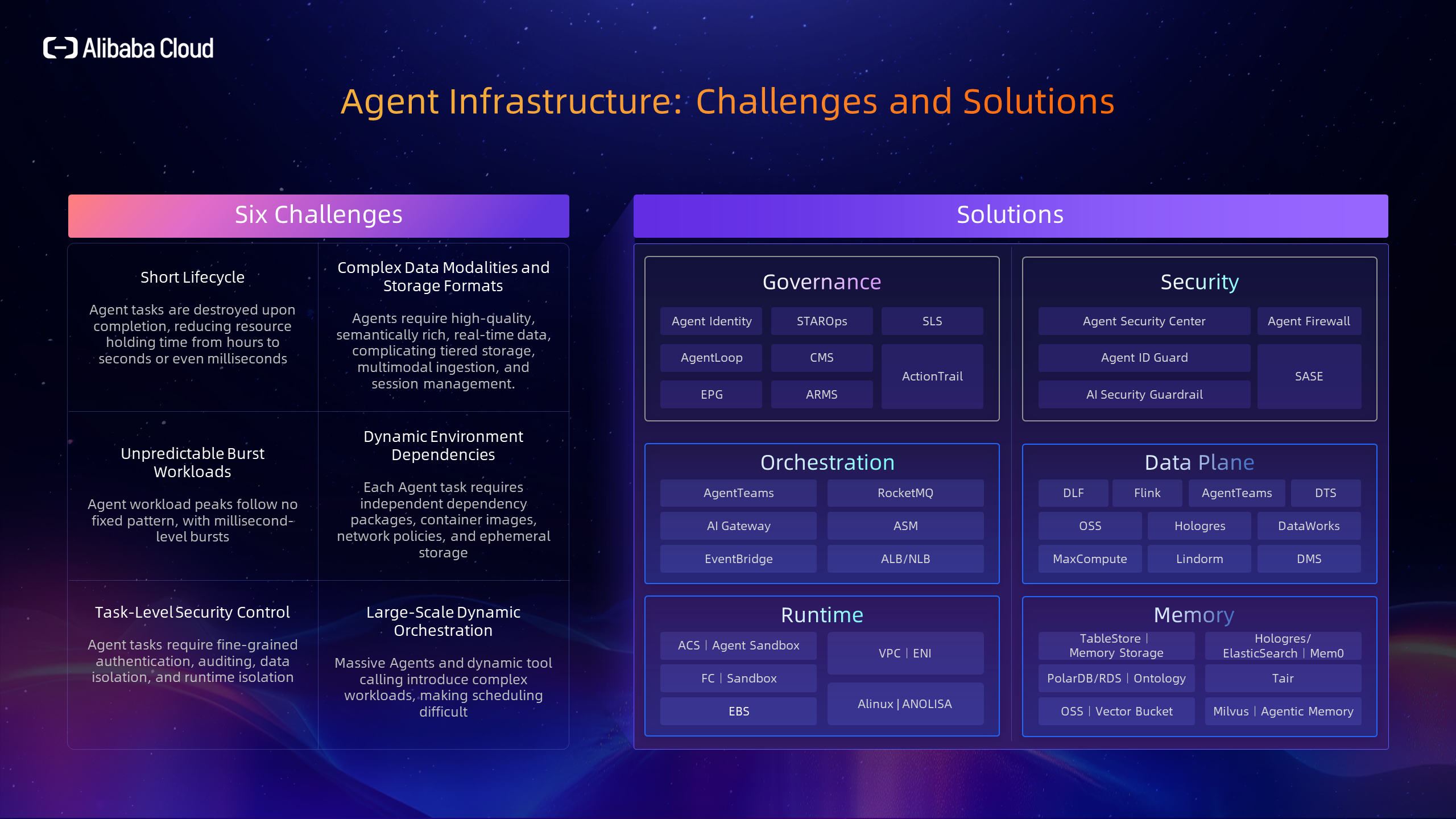
That afternoon, Zhou Xu, Alibaba Cloud Agentic OS product owner, delivered a full ANOLISA product presentation at the Agent Native Infrastructure Breakout Session. Below is a complete recap of the presentation.
Note: ANOLISA stands for Agentic Nexus Operating Layer & Interface System Architecture.
In the past six months, the capability borders of agents have been rapidly expanding — multi-agent collaboration, ultra-long context, and autonomous tool calling. The speed at which these capabilities moved from the lab to production environments has exceeded everyone's expectations. Gartner predicts that by the end of 2026, 40% of enterprise applications will have built-in AI agents.
However, we discovered a counter-intuitive phenomenon in our internal practice: models are getting smarter, but agents are getting more and more "expensive" to run. For decades, the design philosophy of operating systems has revolved around a core assumption — the user is a human. But today, agents have gradually become the new user entities. They don't look at screens or use keyboards, yet they need to execute jobs on servers 24/7 without interruption.
ANOLISA is our agent system manager built for this new era. Its mission: build a more efficient and secure agent-native environment.
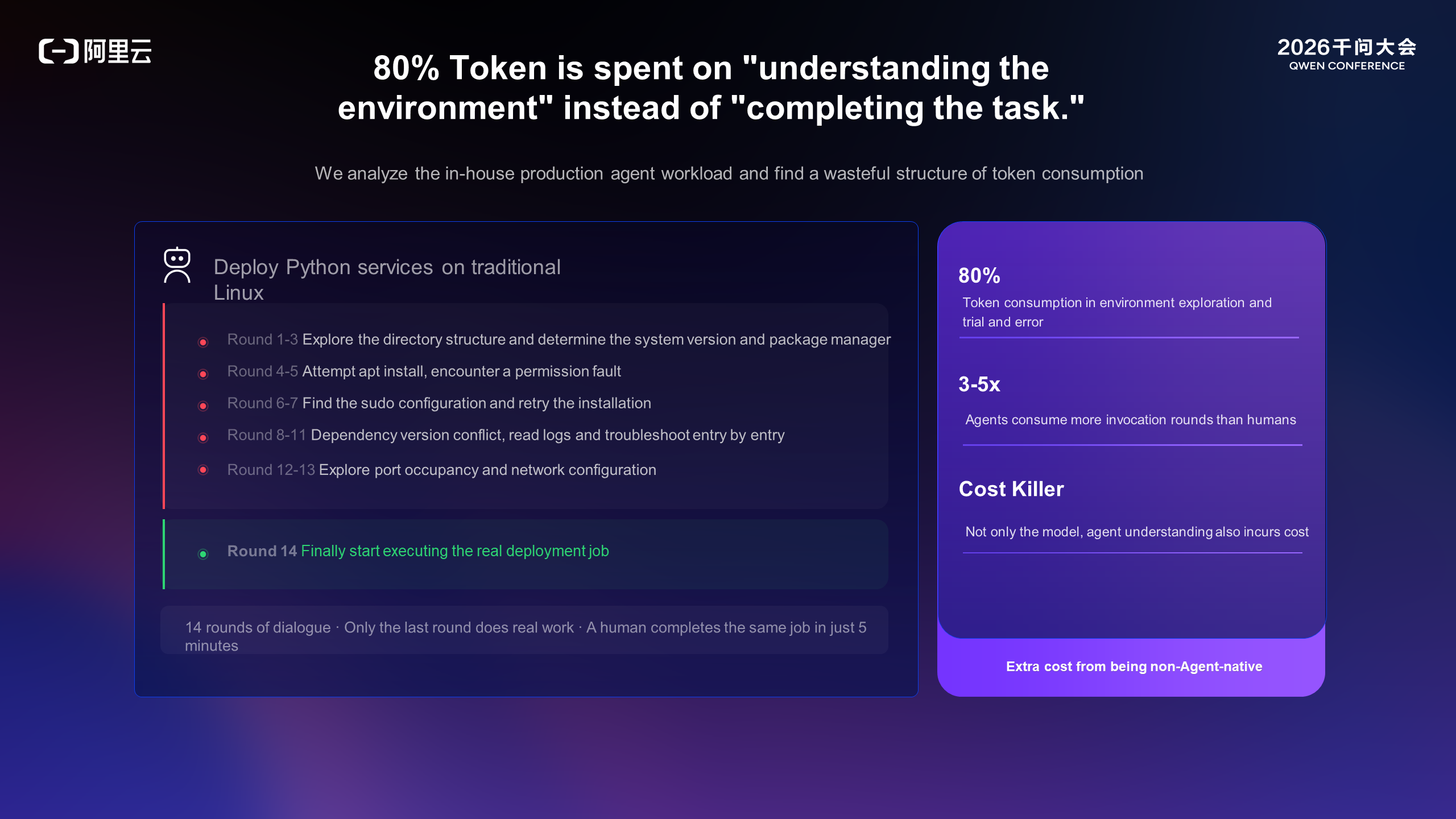
In his talk, Zhou Xu shared a real-world scenario: having an agent deploy a Python service on traditional Linux. What takes a skilled engineer 5 minutes took the agent 14 rounds of conversation. The first 13 rounds were all spent exploring the directory structure, resolving permission issues, handling dependency conflicts, and troubleshooting network configuration — all things engineers can skip at a glance based on experience. It wasn't until round 14 that the actual deployment began.
Breaking down token consumption, about 80% was spent on exploring the environment and trial and error, with less than 20% actually used to deploy services. This is not an isolated case — our internal data shows that agents consume 3–5 times more invocation rounds than humans, and the vast majority of tokens are spent on "understanding the environment".
Why is this so? The following comparison table explains.
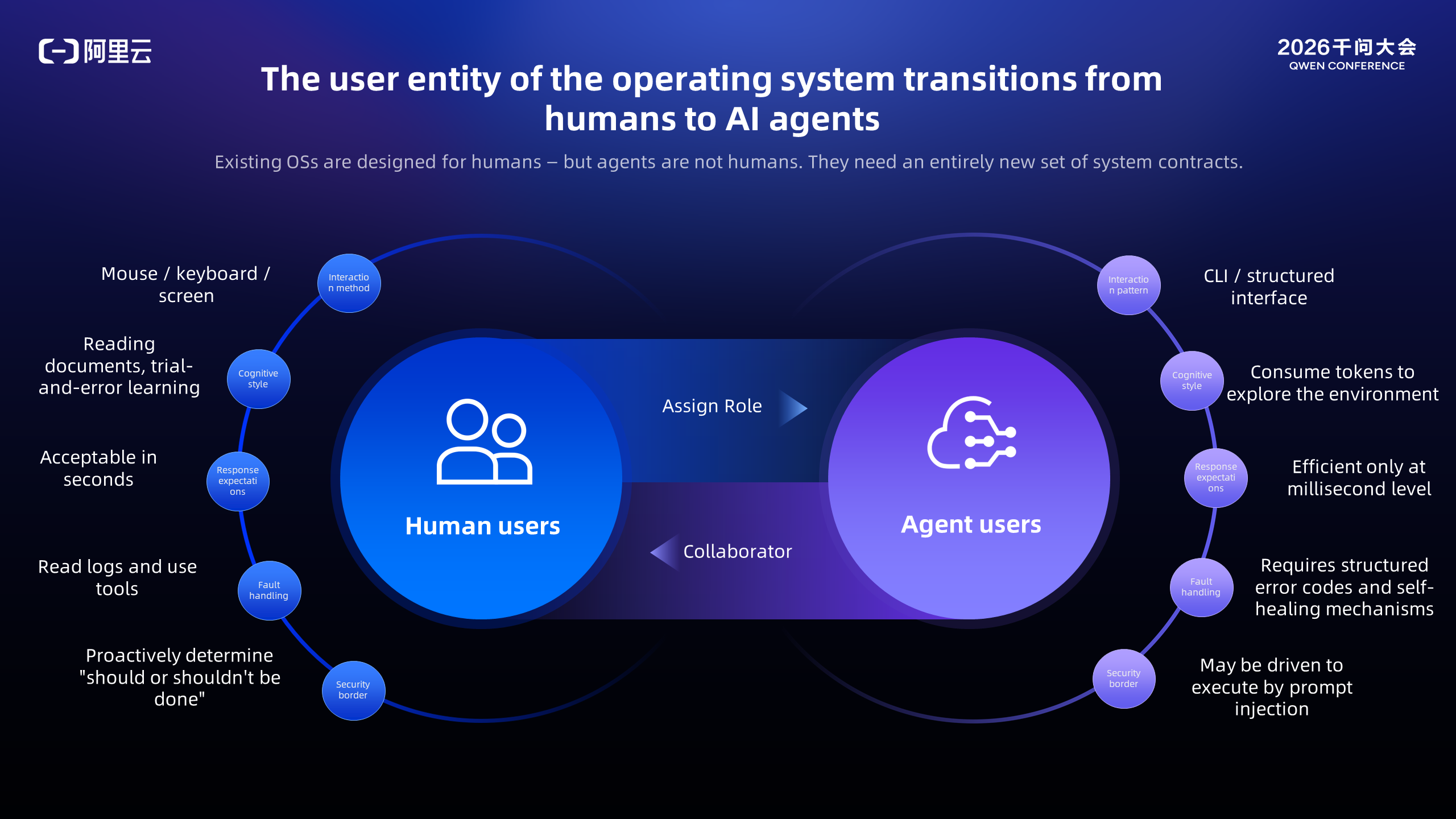
The interaction of human users with the OS is a cycle of "perception-understanding-decision-execution". We use the mouse and keyboard, look at screen logs, can tolerate second-level responses, and can skip redundant steps by experience. Agent and OS interaction is completely different: it needs CLI and structured interface, requires millisecond response, encountered errors need structured status code rather than a human-readable log; It may also be Prompt injection hijacked, without human "instinctive hesitation" to cover the bottom.
To use an analogy to describe, this is like the mobile era gave birth to iOS and Android-not because the function machine is "not good enough", but because touch screen interaction requires a new system layer-the Agent era also needs its own operating system.
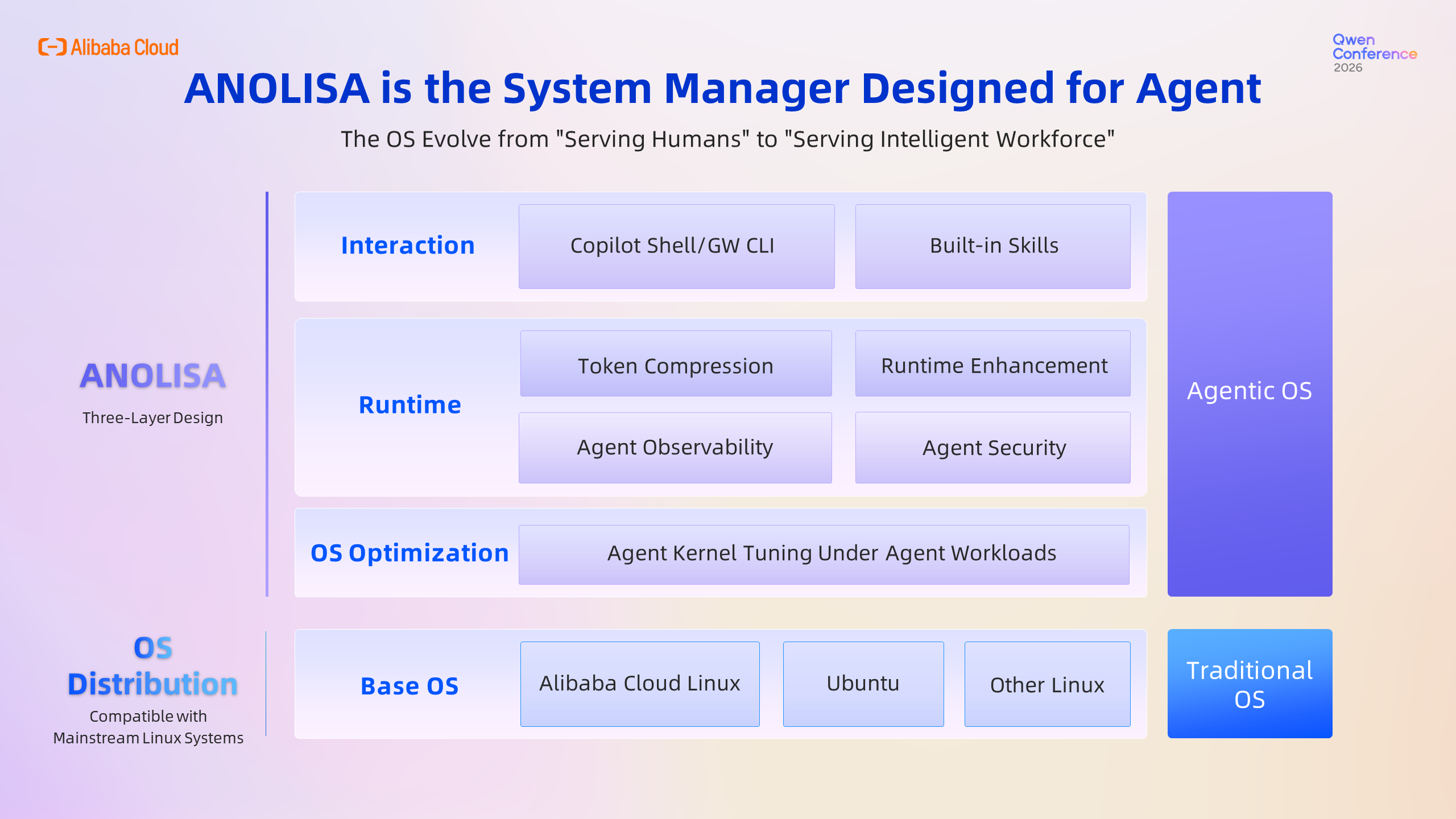
Before we talk about the specific architecture, we need to clarify the position of ANOLISA in the entire Agent ecosystem. Today, there are many excellent agent platforms in the market -- Managed Agents for orchestration, open source frameworks for ecology, and Harness Engineering for the application layer is also developing rapidly. ANOLISA provides a secure, efficient, and standardized operating system base for agents and agent hosting platforms.
Architecturally, ANOLISA uses a three-layer design. The bottom layer is the distribution adaptation layer, compatible with Alibaba Cloud Linux, Ubuntu, and other Linux systems — no need to replace the existing OS; it can be layered on top directly. The middle layer is the system optimization layer, enabling traditional Linux to truly understand agent workload features and perform kernel-level tuning for high-density deployment. The top layer is the runtime layer, which includes agent observability, runtime enhancement, token compression plugins, and an agent security protection system. Above that is the encapsulation interaction layer, allowing agents to interact with the operating system using intents rather than commands.
In one sentence: ANOLISA is the upgrade path from traditional OS to Agentic OS.
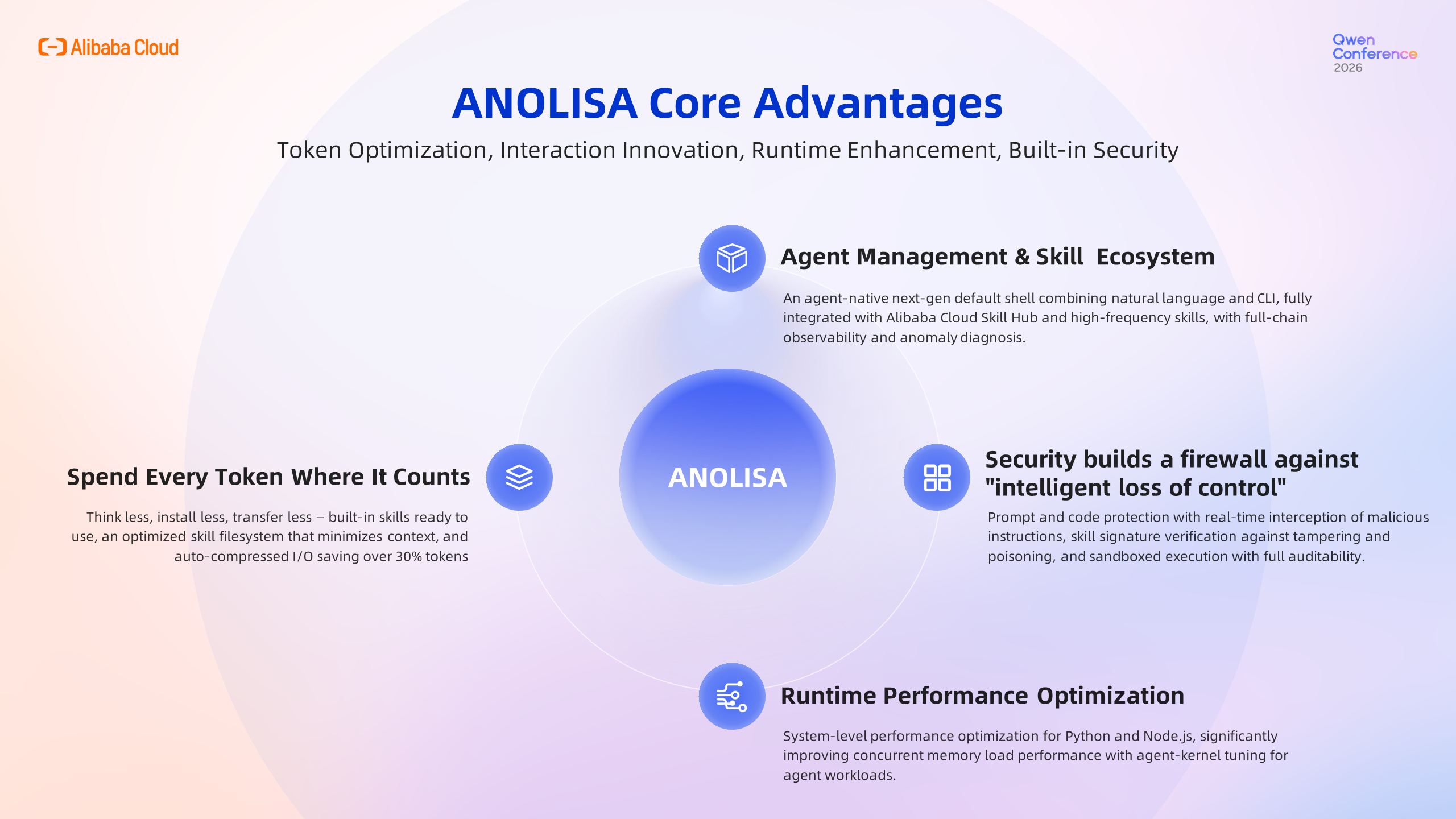
ANOLISA's three-layer architecture delivers four measurable core advantages.
First, token optimization. By thinking less, loading less, and transmitting less, token usage is reduced by over 30%. Second, agent management and Skill ecosystem. Ships with an Agent-native next-generation default shell, fully integrated with the Alibaba Cloud Skill portal, with full-link observability for agents. Third, runtime enhancement. System-layer performance optimization for Python and Node.js, and kernel tuning for agent workloads. Fourth, built-in security. Blocks agent security risks at the OS layer through a three-layer security protection architecture.
The following sections cover each in detail.
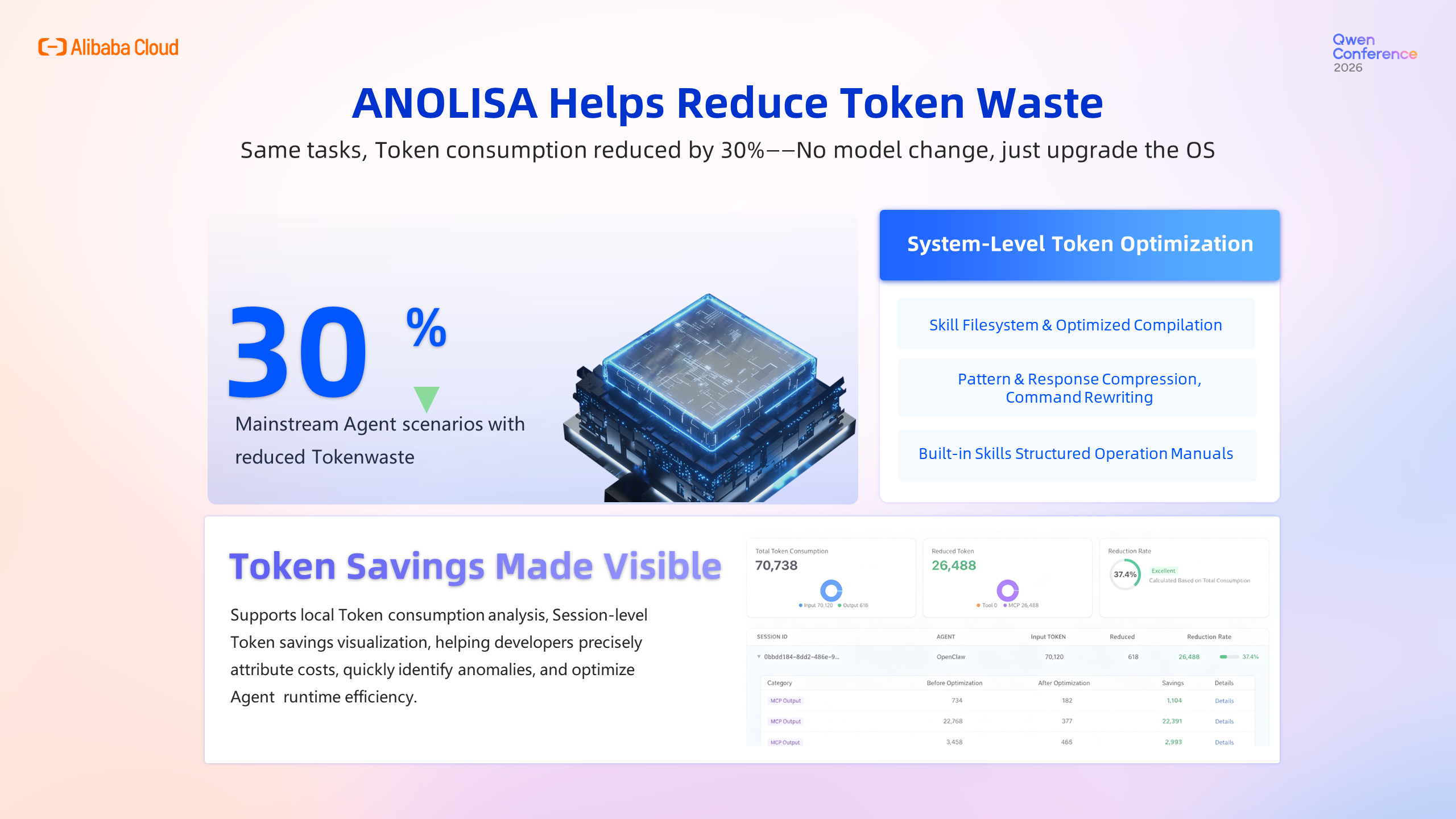
Some teams in the industry have conducted systematic reviews of token optimization and concluded that the memory layer can reduce cost by 3–4x. Various prompt engineering techniques claim to save 70%–80%. However, these are all optimizations at the application layer — treating the symptoms, not the root cause.
Our approach is to fundamentally reduce the amount of information an agent needs to explore at the operating system level. This is achieved through three dimensions — "less thinking, less loading, less transmitting":
• Less thinking — Built-in OS Skills serve as an "environment map" for the agent. The agent no longer needs to spend rounds exploring "how to install packages on this system" or "where the configuration files are." It also includes system tools refined over years, essentially embedding an Alibaba Cloud operating system expert.
• Less loading — The Skill file system exposes only the minimum information set relevant to the current job through compilation optimization and runtime indexing. The agent gets refined context, not the entire manual.
• Less transmitting — Input and output are automatically streamlined and compressed to reduce token overhead at the transport layer. The same amount of information is expressed with fewer tokens.
The end effect is that for the same job, token consumption is reduced by 30%. No model change needed — just upgrade the OS. And this effect is measurable — we have a built-in token consumption analysis panel that supports session-level token saving visualization, helping developers accurately attribute costs and quickly locate abnormal cases.
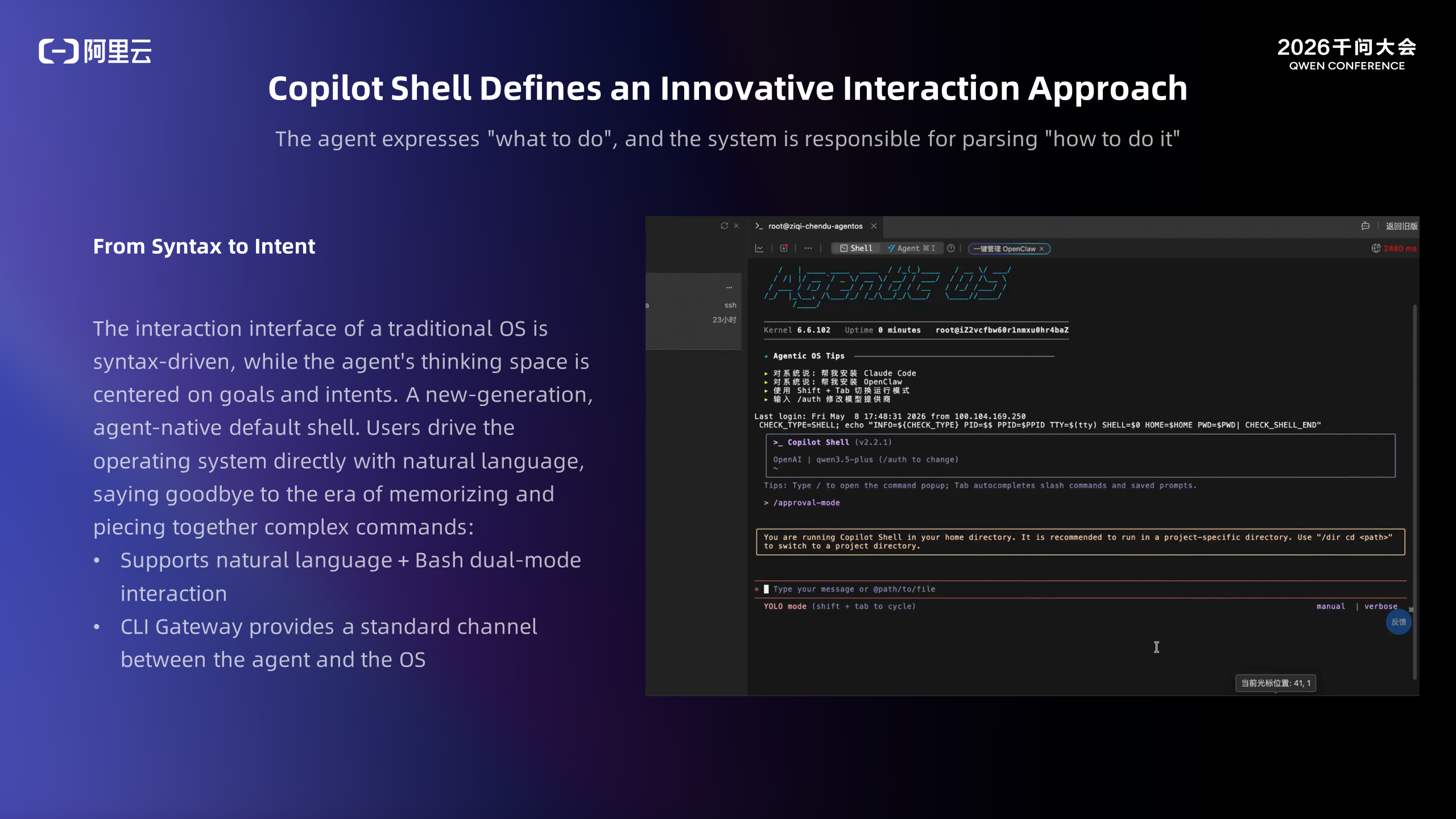
Traditional CLI is syntax-driven — you have to remember exact command syntax, parameter formats, and pipeline combinations. But an agent's thinking space is about goals and intents. What it wants to express is "compress and back up yesterday's logs," not remember tar's parameter order and file path rules.
Cosh serves both humans and agents through natural language and the command-line interface (CLI). A live demo was also shown — we've all been through that moment: jolted awake by an alarm at 2 a.m., staring at a dark terminal, checking documents while trying commands. With Cosh, you just say "find the error logs from the last hour," and the system completes it immediately.
Cosh achieves a key transformation: agents express "what to do," and the system handles parsing "how to do it." Whether you use self-developed agents, open source ecosystem agents, or third-party managed agents, they all connect to ANOLISA through the same CLI Gateway. The upper-layer platform does not need to worry about how underlying system operations are encapsulated — just focus on orchestration and product logic.
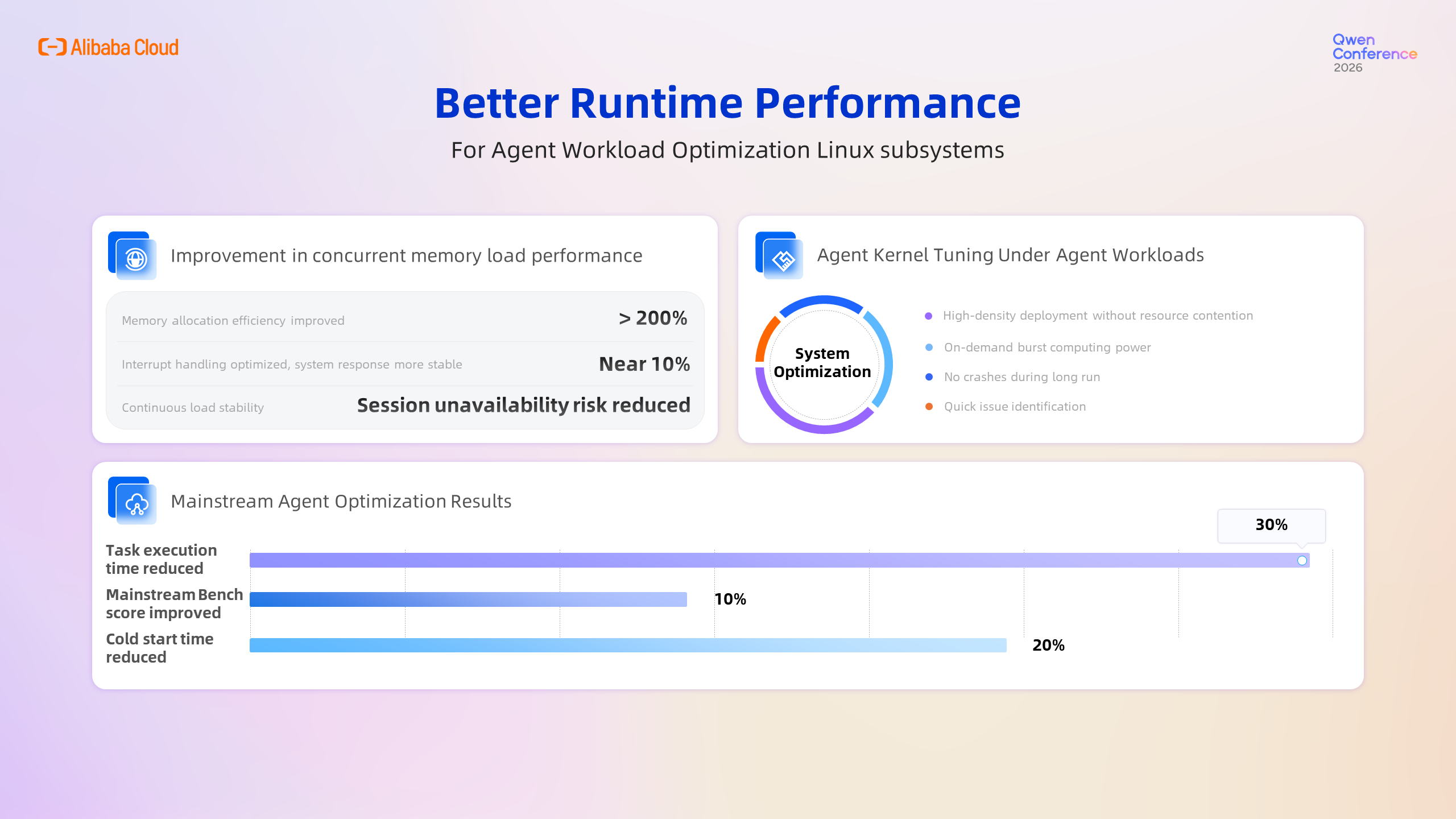
Agents not only need to use fewer tokens, but also need to run faster and more stably.
In the future, a human employee in the enterprise is expected to be equipped with 10 or even 100 AI agents. Tens of hundreds of Agent instances may run on the same server at the same time. The scheduling policies, memory allocation policies, and interrupt handling mechanisms of traditional kernels are not designed for this density at all.
We have done deep tuning for agent workloads at the kernel level. Several key figures: Concurrent memory load performance is improved by more than 200%, memory allocation efficiency is greatly improved, and Agent concurrent execution is smoother. Interrupt processing performance optimization is close to 10%, and system response is more stable.
Overall effect: The execution time of mainstream agents is reduced by 30%, the Bench score is improved by 20%, and the cold start duration is reduced by 10%. The core optimization directions include: high-density deployment does not rob resources, and multiple agents run time without interference at the same time; Burst computing power is released on demand; Long-term operation does not crash, and Agent tasks can run stably for days or even weeks.
In the Agent era, the meaning of security has changed-it is not just "protection", it determines whether the Agent can really be released to work independently. If you don't trust the security boundary of an agent, you will never dare to let it execute independently.
The security model of Agent is completely different from that of traditional software. Traditional software is a deterministic model of "known input → known output" and can be protected with rules and whitelists. However, Agent is a probabilistic model of "unknown intent → unknown action"-the same Prompt changes the wording and the behavior may be completely different.
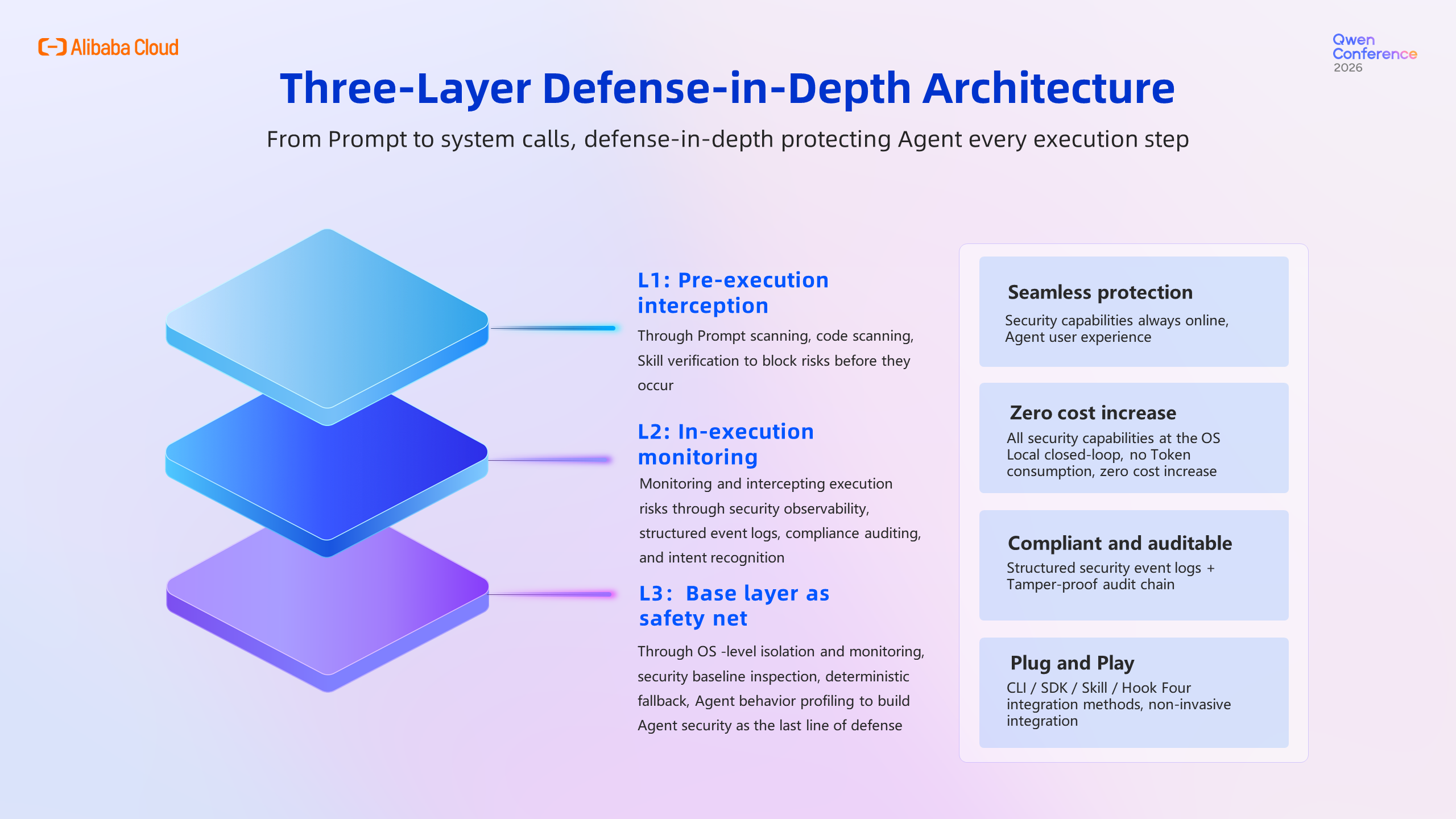
We built a three-layer defense-in-depth architecture:
Layer 1: Block before execution - prompt scanning, code scanning, and Skill verification, and block before risks occur.
Layer 2: In-Execution Monitoring - Security Observability, Structured Event Logs, Compliance Audit, and Intent Identification.
Layer 3: Bottom Layer - OS-level isolation and monitoring, security baseline inspection, and deterministic bottom-up. Even if the first two layers are broken, the operating system itself is the last line of defense.
And most importantly, all this is insensitive to Agent. Security capabilities are fully online, no additional tokens are consumed, and no cost increase is incurred. Supports multiple access modes and provides zero intrusion to existing systems. Security is not a function, it is the foundation of trust. Without this layer, the agent can only run in the demo forever.
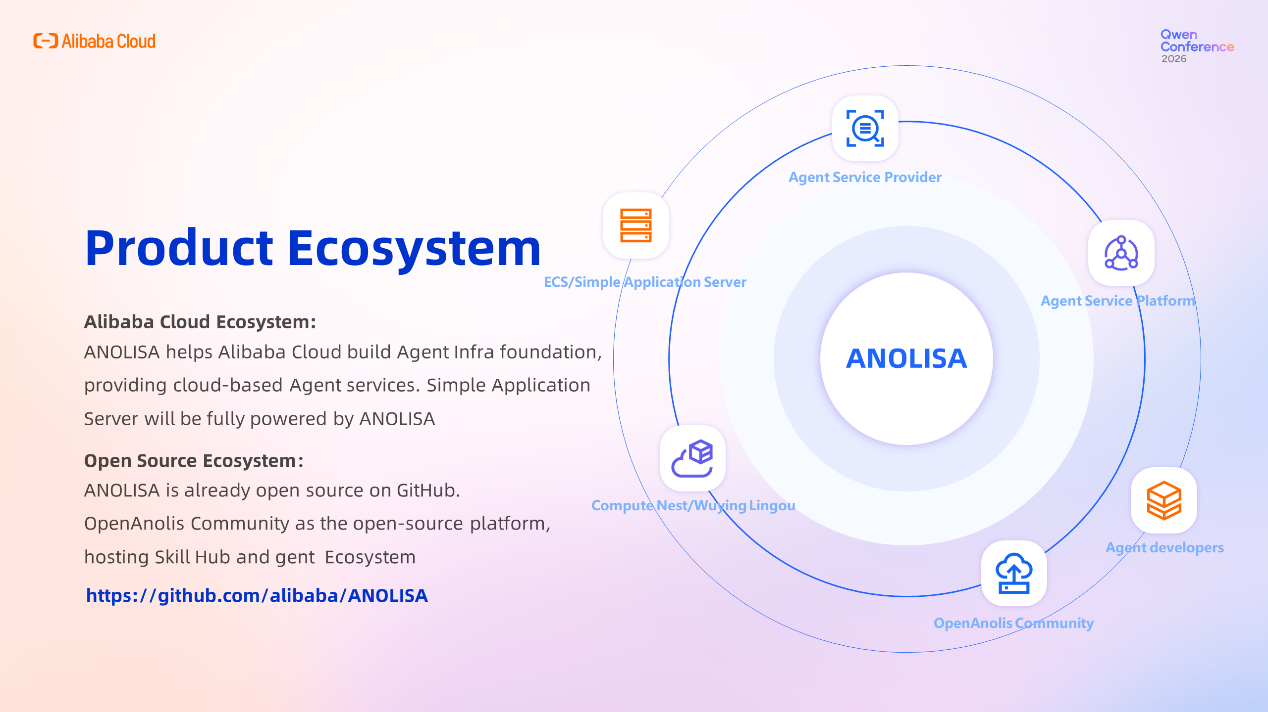
ANOLISA is an open base. The real value of the agent infrastructure lies not in the platform itself, but in the applications and services that grow on it.
In the Alibaba Cloud ecosystem, Simple Application Server Agent applications will be fully equipped with ANOLISA and will be integrated with other cloud products. Whether you are an agent developer or an agent service provider, ANOLISA provides a solid underlying support.
On the open source front, ANOLISA is already open source on GitHub. The OpenAnolis community serves as the open source platform for building the Skill Hub and agent ecosystem. When "engineers writing code with AI" becomes the norm, the operating system that agents run on becomes more critical than ever. We believe this requires the collective participation of the entire community.
The success of Unix was not the design of any particular feature, but the creation of interfaces and ideas that allowed "programs as yet unthought-of" to be created (unthought-out programs). The Agent is rapidly evolving from Copilot mode to Autopilot mode. ANOLISA will serve as the base of the Agent infrastructure to support this evolution.
Our vision is simple: let every agent run on ANOLISA.
Alibaba Cloud Linux 4 Agntic version is now online in the whole region of ECS, and is also online in Aliyun shadowless cloud computer and spirit structure, which will soon cover Simple Application Server. Welcome to try.
O&M No Longer Requires 'Old Masters' - Alibaba Cloud OS Console Releases OS O&M Skills
The More Capable the Agent, the Less You Dare to Let Go? ANOLISA Gives It Full Protection

115 posts | 6 followers
FollowOpenAnolis - June 24, 2026
OpenAnolis - July 15, 2026
OpenAnolis - July 14, 2026
Alibaba Cloud Community - May 26, 2026
OpenAnolis - July 24, 2026
CloudSecurity - May 26, 2026
115 posts | 6 followers
Follow Token Plan
Build more, spend less. One plan, every modality.
Learn More
Alibaba Cloud Model Studio
A one-stop generative AI platform to build intelligent applications that understand your business, based on Qwen model series such as Qwen-Max and other popular models
Learn More Alibaba Cloud Linux
Alibaba Cloud Linux is a free-to-use, native operating system that provides a stable, reliable, and high-performance environment for your applications.
Learn More Qwen
Qwen
Full-range, open-source, multimodal, and multi-functional
Learn MoreMore Posts by OpenAnolis

