You can modify the stream-node-max-bytes parameter to specify the maximum amount of memory that can be used by each macro node in streams. You can also modify the stream-node-max-entries parameter to specify the maximum number of stream entries that can be stored on each macro node.
Prerequisites
The engine version of the instance is Redis 5.0 or later.
The instance uses the standard master-replica architecture.
Relationship between Redis streams and macro nodes
Stream is a new data type introduced in Redis 5.0. A Redis stream stores data on delta-compressed macro nodes that are connected in a radix tree. Each macro node stores multiple stream entries. You can use this data structure to efficiently access random elements, obtain elements within a specified range, and create capped streams. This data structure also significantly optimizes memory usage.
You can specify the stream-node-max-entries parameter to limit the maximum number of stream entries supported by each macro node. You can specify the stream-node-max-bytes parameter to limit the maximum amount of memory that can be consumed by each macro node.
stream-node-max-entries: The default value is 100, which specifies that each macro node can store up to 100 stream entries. Valid values: 0 to 999,999,999,999,999. A value of 0 indicates that no limit exists. If the number of stream entries stored on a macro node reaches the upper limit, new stream entries are stored on a new macro node.
stream-node-max-bytes: Unit: bytes. The default value is 4096, which indicates that each macro node can consume up to 4,096 bytes of memory. Valid values: 0 to 999,999,999,999,999. A value of 0 indicates that no limit exists.
Common scenarios
You can specify the stream-node-max-entries parameter to adjust the length deviation of a fixed-length message queue.
If your application does not need to store messages permanently, you can use the MAXLEN parameter to specify the maximum number of messages that can be stored in a stream when you run the XADD command to add a message to the stream. Example:
XADD cappedstream MAXLEN 5000 * field value5001 // Add a value of value5001 to field1 of cappedstream and set the maximum number of messages to 5,000.When the number of messages in the stream reaches the upper limit, the earliest message is deleted each time a new message is added. The maximum length of the stream remains unchanged regardless of the number of messages that are added to the stream. In addition, the memory consumed by deleted messages is released.
When you delete a message from a macro node, the message is marked as deleted, but the memory consumed by the message is not immediately released. Tair (Redis OSS-compatible) deletes a macro node and releases the consumed memory only when all messages on the macro node are marked as deleted.
If you set the maximum length to an exact value such as 5,000 messages, performance is significantly degraded. To optimize memory usage, a Redis stream stores data on delta-compressed macro nodes that are connected in a radix tree. Each time Tair (Redis OSS-compatible) deletes a message, it must search the macro node for the message and mark the message as deleted. This mechanism is not optimal for high-throughput Tair (Redis OSS-compatible) instances where messages are frequently added and deleted. The service performance degrades if Tair (Redis OSS-compatible) frequently deletes messages. Therefore, we recommend that you add a tilde (~) in the XADD command to specify an approximate maximum length. Example:
XADD cappedstream MAXLEN ~ 5000 * field value1 // Add a value of value5001 to field1 of cappedstream and set the maximum number of messages to approximately 5,000.This way, the actual length of the stream can be an approximate value greater than or equal to the specified value. For example, the stream may contain 5000, 5050, or 5060 messages. The deviation from 5000 depends on the number of macro nodes in the stream and the maximum number of messages that can be stored on each macro node. Tair (Redis OSS-compatible) calculates the approximate value based on the stream-node-max-entries parameter. This parameter specifies the maximum number of messages that can be stored on each macro node. If the number of messages stored in the stream exceeds this approximate value, Tair (Redis OSS-compatible) deletes the macro node that stores the earliest messages, instead of deleting specific messages.
The value of the stream-node-max-entries parameter determines the length deviation of a fixed-length message queue. To reduce the deviation, you can set the parameter to a proper smaller value.
Procedure
Log on to the console and go to the Instances page. In the top navigation bar, select the region in which the instance that you want to manage resides. Then, find the instance and click the instance ID.
In the left-side navigation pane, click Parameter Settings.
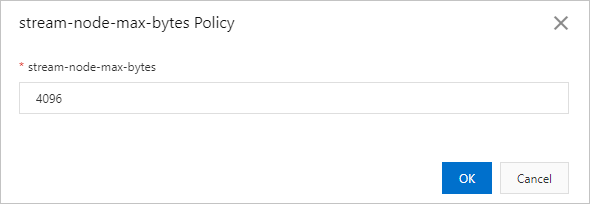
- On the page that appears, find the stream-node-max-bytes parameter and click Modify in the Actions column.
- In the dialog box that appears, perform the following steps:
- Change the value of the stream-node-max-bytes parameter based on your business requirements.
- Click OK.
Related API operations
API operation | Description |
Queries the configuration and operational parameters of an instance. | |
Modifies the parameter settings of an instance. |