This topic describes how to use the MongoDB connector.
Background information
MongoDB is a document-oriented database that stores unstructured data and simplifies application development and scaling. The MongoDB connector supports the following capabilities:
Category | Description |
Supported types | Source, dimension, sink, and data ingestion tables |
Running mode | Streaming mode only |
Monitoring metrics | |
API type | DataStream, SQL, and data ingestion YAML |
Support for updating or deleting sink table data | Yes |
Features
A MongoDB Change Data Capture (CDC) source table captures full and incremental data using the Change Stream API. It first reads historical data in a full snapshot and then seamlessly switches to reading incremental data from the oplog. This process provides exactly-once semantics, which ensures that there are no duplicate or omitted records and guarantees data consistency during fault recovery.
Based on the Change Stream API
The connector uses the Change Stream API introduced in MongoDB 3.6 to efficiently capture insert, update, replace, and delete events from databases and collections. These events are converted into changelog streams that Flink can process.
Seamless full and incremental data capture
The connector automatically reads the initial snapshot and then transitions to incremental mode without manual intervention.
Parallel snapshot reading
The connector reads historical data in parallel to improve performance. This requires MongoDB 4.0 or later.
Multiple startup modes
initial: Performs a full snapshot when the job starts for the first time, and then reads the oplog for incremental changes.latest-offset: Starts reading from the latest position of the oplog and does not read historical data.timestamp: Reads oplog events starting from a specified timestamp, skipping the snapshot. This requires MongoDB 4.0 or later.
Full Changelog support
Outputs complete changelog events that include the state of the data both before and after a change. This requires MongoDB 6.0 or later and the preimage and postimage recording feature.
Flink integration enhancements
VVR 8.0.6 and later
You can synchronize MongoDB data and schema changes to downstream tables using the CREATE TABLE AS (CTAS) or CREATE DATABASE AS (CDAS) statement. This requires the preimage and postimage recording feature.
VVR 8.0.9 and later
The dimension table join capability is extended to support reading the built-in
_idfield of the ObjectId type.
Prerequisites
MongoDB instance requirements
The connector supports only Alibaba Cloud MongoDB (replica set or sharded cluster) or self-managed MongoDB version 3.6 or later.
You must enable the replica set feature for the MongoDB database that you want to monitor. For more information, see Replication.
MongoDB feature dependencies
To use the Full Changelog event stream feature, you must enable the preimage and postimage recording feature.
If MongoDB authentication is enabled, your MongoDB user must have the following database permissions:
MongoDB network and other preparations
An IP address whitelist has been configured to allow Flink to access MongoDB.
You have created the target MongoDB database and table.
Limits
CDC source tables
Parallel reading during the initial snapshot phase is supported only for MongoDB 4.0 and later. To enable this feature, set the
scan.incremental.snapshot.enabledconfiguration option totrue.You cannot read data from the admin, local, or config databases, or from system collections. This is due to the subscription limits of MongoDB Change Streams. For more information, see the MongoDB documentation.
Sink tables
In Realtime Compute for Apache Flink that uses a VVR version earlier than 8.0.5, you can only insert data into sink tables.
In Realtime Compute for Apache Flink that uses VVR 8.0.5 or later, you can insert, update, and delete data if you declare a primary key in the DDL statement used to create the sink table. If no primary key is declared, you can only insert data.
Dimension tables
MongoDB dimension tables are supported in Realtime Compute for Apache Flink that uses VVR 8.0.5 or later.
SQL
Syntax
CREATE TABLE tableName(
  _id STRING,
  [columnName dataType,]*
  PRIMARY KEY(_id) NOT ENFORCED
) WITH (
  'connector' = 'mongodb',
  'hosts' = 'localhost:27017',
  'username' = 'mongouser',
  'password' = '${secret_values.password}',
  'database' = 'testdb',
  'collection' = 'testcoll'
)When you create a CDC source table, you must declare the _id STRING column and specify it as the primary key.
WITH Parameter
General
Parameter | Description | Type | Required? | Default value | Remarks |
connector | The name of the connector. | String | Yes | None |
|
uri | The uniform resource identifier (URI) used to connect to the MongoDB database. | String | No | No default value | Note You must specify either the |
hosts | The hostname of the MongoDB database server. | String | No | None | Separate multiple hostnames with commas ( |
scheme | The connection protocol used to access the MongoDB database. | String | No | mongodb | Valid values:
|
username | The username used to connect to MongoDB. | String | No | No default value | This parameter is required if the identity verification feature is enabled. |
password | The password used to connect to MongoDB. | String | No | No default value | You must configure this parameter if you enable the identity verification feature. Important To prevent password leaks, use variables instead of hardcoding credentials. |
database | The name of the MongoDB database. | String | No | No default value |
Important You cannot monitor data in the admin, local, and config databases. |
collection | The name of the MongoDB collection. | String | No | No default value |
Important You cannot monitor data in system collections. |
connection.options | Additional connection options for MongoDB. | String | No | No default value | Specify additional options as key-value pairs ( Important By default, MongoDB CDC does not set socket connection timeout. This may cause long interruptions during network jitter. We recommend setting socketTimeoutMS to a reasonable value here to avoid this issue. |
Source-specific
Parameters | Description | Type | Required? | Default value | Remarks |
scan.startup.mode | The startup mode of the MongoDB CDC connector. | String | No | initial | Valid values:
For more information, see Startup Properties. |
scan.startup.timestamp-millis | The start timestamp for consumption at the specified offset. | Long | Depends on the value of scan.startup.mode:
| None | The value is the number of milliseconds since the UNIX epoch (00:00:00 UTC on January 1, 1970). Applies only to the |
initial.snapshotting.queue.size | The maximum queue size for the initial snapshot phase. | Integer | No | 10240 | Takes effect only when |
batch.size | The batch processing size of the cursor. | Integer | No | 1024 | N/A. |
poll.max.batch.size | The maximum number of change documents processed in a single batch. | Integer | No | 1024 | This option controls the maximum number of change documents pulled at a time during stream processing. A larger value allocates a larger internal buffer in the connector. |
poll.await.time.ms | The interval between data pulls. | Integer | No | 1000 | Unit: milliseconds. |
heartbeat.interval.ms | The interval at which heartbeat packets are sent. | Integer | No | 0 | Unit: milliseconds. The MongoDB CDC connector sends heartbeat packets to the database to ensure the latest backtracking status. Setting this to 0 disables heartbeat packets. Important We strongly recommend setting this option for infrequently updated collections. |
scan.incremental.snapshot.enabled | Enables parallel reading during the initial snapshot phase. | Boolean | No | false | This is an experimental feature. |
scan.incremental.snapshot.chunk.size.mb | The shard size when parallel snapshot reading is enabled. | Integer | No | 64 | This is an experimental feature. Unit: MB. Takes effect only when parallel snapshot reading is enabled. |
scan.full-changelog | Generates a complete full changelog event stream. | Boolean | No | false | This is an experimental feature. Note Requires MongoDB 6.0 or later with preimage and postimage features enabled. For instructions, see Document Preimages. |
scan.flatten-nested-columns.enabled | Parses fields separated by | Boolean | No | false | If enabled, the Note Supported only in VVR 8.0.5 or later. |
scan.primitive-as-string | Parses all primitive types in BSON documents as STRING. | Boolean | No | false | Note Supported only in VVR 8.0.5 or later. |
scan.ignore-delete.enabled | Whether to ignore delete (-D) messages. | Boolean | No | false | During archiving of MongoDB source data, many DELETE events may appear in the OpLog. Enable this option to ignore those events and prevent them from syncing downstream. Note
|
scan.incremental.snapshot.backfill.skip | Skips watermark backfilling during incremental snapshot reading. | Boolean | No | false | Enabling this option provides only at-least-once semantics. Note Supported only in VVR 11.1 or later. |
initial.snapshotting.pipeline | MongoDB pipeline operations pushed down to MongoDB during snapshot reading to filter only required data and improve efficiency. | String | No | None. |
|
initial.snapshotting.max.threads | The number of threads used for data replication. | Integer | No | None. | Takes effect only when scan.startup.mode is set to initial. Note Supported only in VVR 11.1 or later. |
initial.snapshotting.queue.size | The queue size for the initial snapshot. | Integer | No | 16000 | Takes effect only when scan.startup.mode is set to initial. Note Supported only in VVR 11.1 or later. |
scan.change-stream.reading.parallelism | The parallelism for subscribing to the Change Stream. | Integer | No | 1 | Takes effect only when scan.incremental.snapshot.enabled is enabled. Important To subscribe to the Change Stream with multiple concurrent readers, also set heartbeat.interval.ms. Note Supported only in VVR 11.2 or later. |
scan.change-stream.reading.queue-size | The message queue size for concurrent Change Stream subscriptions. | Integer | No | 16384 | Takes effect only when scan.change-stream.reading.parallelism is enabled. Note Supported only in VVR 11.2 or later. |
Dimension table-specific
Parameters | Description | Data type | Required? | Default value | Remarks |
lookup.cache | The cache policy. | String | No | NONE | Supported policies:
|
lookup.max-retries | The maximum number of retries allowed when querying the database fails. | Integer | No | 3 | N/A. |
lookup.retry.interval | The interval between retries when querying the database fails. | Duration | No | 1s | N/A. |
lookup.partial-cache.expire-after-access | The maximum time records remain in the cache after being accessed. | Duration | No | None | Supported units: ms, s, min, h, d. Requires |
lookup.partial-cache.expire-after-write | The maximum time records remain in the cache after being written. | Duration | No | None | Requires |
lookup.partial-cache.max-rows | The maximum number of rows cached. When exceeded, the oldest rows expire. | Long | No | None | Requires |
lookup.partial-cache.cache-missing-key | Caches empty records when no data is associated with the physical table. | Boolean | No | True | Requires |
Sink-specific
Parameters | Description | Type | Required? | Default value | Remarks |
sink.buffer-flush.max-rows | The maximum number of records written per batch. | Integer | No | 1000 | N/A. |
sink.buffer-flush.interval | The interval at which data is flushed. | Duration | No | 1s | N/A. |
sink.delivery-guarantee | Semantic guarantees for data writes. | String | No | at-least-once | Valid values:
Note Exactly-once is not supported. |
sink.max-retries | The maximum number of retries allowed when writing data to the database fails. | Integer | No | 3 | N/A. |
sink.retry.interval | The interval between retries when writing data to the database fails. | Duration | No | 1s | N/A. |
sink.parallelism | The custom degree of parallelism for the sink. | Integer | No | empty | N/A. |
sink.delete-strategy | Specifies how to handle -D and -U data events. | String | No | CHANGELOG_STANDARD | Valid values:
|
Data type mappings
CDC source tables
BSON type | Flink SQL type |
Int32 | INT |
Int64 | BIGINT |
Double | DOUBLE |
Decimal128 | DECIMAL(p, s) |
Boolean | BOOLEAN |
Date Timestamp | DATE |
Date Timestamp | TIME |
DateTime | TIMESTAMP(3) TIMESTAMP_LTZ(3) |
Timestamp | TIMESTAMP(0) TIMESTAMP_LTZ(0) |
String ObjectId UUID Symbol MD5 JavaScript Regex | STRING |
Binary | BYTES |
Object | ROW |
Array | ARRAY |
DBPointer | ROW<$ref STRING, $id STRING> |
GeoJSON | Point: ROW<type STRING, coordinates ARRAY<DOUBLE>> Line: ROW<type STRING, coordinates ARRAY<ARRAY< DOUBLE>>> |
Dimension and sink tables
BSON type | Flink SQL type |
Int32 | INT |
Int64 | BIGINT |
Double | DOUBLE |
Decimal128 | DECIMAL |
Boolean | BOOLEAN |
DateTime | TIMESTAMP_LTZ(3) |
Timestamp | TIMESTAMP_LTZ(0) |
String ObjectId | STRING |
Binary | BYTES |
Object | ROW |
Array | ARRAY |
Usage Example
CDC source table
CREATE TEMPORARY TABLE mongo_source (
  `_id` STRING, --must be declared
  name STRING,
  weight DECIMAL,
  tags ARRAY<STRING>,
  price ROW<amount DECIMAL, currency STRING>,
  suppliers ARRAY<ROW<name STRING, address STRING>>,
  db_name STRING METADATA FROM 'database_name' VIRTUAL,
  collection_name STRING METADATA VIRTUAL,
  op_ts TIMESTAMP_LTZ(3) METADATA VIRTUAL,
  PRIMARY KEY(_id) NOT ENFORCED
) WITH (
  'connector' = 'mongodb',
  'hosts' = 'dds-bp169b982fc25****.mongodb.rds.aliyuncs.com:3717,dds-bp169b982fc25****.mongodb.rds.aliyuncs.com:3717,',
  'username' = 'root',
  'password' = '${secret_values.password}',
  'database' = 'flinktest',
  'collection' = 'flinkcollection',
  'scan.incremental.snapshot.enabled' = 'true',
  'scan.full-changelog' = 'true'
);
CREATE TEMPORARY TABLE  productssink (
  name STRING,
  weight DECIMAL,
  tags ARRAY<STRING>,
  price_amount DECIMAL,
  suppliers_name STRING,
  db_name STRING,
  collection_name STRING,
  op_ts TIMESTAMP_LTZ(3)
) WITH (
  'connector' = 'print',
  'logger' = 'true'
);
INSERT INTO productssink
SELECT
  name,
  weight,
  tags,
  price.amount,
  suppliers[1].name,
  db_name,
  collection_name,
  op_ts
FROM
  mongo_source;
Dimension table
CREATE TEMPORARY TABLE datagen_source (
  id STRING,
  a int,
  b BIGINT,
  `proctime` AS PROCTIME()
) WITH (
  'connector' = 'datagen'
);
CREATE TEMPORARY TABLE mongo_dim (
  `_id` STRING,
  name STRING,
  weight DECIMAL,
  tags ARRAY<STRING>,
  price ROW<amount DECIMAL, currency STRING>,
  suppliers ARRAY<ROW<name STRING, address STRING>>,
  PRIMARY KEY(_id) NOT ENFORCED
) WITH (
  'connector' = 'mongodb',
  'hosts' = 'dds-bp169b982fc25****.mongodb.rds.aliyuncs.com:3717,dds-bp169b982fc25****.mongodb.rds.aliyuncs.com:3717,',
  'username' = 'root',
  'password' = '${secret_values.password}',
  'database' = 'flinktest',
  'collection' = 'flinkcollection',
  'lookup.cache' = 'PARTIAL',
  'lookup.partial-cache.expire-after-access' = '10min',
  'lookup.partial-cache.expire-after-write' = '10min',
  'lookup.partial-cache.max-rows' = '100'
);
CREATE TEMPORARY TABLE print_sink (
  name STRING,
  weight DECIMAL,
  tags ARRAY<STRING>,
  price_amount DECIMAL,
  suppliers_name STRING
) WITH (
  'connector' = 'print',
  'logger' = 'true'
);
INSERT INTO print_sink
SELECT
  T.id,
  T.a,
  T.b,
  H.name
FROM
  datagen_source AS T JOIN mongo_dim FOR SYSTEM_TIME AS OF T.`proctime` AS H ON T.id = H._id;
Sink table
CREATE TEMPORARY TABLE datagen_source (
  `_id` STRING,
  name STRING,
  weight DECIMAL,
  tags ARRAY<STRING>,
  price ROW<amount DECIMAL, currency STRING>,
  suppliers ARRAY<ROW<name STRING, address STRING>>
) WITH (
  'connector' = 'datagen'
);
CREATE TEMPORARY TABLE mongo_sink (
  `_id` STRING,
  name STRING,
  weight DECIMAL,
  tags ARRAY<STRING>,
  price ROW<amount DECIMAL, currency STRING>,
  suppliers ARRAY<ROW<name STRING, address STRING>>,
  PRIMARY KEY(_id) NOT ENFORCED
) WITH (
  'connector' = 'mongodb',
  'hosts' = 'dds-bp169b982fc25****.mongodb.rds.aliyuncs.com:3717,dds-bp169b982fc25****.mongodb.rds.aliyuncs.com:3717,',
  'username' = 'root',
  'password' = '${secret_values.password}',
  'database' = 'flinktest',
  'collection' = 'flinkcollection'
);
INSERT INTO mongo_sink
SELECT * FROM datagen_source;
Data ingestion (public preview)
You can use the MongoDB connector as a data ingestion source.
Limits
This feature is supported only in VVR 11.1 and later.
Syntax
source:
   type: mongodb
   name: MongoDB Source
   hosts: localhost:33076
   username: ${mongo.username}
   password: ${mongo.password}
   database: foo_db
   collection: foo_col_.*

sink:
  type: ...
Configuration options
Parameters | Description | Required? | Data Types | Default value | Remarks |
type | The data source type. | Yes | STRING | None | Set this option to mongodb. |
scheme | The protocol used to connect to the MongoDB server. | No | STRING | mongodb | Valid values:
|
hosts | The hostname of the MongoDB server. | Yes | STRING | No default value | Separate multiple hostnames with commas (,). |
username | The username used to connect to MongoDB. | No | STRING | No default value | N/A. |
password | The password used to connect to MongoDB. | No | STRING | None | N/A. |
database | The name of the MongoDB database to capture. | Yes | STRING | No default value | Regular expressions are supported. |
collection | The name of the MongoDB collection to capture. | Yes | STRING | No default value | Regular expressions are supported. You must match the complete |
connection.options | Additional connection options when connecting to the MongoDB server. | No | STRING | None | Specify key-value pairs ( |
schema.inference.strategy | The strategy for document type inference. Valid values: | No | STRING |
| When set to When set to |
scan.max.pre.fetch.records | The maximum number of records to sample in each captured collection during initial schema inference. | No | INT | 50 | N/A. |
scan.startup.mode | The startup mode of the MongoDB data source. Valid values: | No | STRING | initial | Valid values:
|
scan.startup.timestamp-millis | When the startup mode is set to | No | LONG | None | N/A. |
chunk-meta.group.size | The maximum metadata chunk size. | No | INT | 1000 | N/A. |
scan.incremental.close-idle-reader.enabled | Specifies whether to close idle source readers after switching to incremental reading. | No | BOOLEAN | false | N/A. |
scan.incremental.snapshot.backfill.skip | Specifies whether to skip the backfill watermark process in the incremental snapshot algorithm. | No | BOOLEAN | false | If your sink connector supports automatic primary-key deduplication, enabling this switch reduces the time needed to transition from snapshot reading to incremental reading. |
scan.incremental.snapshot.unbounded-chunk-first.enabled | Specifies whether to read unbounded chunks first under the incremental snapshot framework. | No | BOOLEAN | false | If the collection to snapshot updates frequently, enabling this feature reduces the risk of out-of-memory errors when reading unbounded chunks. |
batch.size | The batch size for the cursor when reading data from MongoDB. | No | INT | 1024 | N/A. |
poll.max.batch.size | The maximum number of entries to request when pulling a change stream. | No | INT | 1024 | N/A. |
poll.await.time.ms | The minimum wait time between two requests when pulling Change Stream changes. | No | INT | 1000 | Unit: milliseconds. |
heartbeat.interval.ms | The interval at which heartbeat packets are sent. | No | INT | 0 | Unit: milliseconds. The MongoDB CDC connector sends heartbeat packets to the MongoDB database to ensure the latest backtracking status. Setting this to 0 disables heartbeat packets. Note Configure this option for infrequently updated collections. |
scan.incremental.snapshot.chunk.size.mb | The shard size during the snapshotting phase. | No | INT | 64 | Unit: MB. |
scan.incremental.snapshot.chunk.samples | The number of samples to determine collection size during snapshotting. | No | INT | 20 | N/A. |
scan.full-changelog | Specifies whether to generate a complete full changelog event stream based on MongoDB pre- and post-image records. | No | BOOLEAN | false | Requires MongoDB 6.0 or later with preimage and postimage features enabled. For instructions, see Document Preimages. |
scan.cursor.no-timeout | Specifies whether to disable cursor timeouts. | No | BOOLEAN | false | MongoDB servers typically close idle cursors after 10 minutes to prevent memory usage issues. Setting this option to true prevents that behavior. |
scan.ignore-delete.enabled | Specifies whether to ignore delete events from MongoDB. | No | BOOLEAN | false | N/A. |
scan.flatten.nested-documents.enabled | Whether to flatten the nested structure in the BSON document. | No | BOOLEAN | false | When enabled, a schema like |
scan.all.primitives.as-string.enabled | Infers all primitive types as STRING. | No | BOOLEAN | false | Enabling this avoids frequent schema change events when upstream data types are inconsistent. |
metadata.list | The list of metadata to pass downstream. | No | STRING | None. | Separate multiple metadata items with commas. Supported metadata:
|
Data type mappings
BSON type | CDC type | Notes |
STRING | VARCHAR | N/A. |
INT32 | INT | |
INT64 | BIGINT | |
DECIMAL128 | DECIMAL | |
DOUBLE | DOUBLE | |
BOOLEAN | BOOLEAN | |
TIMESTAMP | TIMESTAMP | |
DATETIME | LOCALZONEDTIMESTAMP | |
BINARY | VARBINARY | |
DOCUMENT | MAP | Key and value types are inferred. |
ARRAY | ARRAY | Element types are inferred. |
OBJECTID | VARCHAR | Represented as a HexString. |
SYMBOL REGULAREXPRESSION JAVASCRIPT JAVASCRIPTWITHSCOPE | VARCHAR | Represented as a string. |
Metadata
SQL connectors
MongoDB CDC SQL source tables support metadata column syntax. You can access the following metadata columns:
metadata key | Metadata type | Description |
database_name | STRING NOT NULL | The name of the database containing the document. |
collection_name | STRING NOT NULL | The name of the collection containing the document. |
op_ts | TIMESTAMP_LTZ(3) NOT NULL | The time when the document changed in the database. If the document comes from historical table data rather than the ChangeStream, this value is always 0. |
row_kind | STRING NOT NULL | The type of data change event. Valid values:
Note Supported only in VVR 11.1 or later. |
Data ingestion YAML
MongoDB CDC data ingestion YAML connectors support the following metadata columns:
Metadata column | Metadata type | Description |
ts_ms | BIGINT NOT NULL | The time when the document changed in the database. If the document comes from historical table data rather than the ChangeStream, this value is always 0. |
You can also use generic metadata columns provided by the Transform module to access database name, collection name, and row_kind information.
Preimage and postimage features
By default, MongoDB versions earlier than 6.0 do not retain pre-change or deleted documents. Without the preimage and postimage features enabled, MongoDB supports only UPSERT semantics, which means that UPDATE_BEFORE events are missing. However, many useful Flink operators require a complete changelog stream that includes INSERT, UPDATE_BEFORE, UPDATE_AFTER, and DELETE events.
To supplement missing UPDATE_BEFORE events, the Flink SQL planner automatically generates a ChangelogNormalize operator for UPSERT-type data sources. This operator caches snapshots of the current version of all documents in deployment state data. When a document is updated or deleted, you can query the state data in ChangelogNormalize to obtain its pre-update state. However, this requires storing large amounts of state data.
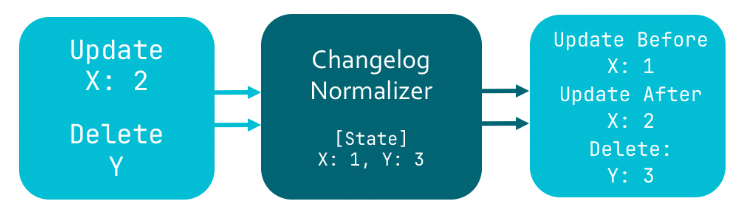
MongoDB 6.0 supports the preimage and postimage features. For more information, see Use MongoDB Change Streams to capture data changes in real time. When you enable this feature, MongoDB records the complete state of a document before and after each change in a special collection. If you enable the scan.full-changelog option in your job, the MongoDB CDC connector uses these change document records to generate UPDATE_BEFORE records. This allows the connector to generate a complete event stream and eliminates the dependency on the ChangelogNormalize operator.
MongoDB CDC DataStream API
When you read or write data using DataStream, use the corresponding DataStream connector to connect to Flink. For more information about how to set up the DataStream connector, see DataStream connector usage.
You can create a DataStream API program and use MongoDBSource. The following code provides an example:
Java
MongoDBSource.builder()
  .hosts("mongo.example.com:27017")
  .username("mongouser")
  .password("mongopasswd")
  .databaseList("testdb")
  .collectionList("testcoll")
  .startupOptions(StartupOptions.initial())
  .deserializer(new JsonDebeziumDeserializationSchema())
  .build();
XML
The Maven Central Repository hosts VVR MongoDB connectors that you can use directly in job development.
<dependency>
    <groupId>com.alibaba.ververica</groupId>
    <artifactId>flink-connector-mongodb</artifactId>
    <version>${vvr.version}</version>
</dependency>When you use the DataStream API, the package that you use to construct the MongoDBSource data source depends on whether you want to enable the incremental snapshot feature. To enable the incremental snapshot feature, use MongoDBSource#builder() from the com.ververica.cdc.connectors.mongodb.source package. Otherwise, use MongoDBSource#builder() from com.ververica.cdc.connectors.mongodb.
You can configure the following parameters when you construct MongoDBSource:
Parameter | Description |
hosts | The hostname of the MongoDB database to connect to. |
username | The username for the MongoDB database service. Note If authentication is not enabled on the MongoDB server, you do not need to configure this parameter. |
password | The password for the MongoDB database service. Note If authentication is not enabled on the MongoDB server, you do not need to configure this parameter. |
databaseList | The name of the MongoDB database to monitor. Note The database name supports regular expressions to read data from multiple databases. Use |
collectionList | The name of the MongoDB collection to monitor. Note The collection name supports regular expressions to read data from multiple collections. Use |
startupOptions | Select the startup mode for MongoDB CDC. Valid values:
For more information, see Startup Properties. |
deserializer | A deserializer that deserializes SourceRecord type records into a specified type. Valid values:
|