This topic describes the meaning of each configuration items when Full Select is image carousel.
Chart style
A image carousel is a type of media component that supports custom image carousel and carousel animation effects. It can display multiple images in turn on a dashboard. 
Style Panel 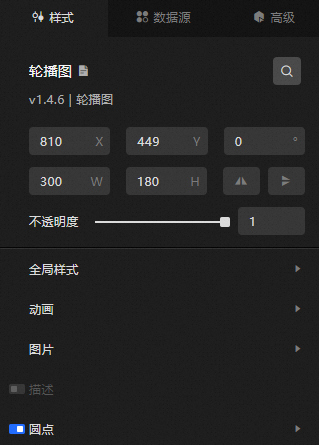
Search Configuration: Click the Search configuration items icon
 in the upper-right corner of the Style panel. In the Search Configuration panel, enter the name of the configuration items that you want to search for and locate the configuration items. Fuzzy match is supported. For more information, see Search configuration items.
 Size: the width and height of the widget. Unit: pixels.
Positioning: the x-axis and y-axis of the component. Unit: pixels. X-coordinate indicates the pixel distance between the upper-left corner of the widget and the left border of the canvas. Y-coordinate indicates the pixel distance between the upper-left corner of the widget and the upper border of the canvas.
Rotate: The widget is rotated around the center of the widget. Unit: degrees.
Directly enter the degrees in the Rotation Angle spin box or click the plus sign (+) or minus sign (-) to increase or decrease the value in the Rotation Angle spin box.
Click the
 icon to flip the widget style.
 Click the
 icon to flip the widget style.
Opacity: Valid values: 0 to 1. If this parameter is set to 0, the widget is hidden. If this parameter is set to 1, the widget is completely displayed. Default value: 1.
Global Style
Parameter
Description
Font
The font of the text in the image carousel widget. Select a font that is installed in your computer. Otherwise, the default font is used.
Font size
The font size of the text in the image carousel widget. Valid value: 10 to 100.
Animation
Parameter
Description
Automatic carousel
Specifies whether to enable or disable automatic carousel.
Pause
The time interval to rotate the images. Unit: ms.
Speed
The duration of the animation. Unit: ms.
Special Effects
The effect of the animation. Valid values: Horizontal Scrolling, Vertical Scrolling, Fade, and Mosaic.
Image
Parameter
Description
Default Image
image carousel the default image. Drag the local image to the dashed box or enter the URL of the image. To delete an image, move the pointer over the image box and click Delete.
NoteIf the url field in the data panel is empty, the image in the default image configuration items is used.
Filling Method
The filling mode of the image. Valid values: Stretch to Fill Container, Fill Container, and Center.
Description: the description style of each image in the carousel. You can click the
 icon to display or hide the description.
 Background Color: the background color of the description.
Parameter
Description
Color Style
The style of the background color. Valent options: Gradient and Monochrome.
Color
The background color. This field takes effect only when the Color Style field is set to Monochrome.
Start Color
The start color of the background. For more information, see color picker description. This value is valid only when the Color Style is set to Gradient.
End Color
The end color of the background. This parameter takes effect only when the Fill Style parameter is set to Gradient.
Angle
The direction in which the two color gradients begin to end.
Color: the color of the description text.
Font Weight: the font weight of the description text.
Width (%): the percentage of the description width to the widget width.
Height: the percentage of the height of the widget. Unit: %.
Top: the top padding of the description from the top border of the widget. Unit: pixels.
Left Margin: the distance between the description bar and the left boundary of the widget. Unit: pixels.
Alignment: the alignment of the text. Valid values: Left, Center, and Right.
Dot: the dot style at the bottom of the image carousel. You can click
the icon to control the display of the dot. Parameter
Description
Dot Color
The dot color of the images that are not in display.
Current Color
The dot color of the image that is in display.
Data Sources panel 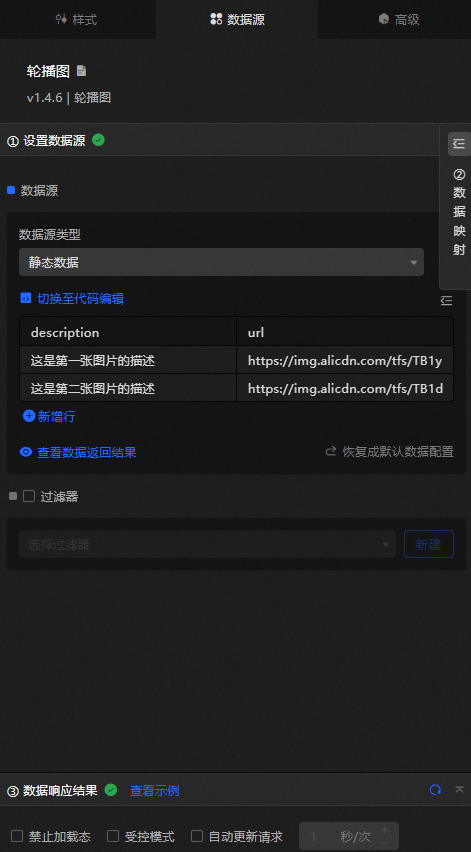
Field | Notes |
| Optional. The description of the image. |
| The URL of the carousel image. It is the same as the configuration items function of Image> Default Image in the Style panel. if you configure both, the content in the url takes precedence. Note You must configure cross-origin access for the image. If you do not specify the protocol, for example, //img.alicdn.com/tps/TB1PH6EPXXXXXXbaFXXXXXXXXXX-4001-2251.png, DataV uses the protocol of the project to request the image. |
Configure data items | Notes |
DataSource | You can use the code editor or visual editor to view the data fields contained in the widget. You can also modify the Data Type parameter to flexibly configure the component data. |
Data Mapping | If you need to customize chart field configurations, you can set different field mapping content in the Data Mapping module and field mapping these content to the corresponding fields of the widget. This allows you to match data without modifying the fields in the data source. You can also click the |
Configure a filter | Turn on Filter, select an existing data filter or create a data filter, and configure a data filter script to filter data. For more information, see Manage data filters. |
Data Response Result | The Data Response Result section displays widget data in real time. If the data source of the widget changes, this section displays the latest data. If the system response is delayed, you can click the |
Forbid Loading | If you select the check box, you will not see the loaded content during component initialization when you update the component and preview the data kanban. If you select the check box, the opposite is true. By default, the status is deselected. |
Controlled Mode | If you select the check box, the component does not request data in the initialized state, and only requests data by using global variables or the method configured in Blueprint Editor. If you clear the check box, you can use automatic update to request data. By default, the status is deselected. |
Auto Data Request | Select the check box to manually enter the time frequency of polling to set dynamic polling. If you clear the page, the page is not automatically updated. You need to manually refresh the page or use Blueprint Editor and global variable events to trigger a request to update data. |
 icon to configure the field style.
  icon on the right to view the data response result. You can also click the
  icon on the right to obtain the latest data of the widget. You can also click View Example to view an example of the response result of the current component.
 Advanced Panel 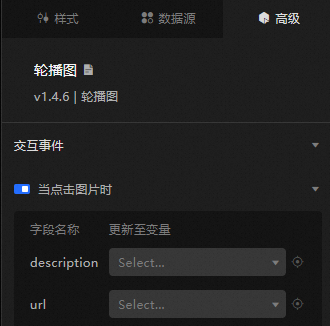
Turn on the switch to enable the widget interaction feature. When the image is clicked, a data request is triggered, a temporary variable is thrown, and the image carousel data is dynamically loaded. By default, the description and url values in the data are thrown. For more information, see Component interaction configuration.
Blueprint Interaction
Click the
 icon in the upper-left corner to go to the Blueprint page.
 On the Layer Nodes tab, add the widget to the main canvas.
View blueprint configuration parameters.
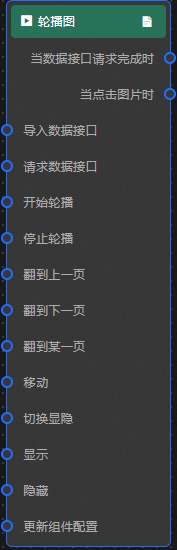
Event
Event
Notes
When the data interface request is completed
The event is triggered with the processed JSON data after a data interface request is responded and processed by a filter. For more information about specific data examples, see the Data Response Result section of the Data Source tab in the right-side configuration panel of the canvas editor.
When you click on the image
When you click an image, this event is triggered to pass the description and URL of the image.
Action
Action
Notes
Request Data Interface
This action is performed to request the server data again. The data sent by an upstream data processing node or layer node is used as a parameter. For example, image carousel the API data source is
https://api.testand the data transferred to the request data interface is{ id: '1'}, the final request interface ishttps://api.test?id=1.Import data
After data of a widget is processed in accordance with its drawing format, the widget is imported for redrawing. You do not need to request server data again. For more information about specific data examples, see the Data Response Result section of the Data Source tab in the right-side configuration panel of the canvas editor.
Start carousel
Start to play the image in turn. For more information, see the sample data.
   {
     // The sequence number of an image in the data source. By default, the value starts from 0.
     "index": 0
   }
Stop carousel
This action stops rotating the images and does not need parameter input.
Turn to the previous page
This action displays the previous image based on the sequence number of the current image and does not need parameter input.
Turn to the next page
This action displays the next image based on the sequence number of the current image and does not need parameter input.
Turn to a page
Play an image without parameters.
Move
Move a widget to a specified location. For more information, see the data example.
    {
      // The positioning type. to indicates absolute positioning, whereas by indicates relative positioning. The default value is to.
        "positionType": "to",
      // The location, which is indicated by the x and y coordinates.
      "attr": {
        "x": 0,
        "y": 0
      },
      // The animation type.
      "animation": {
        "enable": false,
        // The duration in which animation is displayed.
        "animationDuration": 1000,
        // The animation curve, which can be set to linear|easeInOutQuad|easeInOutExpo.
        "animationEasing": "linear"
      }
    }
Switch Display /Display
Toggles whether the widget is displayed or hidden. No parameters are required.
Display
Display the widget. For more information, see Data example.
{
  "animationType": "",// The animation method. Valid value: fade. If you do not set this parameter, no animation is available.
  "animationDuration": 1000,// The animation delay. Unit: ms.
  "animationEasing": ""// animation curve
}
Hide
Hide the component. For more information, see Data example.
{
  "animationType": "",// The animation method. Valid value: fade. If you do not set this parameter, no animation is available.
  "animationDuration": 1000,// The animation delay. Unit: ms.
  "animationEasing": ""// animation curve
}
Update component configurations
Style configurations of widgets are dynamically updated. In the Style panel, click Copy Configuration to Clipboard to obtain the configuration data of the widget. After that, change the style field for the data processing node in Blueprint Editor.