After you configure an outlier detection policy for a service in a destination rule, a Service Mesh proxy observes the number of errors responded by each endpoint of the service over a given length of time. If the number of errors received from an endpoint of the service exceeds a specified threshold, the endpoint is marked as unhealthy and is ejected from the service's list of available endpoints. Subsequent requests are no longer sent to this endpoint for a period of time. This topic describes how to configure an outlier detection policy.
Prerequisites
The preparations are completed, and the HTTPBin and sleep services are deployed. For more information, see Preparations.
Feature description
The following section describes the process of outlier detection in Service Mesh:
When a request is sent to a service, a Service Mesh proxy records the number of errors responded by each endpoint of the service over a period of time. HTTP responses with a status code of 5xx are considered errors. The length of this period is specified by the
intervalparameter.When the number of errors responded by an endpoint exceeds a certain threshold, the endpoint is marked as unhealthy and is ejected from the service's list of available endpoints. This threshold is specified by the
consecutiveErrorsparameter.NoteIf the proportion of available endpoints to the total service endpoints is less than a given proportion after an endpoint is removed, the endpoint is not removed from the list of available endpoints. The proportion is specified by the maxEjectionPercent parameter.
After a service endpoint is ejected, it will not receive any more requests for a given base duration. After this duration, the service endpoint is added back to the list of available service endpoints. If this service endpoint is ejected for the second time because it returns 5xx errors consecutively, the duration of the second ejection will be twice the base duration. The duration of the third ejection will be three times the base duration, and so on. The base duration is specified by the
baseEjectionTimeparameter.
Procedure
Create a destination rule for the HTTPBin service to implement outlier detection.
Log on to the ASM console. In the left-side navigation pane, choose .
On the Mesh Management page, click the name of the ASM instance. In the left-side navigation pane, choose .
On the DestinationRule page, click Create. On the Create page, configure the following parameters, and click Preview. Confirm that the YAML content is correct, click Submit, and then click Create.
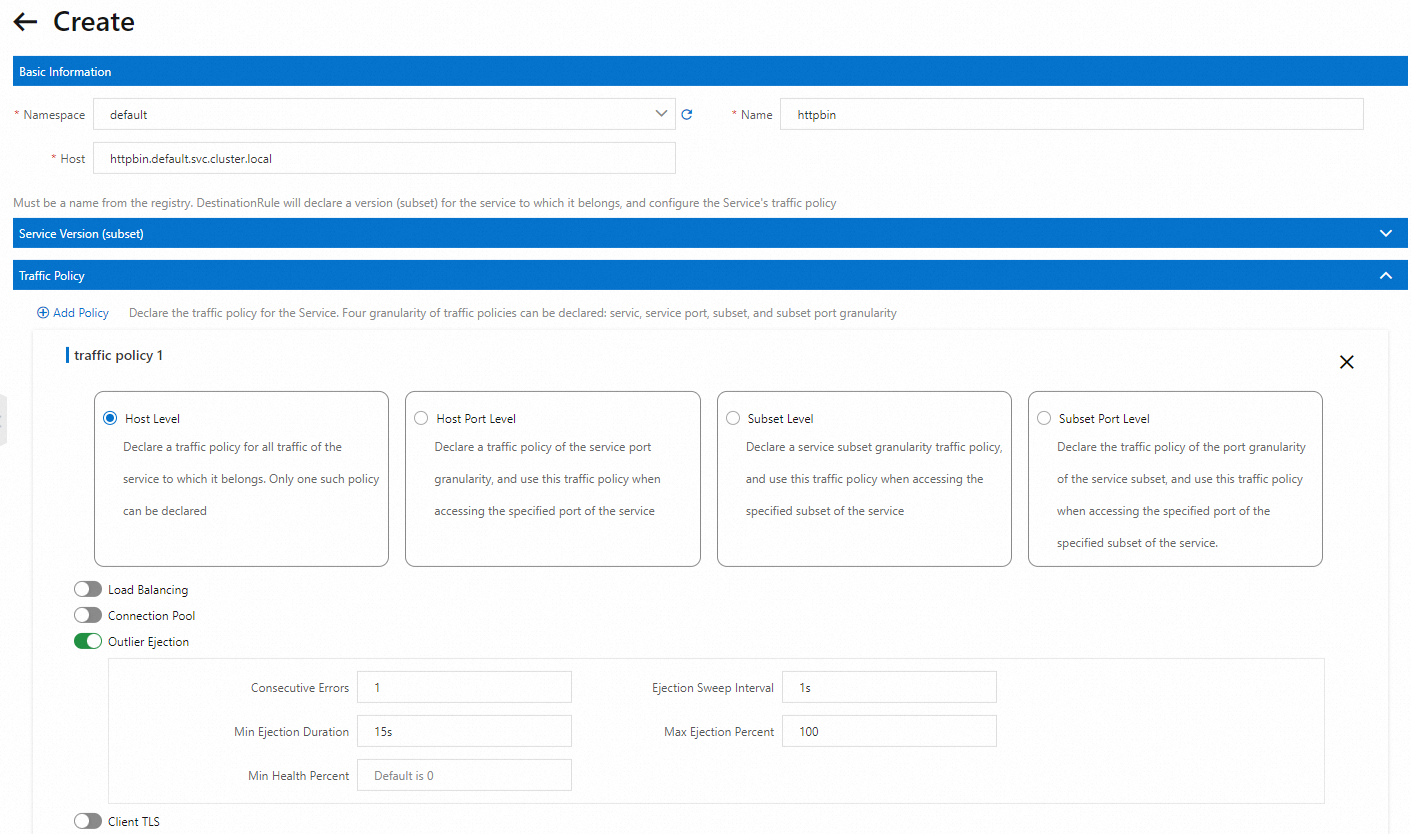
The following code shows the YAML file for preview.
apiVersion: networking.istio.io/v1beta1
kind: DestinationRule
metadata:
  name: httpbin
  namespace: default
  labels: {}
spec:
  host: httpbin.default.svc.cluster.local
  trafficPolicy:
    outlierDetection:
      consecutiveErrors: 1
      interval: 1s
      baseEjectionTime: 15s
      maxEjectionPercent: 100
Check whether the outlier detection policy takes effect.
Use kubectl to connect to the Container Service for Kubernetes (ACK) cluster based on the information in the kubeconfig file, and then run the following command:
kubectl -n legacy exec -it deploy/sleep -- curl httpbin.legacy:8000/status/502 -IExpected output:
HTTP/1.1 502 Bad Gateway
server: envoy
date: xxx, xx xxx 202x xx:xx:xx GMT
content-type: text/html; charset=utf-8
access-control-allow-origin: *
access-control-allow-credentials: true
content-length: 0
x-envoy-upstream-service-time: 4
According to the configuration, a service endpoint is ejected if the endpoint returns an error response within 1 second, and the value of maxEjectionPercent is 100%. At this time, the only endpoint of the HTTPBin service is ejected, and the service becomes unavailable.
Run the following command again within 15 seconds:
kubectl -n legacy exec -it deploy/sleep -- curl httpbin.legacy:8000/status/502 -IExpected output:
HTTP/1.1 503 Service Unavailable
content-length: 19
content-type: text/plain
date: xxx, xx xxx 202x xx:xx:xx GMT
server: envoy
The expected output indicates that when a request is sent to the
/status/502path of the HTTPBin service, the service returns a503 Service Unavailableresponse, instead of an HTTP 502 error. This indicates that all endpoints of the HTTPBin service have been ejected and the outlier detection policy takes effect.