This article examines how Alibaba Cloud's inference, logging, labeling, and training services compose into a closed active learning loop that selectively routes the most informative production samples to human annotation and returns them to model retraining.
A production machine learning model begins to lose accuracy from the moment it is deployed. The data distribution it was trained on diverges from the live distribution it now scores, as user behaviour shifts, new categories appear, and inputs drift away from the training set. Sustaining model quality, therefore depends less on the initial training run than on the discipline of continuous relabeling and retraining. The binding constraint is cost: human annotation is among the most expensive resources in the machine learning lifecycle, and labelling every production sample is neither affordable nor necessary.
Active learning addresses this constraint by selecting only the samples from which the model would learn the most — those it scores with low confidence, those near a decision boundary, those on which an ensemble disagrees — and routing that small fraction to human annotators. The labeled samples re-enter the training set, the model is retrained, and the cycle repeats. The engineering problem is not the selection heuristic in isolation but the construction of a reliable, observable loop that connects inference, capture, annotation, retraining, and redeployment without manual intervention at each step. This article documents how that loop can be assembled from Alibaba Cloud services.
The economics of selective labeling
The value of an active learning system rests on a single premise: a model learns disproportionately more from a small set of carefully chosen samples than from a large set of arbitrary ones. Samples the model already classifies with high confidence add little signal, while samples near the boundary of its current understanding correct it where correction is most needed. Selecting the latter and ignoring the former lets a fixed annotation budget produce a steeper improvement in model quality than uniform random labeling of the same volume.
Several strategies operationalise this premise. Uncertainty sampling ranks candidates by the entropy of the predicted probability distribution. Margin sampling ranks by the gap between the two highest class probabilities, surfacing samples that the model finds ambiguous. Query-by-committee ranks by disagreement across the members of an ensemble. Each approximates the same objective from a different angle, and the appropriate choice depends on the model type and the decision problem rather than on a universal rule.
Prediction capture and uncertainty signals
Real-time inference is served by PAI-EAS, which hosts the deployed model behind a low-latency endpoint. Active learning depends on more than the final prediction: the endpoint is configured to emit per-prediction metadata — the full class probability distribution, individual ensemble member outputs, or an embedding vector — that carries the uncertainty signal selection relies on. Discarding this metadata at inference time forecloses any subsequent selection strategy that depends on it.
Each inference request and its response are written to Log Service (SLS), which captures the input features, the model output, the confidence distribution, and the model version that produced the prediction. Recording the model version against every prediction is what later allows selected samples to be attributed to the model that struggled with them. SLS indexes these records for query and retains them within a configurable hot window before archival. Input payloads too large for log records — images, documents, audio — are written to OSS, with the SLS record holding the object reference rather than the payload, keeping the log store compact while preserving access to the raw sample.
Informativeness scoring and sample selection
A scheduled job evaluates accumulated predictions against the chosen query strategy. Function Compute executes this scoring on a fixed schedule or in response to a volume threshold, reading prediction records from SLS or from a MaxCompute table and writing the ranked candidate set back to a dedicated selection table. Because the scoring workload is intermittent and stateless, an event-driven compute model fits it more naturally than a continuously provisioned cluster.
Two refinements separate a usable selection stage from a naive one. A diversity constraint prevents the selection from filling its budget with near-duplicate uncertain samples that, once labelled, would teach the model the same lesson repeatedly; clustering candidate embeddings before selection and sampling across clusters preserves variety. A budget cap bounds the number of samples promoted to annotation in each cycle, aligning the selection rate with the throughput the annotation team can sustain rather than with the raw volume of uncertain predictions, which can spike sharply when the live distribution shifts.
Annotation orchestration and label quality control
Selected candidates are loaded as labelling tasks into PAI-iTAG, the platform's intelligent labelling tool, with OSS references resolved so annotators view the source data alongside the model's prediction. Presenting the model output as a pre-annotation, rather than a blank task, reduces the effort of confirming or correcting a label relative to annotating from scratch.
Label quality is itself a source of model error, so the annotation stage embeds controls rather than treating human labels as ground truth by assumption. Assigning a subset of samples to multiple annotators and measuring their agreement quantifies label reliability; routing disagreements to an adjudication step resolves them deterministically; and interleaving gold-standard items with known answers monitors individual annotator quality over time. Completed labels are written back to a versioned dataset in MaxCompute or OSS, with each batch tagged by the selection cycle that produced it so that the provenance of every training sample remains traceable.
Retraining and staged redeployment
Newly labelled samples are merged into the training set, and retraining proceeds on PAI-DLC for distributed training jobs, with PAI-DSW available for the interactive development that precedes a production run. The candidate model is evaluated against a held-out set that the active learning loop does not feed, preserving an unbiased measure of generalisation; evaluating only against actively selected samples would overstate performance, since those samples were chosen precisely because they were difficult.
A candidate that clears its evaluation gate is promoted through PAI-EAS traffic splitting rather than replacing the incumbent outright. A shadow or canary deployment directs a small fraction of live traffic to the new version while comparison metrics accumulate, and full promotion follows only once the candidate demonstrates an improvement that holds under production conditions. The same mechanism supports rollback: if metrics degrade after promotion, traffic returns to the prior version without redeployment.
Drift detection and loop closure
The loop is closed by the monitoring layer that decides when it should run faster. Cloud Monitor and Log Service track the distribution of model scores, the trend in prediction confidence, the volume of samples crossing the selection threshold, and annotator agreement rates. A sustained rise in low-confidence predictions or a shift in the score distribution indicates that the live data has moved away from the training distribution and that the model warrants refreshing.
DataWorks orchestrates the recurring schedule that ties the stages together, while EventBridge routes the events that trigger work between them — a completed annotation batch initiating a retraining job, a passed evaluation initiating a canary deployment. The arrangement allows the sampling rate to respond to measured drift: when monitoring detects distribution movement, the selection cadence increases, drawing more samples into annotation precisely when the model needs them, and relaxes once metrics stabilise. This turns the pipeline from a fixed-interval batch process into a system whose labelling effort tracks the rate at which the world it models is changing.
Closing observations
The effectiveness of an active learning system depends less on any single stage than on the contracts that hold between them. The features computed at inference must match those used in retraining, or the model is corrected against samples it never truly saw. The model version must be carried through capture, selection, annotation, and retraining, or the lineage needed to investigate a regression is lost. The selection strategy must be paired with a diversity constraint and an unbiased held-out set, or the loop optimises for difficulty at the expense of generalisation.
Three disciplines determine whether the loop improves a model over time rather than destabilising it. Feature and label parity between serving and training prevents the most common source of unexplained degradation. Version lineage across every stage supports incident investigation when decision behaviour changes after a release. Control of sampling bias — through diversity-aware selection and held-out evaluation untouched by the loop — keeps the model general while it specialises on the samples it finds hard. With these disciplines in place, the services described here form a loop that converts production uncertainty into targeted annotation and steadily compounding model quality.
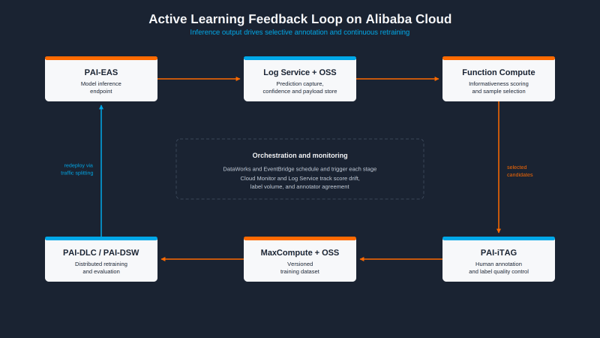
Figure 1. A closed active learning loop on Alibaba Cloud: PAI-EAS inference output is captured through Log Service and OSS, scored and selected by Function Compute, annotated in PAI-iTAG, versioned in MaxCompute and OSS, and retrained on PAI-DLC before redeployment via PAI-EAS traffic splitting, with DataWorks, EventBridge, and Cloud Monitor governing the cycle.
Disclaimer: The views expressed herein are for reference only and don't necessarily represent the official views of Alibaba Cloud
Knowledge Graph Construction from Unstructured Data Using Large Language Models on Alibaba Cloud

115 posts | 2 followers
FollowNeel_Shah - May 22, 2026
Alibaba Cloud Native Community - January 15, 2026
Alibaba Cloud Native Community - March 25, 2026
Alibaba Cloud Community - August 3, 2026
Alibaba Cloud Community - July 3, 2026
Alibaba Clouder - June 17, 2020
115 posts | 2 followers
Follow ECS Bare Metal Instance
An elastic and horizontally scalable high-performance computing service providing the same computing performance as traditional physical servers including physical isolation.
Learn More Function Compute
Alibaba Cloud Function Compute is a fully-managed event-driven compute service. It allows you to focus on writing and uploading code without the need to manage infrastructure such as servers.
Learn More ECS(Elastic Compute Service)
Elastic and secure virtual cloud servers to cater all your cloud hosting needs.
Learn More Container Service for Kubernetes
Alibaba Cloud Container Service for Kubernetes is a fully managed cloud container management service that supports native Kubernetes and integrates with other Alibaba Cloud products.
Learn MoreMore Posts by PM - C2C_Yuan

